
Online Database of Chemicals from Around the World
| Hangzhou Verychem Science And Technology Co., Ltd. | China | |||
|---|---|---|---|---|
 | www.verychem.com | |||
 | +86 (571) 8816-2785 +86 13606544505 | |||
 | +86 (571) 8816-2787 | |||
 | lucy@verychem.com | |||
| Chemical manufacturer since 2004 | ||||
| chemBlink Massive supplier since 2021 | ||||
| Nanjing Odyssey Chemical Industry Co., Ltd. | China | |||
|---|---|---|---|---|
| www.odysseychem.net | |||
| +86 (25) 8531-2873 8532-1503 | |||
| +86 (25) 8532-8962 / 8531-8902 | |||
| nods@163.net | |||
| Chemical manufacturer since 1994 | ||||
| chemBlink Standard supplier since 2005 | ||||
| Ningbo Chemgoo Pharma Tech Co., Ltd. | China | |||
|---|---|---|---|---|
| www.chemgoo.com | |||
| +86 (574) 8681-2320 8699-6982 +86 18969830555 | |||
| +86 (574) 8699-6983 | |||
| sarasun@chemgoo.com | |||
| Chemical manufacturer since 2007 | ||||
| chemBlink Standard supplier since 2011 | ||||
| Amatek Chemical Co., Ltd. | China | |||
|---|---|---|---|---|
| www.amtchem.com | |||
| +86 (512) 5835-6800 5858-4128 | |||
| +86 (512) 5858-4118 | |||
| amtchimie@gmail.com | |||
| Chemical manufacturer | ||||
| chemBlink Standard supplier since 2012 | ||||
| Anvia Chemicals, LLC | USA | |||
|---|---|---|---|---|
| www.anviachem.com | |||
| +1 (414) 534-7845 | |||
| +1 (414) 762-5539 | |||
| sales@anviachem.com | |||
| Chemical manufacturer | ||||
| SynChem, Inc. | USA | |||
|---|---|---|---|---|
| www.synchem.com | |||
| +1 (847) 298-2436 ex 230 | |||
| +1 (847) 298-2439 | |||
| sales@synchem.com | |||
| Chemical manufacturer since 1997 | ||||
| Lianyungang Jinyang Chemical Co., Ltd. | China | |||
|---|---|---|---|---|
| www.jinfengchem.com | |||
| +86 (519) 8361-8188 8289-1288 | |||
| +86 (519) 8361-8998 / 8289-1899 | |||
| czjtjfc@public.cz.js.cn | |||
| Chemical manufacturer | ||||
| Classification | Organic raw materials >> Hydrocarbon compounds and their derivatives >> Hydrocarbon nitrite |
|---|---|
| Name | 4-Nitrobenzeneethanol |
| Synonyms | 2-(4-Nitrophenyl)ethanol; 2-(p-Nitrophenyl)ethanol; p-Nitrophenethyl alcohol |
| Molecular Structure | 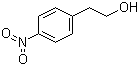 |
| Molecular Formula | C8H9NO3 |
| Molecular Weight | 167.16 |
| CAS Registry Number | 100-27-6 |
| EC Number | 202-835-8 |
| SMILES | C1=CC(=CC=C1CCO)[N+](=O)[O-] |
| Density | 1.3±0.1 g/cm3, Calc.* |
|---|---|
| Melting point | 59-62 °C (Expl.) |
| Index of Refraction | 1.581, Calc.* |
| Boiling Point | 301.8 °C (760 mmHg), Calc.*,337.7 °C (Expl.) |
| Flash Point | 144.5±9.4 °C, Calc.* |
| * | Calculated using Advanced Chemistry Development (ACD/Labs) Software. |
| Hazard Symbols |  GHS07 Warning Details GHS07 Warning Details | ||||||||||||||||
|---|---|---|---|---|---|---|---|---|---|---|---|---|---|---|---|---|---|
| Risk Statements | H302-H319 Details | ||||||||||||||||
| Safety Statements | P264-P264+P265-P270-P280-P301+P317-P305+P351+P338-P330-P337+P317-P501 Details | ||||||||||||||||
| Hazard Classification | |||||||||||||||||
| |||||||||||||||||
| SDS | Available | ||||||||||||||||
 chemBlink Chemical Story
|
4-Nitrobenzeneethanol, also known as 2-(4-nitrophenyl)ethanol, is an organic compound with the molecular formula C8H9NO3. It is composed of a nitro-substituted benzene ring attached to a two-carbon ethanol side chain. The nitro group is positioned para to the ethyl alcohol moiety, which imparts certain electronic characteristics that influence its chemical reactivity and usefulness in synthesis. This compound appears as a yellow to pale yellow crystalline solid and is moderately soluble in organic solvents. The compound has been known and used in chemical research since the mid-20th century. It is typically synthesized by the reduction of 4-nitrophenylacetic acid derivatives or by the nucleophilic substitution of 4-nitrobenzyl halides with a suitable nucleophile, followed by hydrolysis and alcohol formation. Another method includes the direct nitration of 2-phenylethanol, although this route may result in regioisomeric mixtures and is less commonly used when specific para substitution is required. 4-Nitrobenzeneethanol is primarily utilized as an intermediate in organic synthesis. The presence of both a nitro group and a primary alcohol group on the same molecule allows for a wide range of chemical transformations. The nitro group can undergo reduction to an amine, enabling the conversion of the molecule into 4-aminobenzeneethanol, which is valuable in the synthesis of dyes, pharmaceuticals, and agrochemical agents. Additionally, the alcohol group can be derivatized to form esters, ethers, or other functional groups, allowing incorporation into more complex molecular structures. One of the most significant applications of 4-nitrobenzeneethanol is in the preparation of functionalized aromatic compounds for pharmaceutical and materials research. The compound serves as a precursor to aromatic amines that can act as building blocks for bioactive molecules. The nitro group, being an electron-withdrawing substituent, also influences the acidity of nearby hydrogen atoms and enhances the reactivity of adjacent positions on the aromatic ring during electrophilic substitution reactions. In polymer chemistry, 4-nitrobenzeneethanol has been employed in the synthesis of monomers and crosslinking agents where the hydroxyl group participates in esterification reactions with diacid or diisocyanate compounds. This results in materials with pendant aromatic nitro groups, which may undergo post-polymerization modification. Such modified polymers may exhibit altered thermal, optical, or electronic properties. The compound has also been studied in the context of spectroscopic analysis and mechanistic organic chemistry. The electronic characteristics of the nitro group and its effects on the reactivity of the benzylic alcohol have been explored to understand nucleophilic substitution and oxidation-reduction mechanisms. For example, oxidizing the alcohol to the corresponding aldehyde or acid provides a route to analogues useful in further synthetic elaboration. In addition to chemical synthesis, 4-nitrobenzeneethanol can be used as a model compound in studies related to biochemical transformations involving nitroaromatic compounds. These studies are important in environmental chemistry and microbiology, particularly in understanding how such compounds are metabolized or degraded by microbial systems. The microbial reduction of nitro groups to amines is a well-documented pathway, and compounds like 4-nitrobenzeneethanol serve as substrates in these investigations. Due to the presence of a nitro group, handling of 4-nitrobenzeneethanol requires caution, as nitroaromatic compounds can pose health risks upon inhalation or ingestion and may be harmful to aquatic life. Appropriate safety measures should be followed during storage and handling, including the use of gloves and eye protection, as well as adequate ventilation. Overall, 4-nitrobenzeneethanol is a valuable and well-characterized compound in synthetic chemistry. Its dual functionality allows it to serve as a versatile intermediate in the preparation of more complex molecules, making it relevant across several fields including pharmaceuticals, materials science, and environmental research. References 2018. Design, Synthesis and Electronic Properties of Novel Spirobifluorene Derivatives. Chemistry Africa, 1(3-4), 121-130. DOI: 10.1007/s42250-018-0018-4 2017. Hypervalent Iodine-Based Activation of Triphenylphosphine for the Functionalization of Alcohols. Synlett, 28(16), 2093-2097. DOI: 10.1055/s-0036-1589069 2014. Directed evolution of nitrobenzene dioxygenase for the synthesis of the antioxidant hydroxytyrosol. Applied Microbiology and Biotechnology, 98(6), 2621-2631. DOI: 10.1007/s00253-013-5505-6 |
| Market Analysis Reports |