
Online Database of Chemicals from Around the World
| Taizhou Crene Biotechnology Co., Ltd. | China | |||
|---|---|---|---|---|
 | www.pharm-intermediates.com | |||
 | +86 (576) 8881-3233 8820-5808 +86 13396860566 | |||
 | +86 (576) 8822-9589 | |||
 | sales@pharm-intermediates.com | |||
 | QQ Chat | |||
| Chemical manufacturer since 2011 | ||||
| chemBlink Standard supplier since 2009 | ||||
| Shanghai Yingrui Biopharm Co., Ltd. | China | |||
|---|---|---|---|---|
| www.shyrchem.com | |||
| +86 (21) 3358-5366 3466-6753 +86 13311639313 | |||
| +86 (21) 3497-9012 | |||
| sales02@shyrchem.com | |||
| QQ Chat | |||
 | Skype Chat | |||
| Chemical manufacturer since 2009 | ||||
| chemBlink Standard supplier since 2017 | ||||
| Ningbo Kilo Biotechnology Co., Ltd. | China | |||
|---|---|---|---|---|
| www.kilobio.com | |||
| +8613989352104 | |||
| terry.zhang@kilobio.com | |||
| QQ Chat | |||
 | WeChat: Wenzhou Medical University | |||
| Chemical distributor since 2023 | ||||
| chemBlink Standard supplier since 2023 | ||||
| Classification | Chemical reagent >> Organic reagent >> Amide |
|---|---|
| Name | N-Ethyl Fluprostenol Carboxamide |
| Synonyms | TrifluoroMethyl Dechloro; (5Z)-7-[(1R,2R,3R,5S)-3,5-Dihydroxy-2-[(1E,3R)-3-hydroxy-4-[3-(trifluoromethyl)phenoxy]-1-buten-1-yl]cyclopentyl]-N-ethyl-5-heptenamide |
| Molecular Structure | 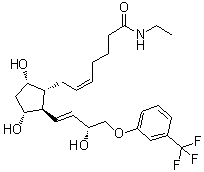 |
| Molecular Formula | C25H34F3NO5 |
| Molecular Weight | 485.54 |
| CAS Registry Number | 1005193-64-5 |
| SMILES | CCNC(=O)CCC/C=CC[C@H]1[C@H](C[C@H]([C@@H]1/C=C/[C@H](COC2=CC=CC(=C2)C(F)(F)F)O)O)O |
| Solubility | Practically insoluble (0.02 g/L) (25 °C), Calc.* |
|---|---|
| Density | 1.252±0.06 g/cm3 (20 °C 760 Torr), Calc.* |
| Boiling point | 640.1±55.0 °C 760 mmHg (Calc.)* |
| Flash point | 340.9±31.5 °C (Calc.)* |
| Index of refraction | 1.557 (Calc.)* |
| * | Calculated using Advanced Chemistry Development (ACD/Labs) Software. |
| Hazard Symbols |   GHS07;GHS08 Warning Details |
|---|---|
| Risk Statements | H302-H360 Details |
| Safety Statements | P264-P201-P202-P281-P301+312-P330-P308+313 Details |
| SDS | Available |
 chemBlink Chemical Story
|
N-Ethyl fluprostenol carboxamide, also known as nortafluprost, belongs to the structural family of prostaglandin analogues. Its framework includes a substituted cyclopentane and two unequal side chains. The terminal carboxyl-derived group is an N-ethyl amide. That detail distinguishes it from fluprostenol itself and from an ester, even though the molecules share substantial portions of their structures. Changing a carboxylic acid to an amide can alter ionization, interactions with water, and the way a molecule is handled by enzymes. An amide cannot simply be assumed to behave like an ester with a similar carbon count. Nor does a resemblance to a known analogue establish the potency, tissue exposure, or safety of this specific compound. The other parts of the molecule, including the arrangement of substituents around the ring, also affect the chemistry. The European Scientific Committee on Consumer Safety examined prostaglandins and their analogues in the context of cosmetic products, including products applied near the eyelashes. Its opinion identified nortafluprost by CAS and structure. The discussion illustrates why classification by intended appearance alone is insufficient: application near the eye can be relevant to pharmacological exposure, and lack of substance-specific information limits what can be concluded. The structure also illustrates why a name search can be an incomplete analytical screen. Two related compounds may share part of a chromatographic or mass-spectral pattern because much of their framework is the same. Identifying the individual substance calls for evidence that distinguishes the terminal group and, where relevant, the stereochemical arrangement. A match to a generic prostaglandin-like signal does not settle those questions. The legitimate scientific use of the identity is to distinguish the compound accurately in analytical and safety assessments. A label such as prostaglandin analogue identifies a family, not a single ingredient. A study of a related eyelash preparation or ophthalmic drug cannot replace evidence on the actual amide and formulation being evaluated. This distinction is particularly important for a compound at the boundary between cosmetic ingredient discussions and pharmacology. References: 1. SCCS. Opinion on prostaglandins and prostaglandin analogues used in cosmetic products, SCCS/1635/21. https://health.ec.europa.eu/document/download/14b09ba4-0113-4b4d-b4e8-5e94bb13a3bc_en?filename=sccs_o_258.pdf |
| Market Analysis Reports |