
Online Database of Chemicals from Around the World
| Tianjin Zhongxin Chem-tech Co., Ltd. | China | |||
|---|---|---|---|---|
 | www.tjzxchem.com | |||
 | +86 (22) 6688-0623 | |||
 | +86 (22) 8988-0739 ex 8030 | |||
 | sales@tjzxchem.com | |||
| Chemical manufacturer since 2007 | ||||
| chemBlink Standard supplier since 2009 | ||||
| Achemica | Switzerland | |||
|---|---|---|---|---|
| www.achemica.com | |||
| +41 (24) 466-2929 | |||
| +41 (24) 466-2800 | |||
| contact@achemica.com | |||
| Chemical manufacturer since 2010 | ||||
| Classification | Pharmaceutical intermediate >> Heterocyclic compound intermediate >> Pyrimidine compound >> Carboxylic acid |
|---|---|
| Name | 1-(1H-Indol-3-ylmethyl)piperidine-4-carboxylic acid |
| Molecular Structure | 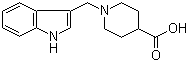 |
| Molecular Formula | C15H18N2O2 |
| Molecular Weight | 258.32 |
| CAS Registry Number | 100957-76-4 |
| SMILES | C1CN(CCC1C(=O)O)CC2=CNC3=CC=CC=C32 |
| Solubility | 1939 mg/L (25 °C water) |
|---|---|
| Density | 1.3±0.1 g/cm3, Calc.* |
| Index of Refraction | 1.662, Calc.* |
| Melting point | 303.10 °C |
| Boiling Point | 476.4±40.0 °C (760 mmHg), Calc.*, 473.61 °C |
| Flash Point | 241.9±27.3 °C, Calc.* |
| * | Calculated using Advanced Chemistry Development (ACD/Labs) Software. |
| Hazard Symbols |  GHS07 Warning Details GHS07 Warning Details |
|---|---|
| Risk Statements | H302-H315-H319-H335 Details |
| Safety Statements | P261-P264-P270-P271-P280-P301+P312-P302+P352-P304+P340-P305+P351+P338-P330-P332+P313-P337+P313-P362-P403+P233-P405-P501 Details |
| SDS | Available |
 chemBlink Chemical Story
|
1-(1H-Indol-3-ylmethyl)piperidine-4-carboxylic acid is a chemical compound characterized by the presence of an indole group linked to a piperidine ring, with a carboxylic acid functional group attached to the piperidine at the 4-position. This unique structure combines two significant chemical motifs, the indole and piperidine rings, which are both commonly found in biologically active molecules, making this compound of interest for various applications, particularly in pharmaceuticals and organic synthesis. The indole group, derived from indole (C₈H₇N), is a well-known structure present in many natural products, such as tryptophan and serotonin, and has been extensively studied for its biological activity. The piperidine ring, a saturated six-membered ring containing one nitrogen atom, is also a frequent structural component in many drugs, contributing to the molecule’s stability and bioavailability. The combination of these two groups in 1-(1H-Indol-3-ylmethyl)piperidine-4-carboxylic acid offers the potential for various pharmacological activities due to the compound's ability to interact with biological systems through multiple pathways. The discovery of 1-(1H-Indol-3-ylmethyl)piperidine-4-carboxylic acid arose from efforts to develop new synthetic intermediates and scaffolds for drug discovery. This compound was initially synthesized through multi-step organic reactions involving indole derivatives and piperidine-based building blocks. Researchers were interested in this structure because indole derivatives are known to exhibit a wide range of biological activities, including anticancer, antiviral, and anti-inflammatory properties. The addition of the piperidine-4-carboxylic acid moiety was designed to enhance the compound's pharmacokinetic properties, improving its stability, solubility, and interaction with biological targets. The primary application of 1-(1H-Indol-3-ylmethyl)piperidine-4-carboxylic acid is in the pharmaceutical industry, where it serves as a scaffold for the design of new drug candidates. The indole and piperidine rings provide a versatile framework for the development of small molecules with potential therapeutic effects. This compound has been studied for its potential to interact with various receptors in the body, including G protein-coupled receptors (GPCRs) and ion channels, which are common targets for drug development. Its structure allows for modifications that can fine-tune its activity, selectivity, and efficacy, making it an attractive candidate for further research in drug discovery. In addition to its pharmaceutical potential, 1-(1H-Indol-3-ylmethyl)piperidine-4-carboxylic acid has been investigated as an intermediate in organic synthesis. The presence of both an indole group and a carboxylic acid functional group makes it a useful starting material for the synthesis of more complex molecules. Chemists have explored its use in constructing larger molecular frameworks, such as heterocyclic compounds, which are important in the development of new materials, agrochemicals, and specialty chemicals. Its ability to participate in various reactions, such as amide formation, esterification, and cyclization, further expands its utility in synthetic chemistry. Moreover, the indole ring’s electronic properties, particularly its ability to engage in π-π interactions and hydrogen bonding, make 1-(1H-Indol-3-ylmethyl)piperidine-4-carboxylic acid a valuable molecule for studying molecular recognition processes. In biochemical research, this compound is used to investigate how indole-containing molecules interact with proteins, enzymes, and other biomolecules, which can provide insights into drug-receptor interactions and the development of novel therapeutics. Despite its promising applications, the safety and toxicity profile of 1-(1H-Indol-3-ylmethyl)piperidine-4-carboxylic acid must be carefully evaluated, especially in the context of drug development. Like many indole derivatives, it may exhibit varying degrees of bioactivity, and understanding its pharmacodynamics and pharmacokinetics is crucial to ensure that it can be developed into safe and effective therapeutic agents. Ongoing research focuses on optimizing the compound’s properties, minimizing potential side effects, and exploring its efficacy in preclinical models. In conclusion, 1-(1H-Indol-3-ylmethyl)piperidine-4-carboxylic acid represents a valuable chemical structure with broad applications in pharmaceuticals and organic synthesis. Its discovery has opened new avenues for the development of biologically active molecules, with potential implications in drug discovery, materials science, and biochemical research. |
| Market Analysis Reports |