Online Database of Chemicals from Around the World

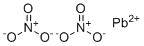
Lead dinitrate
[CAS# 10099-74-8]

List of Suppliers
Nile Chemicals India Inquire
www.nilechemicals.com
+91 (22) 6631-3162
+91 (22) 2205-4833
sales@nilechemicals.com
Chemical manufacturer
chemBlink Standard supplier since 2009
Hefei TNJ Chemical Industry Co., Ltd. China Inquire
www.tnjchem.com
+86 (551) 6541-8684
+86 (551) 6541-8697
sales@tnjchem.com
Chemical manufacturer since 2001
chemBlink Standard supplier since 2010
BOC Sciences USA Inquire
www.bocsci.com
+1 (631) 485-4226
+1 (631) 614-7828
info@bocsci.com
Chemical manufacturer
chemBlink Standard supplier since 2010
Changsha Yonta Industry Co., Ltd. China Inquire
www.hunanchem.com
+86 (731) 8535-2228
+86 (731) 8535-2208
yontachem@gmail.com
Chemical distributor
chemBlink Standard supplier since 2011
Ereztech LLC USA Inquire
www.ereztech.com
+1 (888) 658-1221
sales@ereztech.com
Chemical distributor since 2010
chemBlink Standard supplier since 2011
Hangzhou Leap Chem Co., Ltd. China Inquire
www.leapchem.com
+86 (571) 8771-1850
market19@leapchem.com
QQ Chat
Chemical manufacturer since 2006
chemBlink Standard supplier since 2015
SSV Enterprises India Inquire
www.ssvleadnitrates.com
+92 (480) 85-085
leadnitratessv1@gmail.com
ssventp24@gmail.com
Chemical manufacturer since 1990
chemBlink Standard supplier since 2021
Riverland Trading LLC. USA Inquire
www.riverlandtrading.com
+1 (336).944-2293
bens@riverlandtrading.com
Chemical distributor
chemBlink Standard supplier since 2023
Vishnupriya Chemicals Private Limited India Inquire
vishnupriya.in
+91 9676770180
web@vishnupriya.in
Chemical manufacturer since 1979
chemBlink Standard supplier since 2024
Advance Research Chemicals, Inc. USA Inquire
www.fluoridearc.com
+1 (918) 266-6789
+1 (918) 266-6796
sales@fluoridearc.com
Chemical manufacturer
Thermo Fisher Scientific USA Inquire
www.fishersci.com
+1 (800) 766-7000
+1 (800) 926-1166
fs.order@thermofisher.com
Chemical manufacturer
Materion USA Inquire
www.materion.com
+1 (216) 486-4200
+1 (414) 289-9805
info@materion.com
Chemical manufacturer
ChemPur GmbH Germany Inquire
www.chempur.de
+49 (721) 933-840
+49 (721) 47-2001
info@chempur.de
Chemical manufacturer
ProChem, Inc. USA Inquire
www.prochemonline.com
+1 (815) 398-1788
+1 (815) 398-1810
prochem3@aol.com
Chemical manufacturer since 1986
Celtic Chemicals Ltd. UK Inquire
www.celticchemicals.co.uk
+44 (1656) 749-358
+44 (1656) 746-490
sales@celticchemicals.co.uk
Chemical manufacturer
Avonchem/Chromos Express Ltd. UK Inquire
www.avonchem.co.uk
+44 (1625) 434-300
+44 (1625) 869-777
info@avonchem.co.uk
Chemical manufacturer
Strem Chemicals, Inc. USA Inquire
www.strem.com
+1 (978) 499-1600
+1 (978) 465-3104
info@strem.com
Chemical manufacturer
Gelest, Inc. USA Inquire
www.gelest.com
+1 (215) 547-1015
+1 (215) 547-2484
info@gelest.com
Chemical manufacturer

Identification
ClassificationInorganic chemical industry >> Inorganic salt >> Metal nitrates and nitrites
NameLead dinitrate
SynonymsLead(II) nitrate
Molecular StructureCAS # 10099-74-8, Lead dinitrate
Molecular FormulaPb(NO3)2
Molecular Weight331.21
CAS Registry Number10099-74-8
EC Number233-245-9
SMILES[N+](=O)([O-])[O-].[N+](=O)([O-])[O-].[Pb+2]
Properties
Density4.53 g/mL (20 °C) (Expl.)
Melting point470 °C (decomp.) (Expl.)
Water solubility343 g/L (Expl.)
Safety Data
Hazard Symbolssymbol symbol symbol symbol symbol   GHS03;GHS05;GHS07;GHS08;GHS09 Danger  Details
Risk StatementsH272-H302+H332-H302-H317-H318-H332-H351-H360-H360Df-H372-H373-H400-H410  Details
Safety StatementsP203-P210-P220-P260-P261-P264-P264+P265-P270-P271-P272-P273-P280-P301+P317-P302+P352-P304+P340-P305+P354+P338-P317-P318-P319-P321-P330-P333+P317-P362+P364-P370+P378-P391-P405-P501  Details
Hazard Classification
up    Details
HazardClassCategory CodeHazard Statement
Acute toxicityAcute Tox.4H302
Acute toxicityAcute Tox.4H332
Chronic hazardous to the aquatic environmentAquatic Chronic1H410
Acute hazardous to the aquatic environmentAquatic Acute1H400
Serious eye damageEye Dam.1H318
Reproductive toxicityRepr.1AH360Df
Specific target organ toxicity - repeated exposureSTOT RE2H373
Skin sensitizationSkin Sens.1BH317
Specific target organ toxicity - repeated exposureSTOT RE1H372
CarcinogenicityCarc.2H351
Reproductive toxicityRepr.1AH360
Oxidising solidsOx. Sol.2H272
Oxidising solidsOx. Sol.3H272
Transport InformationUN 1469
SDSAvailable
up Discovery and Applications
Lead dinitrate, with the chemical formula Pb(NO₃)₂, is an inorganic compound composed of lead cations (Pb²⁺) and nitrate anions (NO₃⁻). It is a white, crystalline substance that is highly soluble in water. Lead dinitrate has been known since the early 19th century and is primarily used in industrial applications, particularly in the production of lead-based compounds, explosives, and as a chemical reagent. Its discovery and development have played a significant role in various fields, although its use has decreased in modern times due to the toxic nature of lead and environmental concerns.

The discovery of lead dinitrate can be traced back to the work of early chemists studying the properties of lead and its compounds. Lead salts were known to ancient civilizations and were used in a variety of applications, including cosmetics, plumbing, and pigments. However, it was in the 19th century, with the increased understanding of chemical reactions and compounds, that lead nitrate compounds like lead dinitrate were isolated and studied. Lead nitrate, the precursor of lead dinitrate, is produced by reacting lead with nitric acid. The specific form of lead dinitrate, characterized by its crystallization from a water solution, was identified in the scientific literature during this period.

Lead dinitrate has several applications, especially in the fields of explosives and pyrotechnics. One of its primary uses is in the manufacturing of primary explosives, such as those used in detonators and blasting caps. The nitrate component of lead dinitrate acts as an oxidizing agent, facilitating the decomposition of other materials in explosive reactions. Its role as a powerful oxidizer makes it valuable in the production of explosives, where the rapid release of energy is essential.

In addition to its use in explosives, lead dinitrate is employed in the production of other lead-based compounds, including lead oxides and lead salts, which are essential for various industrial processes. It has also been used historically in the preparation of pigments, such as chrome yellow, and in the synthesis of certain chemical reagents for laboratories. In some instances, lead dinitrate has been used in the synthesis of other valuable chemicals, such as lead acetate and lead carbonate.

Despite its usefulness in industrial applications, lead dinitrate is highly toxic, and its use has decreased significantly in recent years due to health and environmental concerns. Lead is a well-known neurotoxin, and exposure to lead-containing compounds can result in severe health effects, particularly in children. The handling and disposal of lead dinitrate require strict safety measures to prevent contamination of the environment and exposure to humans. For these reasons, its use has become more restricted, and alternatives are being explored in various applications, such as in explosives and chemical synthesis.

In conclusion, lead dinitrate is a compound with a significant historical role in the production of explosives, chemical reagents, and other industrial applications. However, its toxic properties have led to a decrease in its use, and contemporary practices prioritize safer, more environmentally friendly alternatives. As such, while lead dinitrate remains a relevant chemical in certain industries, its role has diminished in favor of less hazardous materials.

References

1982. Stimulation of rat liver growth by a single administration of lead nitrate. Toxicology and Applied Pharmacology, 65(3).
DOI: 10.1016/0041-008X(82)90392-1

2021. Lead exposure affects cephalic morphogenesis and neural crest cells in Gallus gallus embryo. Neurotoxicology and Teratology, 84.
DOI: 10.1016/j.ntt.2021.106948

2024. Aquatic assessment of the chelating ability of Silica-stabilized magnetite nanocomposite to lead nitrate toxicity with emphasis to their impact on hepatorenal, oxidative stress, genotoxicity, histopathological, and bioaccumulation parameters in Oreochromis niloticus and Clarias gariepinus. BMC Veterinary Research, 20(1).
DOI: 10.1186/s12917-024-04094-9
Market Analysis Reports
List of Reports Available for Lead dinitrate
Related Products
Lead dibromide  Lead Dibutanola...  Lead Dibutyrate  Lead dichloride  Lead(2+) Didoco...  Lead Diethyl Di...  Lead(2+) Dihexa...  Lead Dihexanoat...  Lead Dilaurate  Lead Diniobium ...  Lead(2+) 4,6-Di...  Lead Dinitroort...  Lead(2+) di[(9Z...  Lead dioleate  Lead dioxide  Lead Dipicrate  Lead(2+) di[(2S...  Lead(2+) di(2-p...  Lead(4+) Disele...  Lead(4+) Disulf...