
Online Database of Chemicals from Around the World
| Hangzhou Verychem Science And Technology Co., Ltd. | China | |||
|---|---|---|---|---|
 | www.verychem.com | |||
 | +86 (571) 8816-2785 +86 13606544505 | |||
 | +86 (571) 8816-2787 | |||
 | lucy@verychem.com | |||
| Chemical manufacturer since 2004 | ||||
| chemBlink Massive supplier since 2021 | ||||
| Shanghai Oripharm Co., Ltd. | China | |||
|---|---|---|---|---|
| www.oripharm.com.cn | |||
| +86 (21) 6439-6936 | |||
| +86 (21) 6481-4386 | |||
| info@oripharm.com.cn sales@oripharm.com.cn | |||
| Chemical distributor since 2003 | ||||
| chemBlink Standard supplier since 2006 | ||||
| Astatech, Inc. | USA | |||
|---|---|---|---|---|
| www.astatechinc.com | |||
| +1 (215) 785-3197 | |||
| +1 (215) 785-2656 | |||
| sales@astatechinc.com | |||
| Chemical manufacturer since 1996 | ||||
| chemBlink Standard supplier since 2009 | ||||
| Win-Win Chemical Co., Ltd. | China | |||
|---|---|---|---|---|
| www.win-winchemical.com | |||
| +86 (577) 6449-8589 +86 15325081899 | |||
| +86 (577) 5699-4596 | |||
| sales@win-winchemical.com winwinchemical@gmail.com | |||
 | QQ Chat | |||
 | Skype Chat | |||
| Chemical manufacturer since 2007 | ||||
| chemBlink Standard supplier since 2011 | ||||
| NetQem, LLC | USA | |||
|---|---|---|---|---|
| www.netqem.us | |||
| +1 (919) 544-4122 | |||
| +1 (919) 544-4109 | |||
| sales@netqem.us | |||
| Chemical distributor since 2013 | ||||
| chemBlink Standard supplier since 2014 | ||||
| Amadis Chemical Co., Ltd. | China | |||
|---|---|---|---|---|
| www.amadischem.com | |||
| +86 (571) 8992-5085 | |||
| +86 (571) 8992-5065 | |||
| sales@amadischem.com | |||
| Chemical manufacturer since 2010 | ||||
| chemBlink Standard supplier since 2015 | ||||
| Berry & Associates, Inc. | USA | |||
|---|---|---|---|---|
| www.berryassoc.com | |||
| +1 (734) 426-3787 | |||
| +1 (734) 426-9077 | |||
| orders@berryassoc.com | |||
| Chemical manufacturer | ||||
| Classification | Biochemical >> Nucleoside drugs >> Deoxynucleotides and their analogues |
|---|---|
| Name | 5-Bromo-2'-deoxycytidine |
| Synonyms | 4-Amino-5-bromo-1-[(2R,5R)-4-hydroxy-5-(hydroxymethyl)oxolan-2-yl]pyrimidin-2-one; 5-BrdC |
| Molecular Structure | 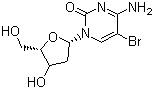 |
| Molecular Formula | C9H12BrN3O4 |
| Molecular Weight | 306.11 |
| Protein Sequence | N |
| CAS Registry Number | 1022-79-3 |
| EC Number | 213-824-2 |
| SMILES | C1[C@@H]([C@H](O[C@H]1N2C=C(C(=NC2=O)N)Br)CO)O |
| Density | 2.1±0.1 g/cm3, Calc.* |
|---|---|
| Index of Refraction | 1.764, Calc.* |
| Boiling Point | 510.8±60.0 °C (760 mmHg), Calc.* |
| Flash Point | 262.7±32.9 °C, Calc.* |
| * | Calculated using Advanced Chemistry Development (ACD/Labs) Software. |
| Hazard Symbols |  GHS08 Warning Details GHS08 Warning Details | ||||||||
|---|---|---|---|---|---|---|---|---|---|
| Risk Statements | H351 Details | ||||||||
| Safety Statements | P203-P260-P263-P264-P270-P280-P318-P405-P501 Details | ||||||||
| Hazard Classification | |||||||||
| |||||||||
| SDS | Available | ||||||||
 chemBlink Chemical Story
|
5-Bromo-2'-deoxycytidine is a synthetic nucleoside analogue derived from 2'-deoxycytidine, in which the hydrogen atom at the 5-position of the cytosine ring is replaced by a bromine atom. This compound has the molecular formula C9H12BrN3O4 and is structurally related to naturally occurring nucleosides found in DNA. It is classified as a halogenated pyrimidine deoxynucleoside and is of significant interest in biochemical research due to its biological activity and utility in nucleic acid studies. The compound was first synthesized and studied during the mid-20th century, a period marked by extensive research into modified nucleosides and their incorporation into nucleic acids. Halogenated nucleosides like 5-bromo-2'-deoxycytidine were initially developed to investigate DNA replication and repair mechanisms, as well as for their potential application in cancer therapy and virology. The bromine substitution at the 5-position of the cytosine ring alters the electronic properties of the molecule, which can influence base-pairing behavior and interaction with enzymes involved in DNA metabolism. 5-Bromo-2'-deoxycytidine is structurally analogous to 5-bromo-2'-deoxyuridine (BrdU), another halogenated nucleoside widely used in DNA labeling. While BrdU is incorporated in place of thymidine, 5-bromo-2'-deoxycytidine can be incorporated in place of deoxycytidine during DNA synthesis. Once incorporated, it can affect the fidelity of DNA replication and may result in base mispairing or altered enzyme recognition. These properties have made the compound valuable for probing DNA synthesis and mutagenesis. One of the primary applications of 5-bromo-2'-deoxycytidine has been in the study of DNA methylation and epigenetic regulation. The compound can act as a substitute for deoxycytidine in experimental systems and has been used to investigate the activity of cytosine methyltransferases and the role of 5-position substitution in gene expression control. It can also serve as a substrate in enzymatic assays designed to assess the selectivity and mechanism of DNA-modifying enzymes. The compound has also been used in radiolabeling and autoradiography studies. Its brominated structure makes it amenable to further derivatization or labeling with radioactive isotopes, allowing it to be used as a tracer in molecular biology experiments. Incorporation into DNA enables detection and quantification of DNA synthesis, localization of replicating cells, and analysis of DNA repair pathways. In cancer research, 5-bromo-2'-deoxycytidine has been examined for its potential as a radiosensitizer. Halogenated nucleosides are known to enhance the sensitivity of DNA to ionizing radiation by facilitating the formation of DNA strand breaks upon irradiation. This property has been of interest in the context of radiation therapy for tumors, although other analogues such as BrdU have been more widely employed clinically. The compound is also relevant in synthetic chemistry as a starting material for the preparation of more complex nucleoside analogues. The bromine atom at the 5-position provides a functional handle for further chemical modification through substitution or cross-coupling reactions. Such derivatives have been explored for the development of antiviral and anticancer agents, as well as for creating probes to investigate nucleic acid structure and function. Handling of 5-bromo-2'-deoxycytidine requires standard precautions applicable to nucleoside analogues. It should be stored under dry conditions and protected from light. Safety measures should be followed to avoid exposure through inhalation, ingestion, or skin contact, as halogenated nucleosides may have cytotoxic or mutagenic effects depending on the context of use. 5-Bromo-2'-deoxycytidine continues to be utilized in nucleic acid chemistry and molecular biology due to its unique ability to mimic natural nucleosides while introducing distinct chemical properties. Its incorporation into DNA allows researchers to probe the intricacies of genetic and epigenetic processes with precision, making it a valuable tool in both fundamental and applied biosciences. References 2019. Synthesis of Site-Specific Crown Ether Adducts to DNA Abasic Sites: 8-Oxo-7,8-Dihydro-2'-Deoxyguanosine and 2′-Deoxycytidine. Methods in Molecular Biology, 1973, 29-44. DOI: 10.1007/978-1-4939-9216-4_2 2017. Facile Access to Bromonucleosides Using Sodium Monobromoisocyanurate (SMBI). Current Protocols in Nucleic Acid Chemistry, 68, 13.15.1-13.15.9. DOI: 10.1002/cpnc.24 2016. 5-Bromo-2′-deoxycytidine—a potential DNA photosensitizer. Organic & Biomolecular Chemistry, 14(41), 9758-9765. DOI: 10.1039/c6ob01446a |
| Market Analysis Reports |