
Online Database of Chemicals from Around the World
| Changzhou Ditong Chemical Co., Ltd. | China | |||
|---|---|---|---|---|
 | www.edengenechem.com | |||
 | +86 (519) 8829-8848 +86 18118010980 | |||
 | info@edengenechem.com sale@edengenechem.com | |||
 | QQ Chat | |||
 | WeChat: 18118010980 | |||
| Chemical manufacturer since 2006 | ||||
| chemBlink Premium supplier since 2026 | ||||

| Hangzhou Verychem Science And Technology Co., Ltd. | China | |||
|---|---|---|---|---|
| www.verychem.com | |||
| +86 (571) 8816-2785 +86 13606544505 | |||
 | +86 (571) 8816-2787 | |||
| lucy@verychem.com | |||
| Chemical manufacturer since 2004 | ||||
| chemBlink Massive supplier since 2021 | ||||
| Classification | Biochemical >> Nucleoside drugs >> Deoxynucleotides and their analogues |
|---|---|
| Name | 5'-O-(4,4'-Dimethoxytrityl)-N4-benzoyl-2'-deoxycytidine-3'-(2-cyanoethyl-N,N-diisopropyl)phosphoramidite |
| Synonyms | N-Benzoyl-5'-O-[bis(4-methoxyphenyl)phenylmethyl]-2'-deoxy-cytidine 3'-[2-cyanoethyl bis(1-methylethyl)phosphoramidite] |
| Molecular Structure | 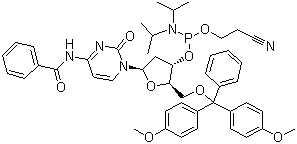 |
| Molecular Formula | C46H52N5O8P |
| Molecular Weight | 833.91 |
| CAS Registry Number | 102212-98-6 |
| EC Number | 801-520-8 |
| SMILES | CC(C)N(C(C)C)P(OCCC#N)O[C@H]1C[C@@H](O[C@@H]1COC(C2=CC=CC=C2)(C3=CC=C(C=C3)OC)C4=CC=C(C=C4)OC)N5C=CC(=NC5=O)NC(=O)C6=CC=CC=C6 |
| Hazard Symbols |  GHS07 Warning Details GHS07 Warning Details | ||||||||
|---|---|---|---|---|---|---|---|---|---|
| Risk Statements | H302 Details | ||||||||
| Safety Statements | P264-P270-P301+P317-P330-P501 Details | ||||||||
| Hazard Classification | |||||||||
| |||||||||
| SDS | Available | ||||||||
 chemBlink Chemical Story
|
5'-O-(4,4'-Dimethoxytrityl)-N4-benzoyl-2'-deoxycytidine-3'-(2-cyanoethyl-N,N-diisopropyl)phosphoramidite is a protected nucleoside phosphoramidite that serves as one of the standard building blocks for the automated solid-phase synthesis of DNA oligonucleotides. It is a chemically modified derivative of 2'-deoxycytidine in which the reactive functional groups are protected to allow selective, stepwise formation of phosphite triester linkages during phosphoramidite-based DNA synthesis. The molecular framework is based on 2'-deoxycytidine, which consists of the pyrimidine nucleobase cytosine attached through a β-N-glycosidic bond to a 2-deoxyribose sugar. The pyrimidine ring is planar and aromatic, containing two nitrogen atoms and an exocyclic amino group at the 4-position. The sugar adopts a five-membered furanose ring conformation and contains the characteristic 5', 3', and 2' carbon atoms, with the 2'-position lacking the hydroxyl group found in ribonucleosides. The exocyclic amino group of cytosine is protected as an N4-benzoyl amide. The benzoyl group suppresses the nucleophilicity of the amino nitrogen during oligonucleotide synthesis and prevents undesired side reactions. The amide bond is resonance-stabilized and remains chemically stable throughout the synthesis cycle, while being removable under the final deprotection conditions used after chain assembly. The 5'-hydroxyl group is protected with a 4,4'-dimethoxytrityl (DMTr) group. This protecting group consists of a triphenylmethyl framework bearing two para-methoxy substituents. The bulky aromatic structure sterically shields the 5'-hydroxyl while the methoxy groups stabilize the trityl cation formed during acid-mediated deprotection. The DMTr group is selectively removed under mildly acidic conditions, exposing the 5'-hydroxyl for the next coupling cycle without affecting the remaining protecting groups. The 3'-hydroxyl group is converted into a phosphoramidite functional group, which is the reactive center used for chain elongation. The phosphorus atom is trivalent and adopts an approximately tetrahedral geometry, being bonded to the 3'-oxygen of the nucleoside, a diisopropylamino group, a 2-cyanoethyl oxy substituent, and a lone pair of electrons. The phosphorus(III) center is considerably more reactive than phosphate esters and is readily activated by tetrazole-based activators during oligonucleotide synthesis. The diisopropylamino substituent serves as the leaving group during the coupling reaction. Upon activation, it is displaced by the 5'-hydroxyl group of the growing oligonucleotide chain, forming a phosphite triester linkage. Subsequent oxidation converts the phosphorus(III) intermediate into the chemically stable phosphorus(V) phosphate triester. The 2-cyanoethyl group functions as a phosphate protecting group. It remains attached during chain assembly, protecting the phosphate functionality from undesired reactions. During the final deprotection step, it is removed under basic conditions through a β-elimination process, yielding the natural phosphodiester backbone of DNA. From a physicochemical perspective, the molecule is amphiphilic. The nucleoside and phosphoramidite portions contain numerous heteroatoms capable of hydrogen bonding, while the large aromatic DMTr and benzoyl groups contribute significant hydrophobic character. The molecule is therefore highly soluble in anhydrous organic solvents commonly employed in automated DNA synthesis. Chemically, the phosphoramidite group is the most reactive functionality and is highly sensitive to moisture, undergoing hydrolysis upon exposure to water. Consequently, handling and storage require rigorously anhydrous conditions. In contrast, the DMTr and benzoyl protecting groups are designed to exhibit orthogonal stability, allowing their selective removal at different stages of the synthesis process. Overall, 5'-O-(4,4'-dimethoxytrityl)-N4-benzoyl-2'-deoxycytidine-3'-(2-cyanoethyl-N,N-diisopropyl)phosphoramidite is a fully protected deoxycytidine phosphoramidite specifically engineered for automated DNA synthesis. Its combination of orthogonal protecting groups and a reactive phosphorus(III) center enables the efficient, sequential construction of defined DNA oligonucleotides while preserving the integrity of the nucleobase and sugar throughout the synthetic process. References 2024. Nucleoside phosphoramidite monomers and their preparation methods and applications. CN-117362370-B Grant Date: 2024-03-05. URL: https://patents.google.com/patent/CN117362370B 2023. Modified thio-oligonucleotides and their applications. CN-114369130-B Grant Date: 2023-10-03. URL: https://patents.google.com/patent/CN114369130B |
| Market Analysis Reports |