
Online Database of Chemicals from Around the World
| Chemfun Medical Technology (shanghai) Co., Ltd. | China | |||
|---|---|---|---|---|
 | www.chemfun.net | |||
 | +86 (21) 6722-0633 | |||
 | +86 (21) 6722-0633 | |||
 | sales1@chemfun.net | |||
 | QQ Chat | |||
 | WeChat: 3046659337 | |||
| Chemical manufacturer since 2010 | ||||
| chemBlink Standard supplier since 2010 | ||||
| Chengdu Climb Pharmaceutical Technology Co., Ltd. | China | |||
|---|---|---|---|---|
| www.cdclimb.com | |||
| +86 (28) 8760-8726 +86 13540107218 | |||
| +86 (28) 8760-8725 | |||
| sales@cdclimb.com | |||
| QQ Chat | |||
| Chemical manufacturer since 2013 | ||||
| chemBlink Standard supplier since 2014 | ||||
| Hubei Teyer Pharmaceutical Co., Ltd. | China | |||
|---|---|---|---|---|
| www.hubeiteyer.com | |||
| +86 (728) 533-2622 | |||
| info@hubeiteyer.com | |||
| Chemical manufacturer since 2002 | ||||
| Classification | Organic raw materials >> Alcohols, phenols, phenolic compounds and derivatives |
|---|---|
| Name | 4-Cyclopropylphenol |
| Molecular Structure | 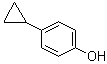 |
| Molecular Formula | C9H10O |
| Molecular Weight | 134.18 |
| CAS Registry Number | 10292-61-2 |
| EC Number | 876-090-8 |
| SMILES | C1CC1C2=CC=C(C=C2)O |
| Solubility | Slightly soluble (3.1 g/L) (25 °C), Calc.* |
|---|---|
| Density | 1.158±0.06 g/cm3 (20 °C 760 Torr), Calc.* |
| Melting point | 57-58 °C** |
| Boiling point | 248.2±19.0 °C (760 Torr), Calc.* |
| Refractive index | 1.5618 (589.3 nm 20 °C)*** |
| Flash point | 119.8±11.0 °C, Calc.* |
| * | Calculated using Advanced Chemistry Development (ACD/Labs) Software V11.02 (©1994-2013 ACD/Labs) |
| ** | Shabarov, Yu. S. |
| *** | Shabarov, Yu. S. |
| Hazard Symbols |   GHS05;GHS07 Danger Details GHS05;GHS07 Danger Details |
|---|---|
| Risk Statements | H315-H318-H335 Details |
| Safety Statements | P261-P264-P264+P265-P271-P273-P280-P302+P352-P304+P340-P305+P354+P338-P317-P319-P321-P332+P317-P362+P364-P391-P403+P233-P405-P501 Details |
| SDS | Available |
 chemBlink Chemical Story
|
4-Cyclopropylphenol is an aromatic organic compound consisting of a phenol ring substituted at the para-position with a cyclopropyl group. It belongs to the class of para-substituted phenols and is characterized by the combination of a hydroxy functional group with a strained three-membered cyclopropyl ring. This structural motif contributes to both electronic and steric properties that influence its reactivity and biological relevance. The compound appears as a colorless to pale yellow solid under standard conditions and is moderately soluble in organic solvents. The synthesis of 4-cyclopropylphenol has been achieved through established procedures, most notably via electrophilic aromatic substitution or metal-catalyzed cross-coupling methods. A common route involves the use of 4-halophenols, such as 4-bromophenol, which undergo cyclopropylation through Grignard or organozinc intermediates under palladium-catalyzed coupling conditions. These methods yield 4-cyclopropylphenol with good regioselectivity and efficiency. The phenolic hydroxyl group remains intact under mild reaction conditions, allowing further derivatization of the molecule. 4-Cyclopropylphenol has been applied in the synthesis of biologically active molecules and pharmaceutical intermediates. Its phenol moiety serves as a reactive site for functionalization through etherification, esterification, or oxidative coupling reactions, while the cyclopropyl substituent is known to modulate biological activity and metabolic stability in drug design. The cyclopropyl group, due to its conformational rigidity and electron-donating properties, is often introduced to enhance receptor binding or resistance to enzymatic degradation. The compound has been studied as a building block in the preparation of ligands and small-molecule frameworks for medicinal chemistry. In particular, cyclopropyl-substituted phenols and anilines have been evaluated for their role in receptor modulation, antimicrobial action, and enzyme inhibition. While 4-cyclopropylphenol itself is not a registered drug, it contributes to structure-activity relationship (SAR) studies that explore the impact of rigid aliphatic groups on bioactivity. Additionally, 4-cyclopropylphenol has found use in polymer and materials research, where phenol derivatives are employed in the synthesis of resins, adhesives, and high-performance plastics. Its incorporation into phenolic resins may provide modifications in thermal stability and mechanical properties due to the strain and rigidity of the cyclopropyl unit. It also serves as a potential monomer or comonomer in the preparation of modified polyphenols. In analytical chemistry, substituted phenols such as 4-cyclopropylphenol have been evaluated in chromatographic and spectroscopic studies as model compounds for assessing substitution effects on aromatic reactivity and electron distribution. The influence of the cyclopropyl group on UV absorption and redox behavior has been of interest in mechanistic studies. The physical and chemical stability of 4-cyclopropylphenol allows for routine handling and storage under standard laboratory conditions. It is typically stable to air and moisture but may undergo oxidation in the presence of strong oxidizing agents. Standard laboratory precautions for handling phenolic compounds apply, including the use of gloves, eye protection, and ventilation. Overall, 4-cyclopropylphenol is a well-characterized compound with defined roles in synthetic organic chemistry and molecular design. Its use as a structural motif in chemical research continues to support investigations into bioactive compound development, materials science, and synthetic methodology. |
| Market Analysis Reports |