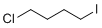
The chemical substance 1-chloro-4-iodobutane is a dihalogenated alkane, recognized in organic chemistry as a versatile synthetic intermediate, particularly in the synthesis of pharmaceuticals, agrochemicals, and specialty chemicals. Its discovery and applications are well-documented in the literature, rooted in the development of halogenated hydrocarbons and selective halogenation techniques.
The origins of 1-chloro-4-iodobutane are tied to the study of alkyl halides, which have been explored since the 19th century for their reactivity in nucleophilic substitution and elimination reactions. The introduction of different halogens, such as chlorine and iodine, at specific positions on an alkane chain became feasible with advances in selective halogenation methods in the early 20th century. The specific 1,4-dihalobutane structure, with chlorine and iodine at opposite ends of a four-carbon chain, emerged as a useful bifunctional intermediate in the mid-20th century, driven by the need for reactive building blocks in organic synthesis. Techniques like radical halogenation and halide exchange reactions, refined in the 1950s and 1960s, enabled the efficient production of such compounds.
Synthetically, 1-chloro-4-iodobutane is typically prepared through a straightforward process. A common route starts with 1,4-dichlorobutane, a commercially available starting material. The chlorine at one end is selectively replaced with iodine via a Finkelstein reaction, using sodium iodide in a polar solvent like acetone, which favors the displacement of chloride by iodide due to the greater nucleophilicity of iodide and the precipitation of sodium chloride. Alternatively, the compound can be synthesized from 1,4-butanediol by sequential halogenation: one hydroxyl group is converted to a chloride using thionyl chloride, and the other is transformed into an iodide using phosphorus triiodide or a similar reagent. These steps rely on well-established halogenation and substitution protocols, ensuring high yields and purity.
The primary application of 1-chloro-4-iodobutane is as a synthetic intermediate in organic chemistry. The presence of two different halogens with distinct reactivities—chlorine being less reactive and iodine more reactive—allows for selective functionalization. The iodine end is highly reactive in nucleophilic substitution reactions, enabling the introduction of amines, thiols, or carbon nucleophiles, while the chlorine end can be modified under harsher conditions or retained as a functional group. This compound is frequently used in the synthesis of pharmaceutical intermediates, such as heterocyclic compounds or alkylated amines, which are components of drugs targeting neurological disorders, infections, or cancer. Its four-carbon chain serves as a spacer in molecular scaffolds, providing flexibility and precise positioning of functional groups.
In agrochemical synthesis, 1-chloro-4-iodobutane is employed to construct molecules with pesticidal or herbicidal activity, where the halogenated chain contributes to bioactivity and stability. In academic research, it serves as a model compound for studying selective nucleophilic substitution, halide reactivity, and the kinetics of dihalide transformations. Its synthesis has contributed to the optimization of halide exchange and selective halogenation techniques.
The significance of 1-chloro-4-iodobutane lies in its role as a bifunctional intermediate that leverages the differential reactivity of chlorine and iodine to enable selective synthetic transformations. Its development reflects progress in halogenation chemistry and nucleophilic substitution. By facilitating the efficient synthesis of complex molecules with tailored functionalities, it has become a critical tool in advancing pharmaceutical, agrochemical, and chemical research.
|




 GHS07 Warning Details
 chemBlink Chemical Story