
Online Database of Chemicals from Around the World
| BOC Sciences | USA | |||
|---|---|---|---|---|
 | www.bocsci.com | |||
 | +1 (631) 485-4226 | |||
 | +1 (631) 614-7828 | |||
 | info@bocsci.com | |||
| Chemical manufacturer | ||||
| chemBlink Standard supplier since 2010 | ||||
| Finetech Industry Limited | China | |||
|---|---|---|---|---|
| www.finetechchem.com | |||
| +86 (27) 8746-5837 +86 18971612321 | |||
| +86 (27) 8777-2287 | |||
| sales@finetechnology-ind.com | |||
 | QQ Chat | |||
| Chemical manufacturer since 2009 | ||||
| chemBlink Standard supplier since 2019 | ||||
| Zhangshu Hongyuan Biomedical Technology Co., Ltd. | China | |||
|---|---|---|---|---|
| www.zsshysw.cn | |||
| +86 19195036662 | |||
| 335864138@qq.com | |||
| QQ Chat | |||
| Chemical manufacturer since 2022 | ||||
| chemBlink Standard supplier since 2022 | ||||
| Targetmol China | China | |||
|---|---|---|---|---|
| www.targetmol.cn | |||
| +86 (400) 820-0310 | |||
| sales@targetmol.cn | |||
| Chemical manufacturer since 2015 | ||||
| chemBlink Standard supplier since 2025 | ||||
| Chemos GmbH & Co. KG | Germany | |||
|---|---|---|---|---|
| www.chemos.de | |||
| +49 871-966346-0 | |||
| +49 871-966346-13 | |||
| chemos@chemos.de | |||
| Chemical distributor | ||||
| Melford Laboratories Limited | UK | |||
|---|---|---|---|---|
| www.melford.co.uk | |||
| +44 (1449) 741-178 | |||
| +44 (1449) 741-217 | |||
| pfranklin@melford.co.uk sales@melford.co.uk | |||
| Chemical manufacturer since 1985 | ||||
| Indofine Chemical Company, Inc. | USA | |||
|---|---|---|---|---|
| www.indofinechemical.com | |||
| +1 (888) 463-6346 | |||
| +1 (908) 359-1179 | |||
| info@indofinechemical.com | |||
| Chemical manufacturer since 1981 | ||||
| Santa Cruz Biotechnology, Inc. | USA | |||
|---|---|---|---|---|
| www.scbt.com | |||
| +1 (831) 457-3800 | |||
| +1 (831) 457-3801 | |||
| scbt@scbt.com | |||
| Chemical manufacturer | ||||
| LKT Laboratories, Inc. | USA | |||
|---|---|---|---|---|
| www.lktlabs.com | |||
| +1 (888) 558-5227 | |||
| +1 (651) 644-8357 | |||
| peacerli@mbolin-lktlabs.com | |||
| Chemical manufacturer | ||||
| Classification | Biochemical >> Peptide |
|---|---|
| Name | Leupeptin |
| Synonyms | Acetyl-L-leucyl-L-leucyl-L-argininal hemisulfate; Leupeptin hemisulfate salt |
| Molecular Structure | 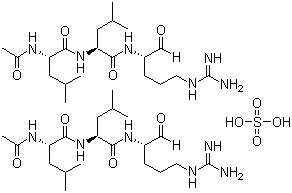 |
| Molecular Formula | 2(C20H38N6O4).H2SO4 |
| Molecular Weight | 951.19 |
| CAS Registry Number | 103476-89-7 |
| EC Number | 600-443-5 |
| SMILES | CC(C)C[C@@H](C(=O)N[C@@H](CC(C)C)C(=O)N[C@@H](CCCN=C(N)N)C=O)NC(=O)C.CC(C)C[C@@H](C(=O)N[C@@H](CC(C)C)C(=O)N[C@@H](CCCN=C(N)N)C=O)NC(=O)C.OS(=O)(=O)O |
| alpha | -76 ° (c=1, water) |
|---|---|
| Water solubility | soluble |
| Hazard Symbols |   GHS07;GHS08 Warning Details GHS07;GHS08 Warning Details | ||||||||||||||||||||
|---|---|---|---|---|---|---|---|---|---|---|---|---|---|---|---|---|---|---|---|---|---|
| Risk Statements | H302-H312-H332-H361 Details | ||||||||||||||||||||
| Safety Statements | P203-P261-P264-P270-P271-P280-P301+P317-P302+P352-P304+P340-P317-P318-P321-P330-P362+P364-P405-P501 Details | ||||||||||||||||||||
| Hazard Classification | |||||||||||||||||||||
| |||||||||||||||||||||
| SDS | Available | ||||||||||||||||||||
 chemBlink Chemical Story
|
Leupeptin is a naturally occurring tripeptide aldehyde that functions as a potent protease inhibitor. It was first isolated from the actinomycete Streptomyces roseus, a soil-dwelling bacterium, during a systematic search for microbial products that inhibit enzymatic protein degradation. The compound is composed of N-acetyl-L-leucyl-L-leucyl-L-argininal, and its structure includes an aldehyde group at the C-terminal, which is essential for its inhibitory activity. The discovery of leupeptin occurred in the 1960s, during a period when the identification of microbial metabolites with biochemical utility was intensively pursued. Researchers observed that cultures of *S. roseus* produced a substance capable of inhibiting the activity of serine and cysteine proteases, particularly trypsin, plasmin, papain, and calpain. Further purification and structural elucidation revealed that leupeptin acts as a reversible, competitive inhibitor, with a strong affinity for the active sites of these enzymes. Its inhibitory potency is attributed to the formation of a covalent hemiacetal intermediate between the aldehyde group of leupeptin and the catalytic serine or cysteine residue in the target protease. Leupeptin has since become a widely used tool in biochemical and cell biology research. One of its primary applications is in the protection of proteins from proteolytic degradation during extraction and purification processes. In many experimental protocols, especially those involving tissue homogenization or subcellular fractionation, endogenous proteases are activated and can degrade target proteins. The addition of leupeptin to lysis buffers and storage solutions helps maintain protein integrity by inhibiting these enzymes, allowing for accurate downstream analyses such as Western blotting, enzyme assays, or structural studies. Beyond its role in preserving protein samples, leupeptin has been employed to investigate the physiological functions of proteases in various biological systems. It has been used in studies of cell signaling, apoptosis, inflammation, and muscle physiology, where it helps delineate the contribution of specific proteolytic pathways. For instance, its inhibition of calpain activity has made it useful in examining calcium-dependent signaling cascades and their involvement in cellular responses. In neurobiology, leupeptin has been applied in studies of neuronal injury and degeneration, where calpain-mediated proteolysis contributes to pathological processes. Similarly, in cardiovascular research, the compound has been utilized to investigate the role of proteases in myocardial ischemia and reperfusion injury. These studies have helped clarify the molecular mechanisms underlying disease progression and identify potential targets for therapeutic intervention. Leupeptin is typically used in combination with other protease inhibitors such as aprotinin, pepstatin A, and PMSF to provide broad-spectrum protection against various classes of proteolytic enzymes. It is stable in aqueous solution at neutral pH and is often prepared as a stock solution in water or dimethyl sulfoxide for laboratory use. Despite its effectiveness, leupeptin has limitations. It does not inhibit all types of proteases, such as metalloproteases or aspartic proteases, and its inhibitory activity is reversible, which may require its continual presence during experiments. Additionally, its specificity must be considered in experimental design, as off-target effects can influence interpretation of results in complex biological systems. The development and continued use of leupeptin underscore the importance of natural products in biochemical research. Its utility as a protease inhibitor has made it a standard reagent in molecular biology, enabling the preservation of protein function and the detailed study of protease-related cellular processes. References 1981. The effects of low temperature and chloroquine on 125I-insulin degradation by the perfused rat liver. Archives of Biochemistry and Biophysics, 212(1). DOI: 10.1016/0003-9861(81)90356-8 2018. Kinetic studies of serine protease inhibitors in simple and rapid ‘active barrier’ model systems - Diffusion through an inhibitor barrier. Analytical Biochemistry, 546. DOI: 10.1016/j.ab.2018.01.022 2021. Strong Binding of Leupeptin with TMPRSS2 Protease May Be an Alternative to Camostat and Nafamostat for SARS-CoV-2 Repurposed Drug: Evaluation from Molecular Docking and Molecular Dynamics Simulations. Applied Biochemistry and Biotechnology, 193(5). DOI: 10.1007/s12010-020-03475-8 |
| Market Analysis Reports |