
Online Database of Chemicals from Around the World
| Simagchem Corporation | China | |||
|---|---|---|---|---|
 | www.simagchem.com | |||
 | +86 13806087780 | |||
 | +86 (592) 268-0237 | |||
 | sale@simagchem.com | |||
| Chemical manufacturer since 2002 | ||||
| chemBlink Standard supplier since 2008 | ||||
| Tianjin Zhongxin Chem-tech Co., Ltd. | China | |||
|---|---|---|---|---|
| www.tjzxchem.com | |||
| +86 (22) 6688-0623 | |||
| +86 (22) 8988-0739 ex 8030 | |||
| sales@tjzxchem.com | |||
| Chemical manufacturer since 2007 | ||||
| chemBlink Standard supplier since 2009 | ||||
| Hefei TNJ Chemical Industry Co., Ltd. | China | |||
|---|---|---|---|---|
| www.tnjchem.com | |||
| +86 (551) 6541-8684 | |||
| +86 (551) 6541-8697 | |||
| sales@tnjchem.com | |||
| Chemical manufacturer since 2001 | ||||
| chemBlink Standard supplier since 2010 | ||||
| BOC Sciences | USA | |||
|---|---|---|---|---|
| www.bocsci.com | |||
| +1 (631) 485-4226 | |||
| +1 (631) 614-7828 | |||
| info@bocsci.com | |||
| Chemical manufacturer | ||||
| chemBlink Standard supplier since 2010 | ||||
| ChemiYu Chemical Co., Ltd. | China | |||
|---|---|---|---|---|
| www.chemiyu.com | |||
| +86 (21) 3429-3107 +86 15800476089 | |||
| +86 (21) 3429-3107 | |||
| miranda@chemiyu.com | |||
| Chemical manufacturer since 2015 | ||||
| chemBlink Standard supplier since 2017 | ||||
| Frontier Scientific Services, Inc. | USA | |||
|---|---|---|---|---|
| www.frontierssi.com | |||
| +1 (302) 266-6891 (888) 577-2734 | |||
| +1 (302) 266-8296 | |||
| customerservice@frontierssi.com | |||
| Chemical manufacturer | ||||
| Trigona oHG | Germany | |||
|---|---|---|---|---|
| www.trigona.de | |||
| +49 (611) 962-5283 | |||
| +49 (611) 962-9032 | |||
| info@trigona.de | |||
| Chemical manufacturer | ||||
| Classification | Organic raw materials >> Amino compound >> Acyclic monoamines, polyamines and their derivatives and salts |
|---|---|
| Name | 3-Diethylaminopropylamine |
| Synonyms | 3-Aminopropyldiethylamine; N,N-Diethyl-1,3-propanediamine; N,N-Diethyl-1,3-diaminopropane |
| Molecular Structure | 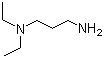 |
| Molecular Formula | C7H18N2 |
| Molecular Weight | 130.23 |
| CAS Registry Number | 104-78-9 |
| EC Number | 203-236-4 |
| SMILES | CCN(CC)CCCN |
| Density | 0.82 |
|---|---|
| Melting point | -60 °C |
| Boiling point | 168-171 °C |
| Refractive index | 1.4406-1.4426 |
| Flash point | 53 °C |
| Water solubility | MISCIBLE |
| Hazard Symbols |     GHS02;GHS05;GHS06;GHS07 Danger Details GHS02;GHS05;GHS06;GHS07 Danger Details | ||||||||||||||||||||||||||||||||||||||||||||||||
|---|---|---|---|---|---|---|---|---|---|---|---|---|---|---|---|---|---|---|---|---|---|---|---|---|---|---|---|---|---|---|---|---|---|---|---|---|---|---|---|---|---|---|---|---|---|---|---|---|---|
| Risk Statements | H226-H312-H302-H314-H317 Details | ||||||||||||||||||||||||||||||||||||||||||||||||
| Safety Statements | P210-P233-P240-P241-P242-P243-P260-P261-P262-P264-P264+P265-P270-P271-P272-P280-P301+P317-P301+P330+P331-P302+P352-P302+P361+P354-P303+P361+P353-P304+P340-P305+P354+P338-P316-P317-P319-P321-P330-P333+P317-P361+P364-P362+P364-P363-P370+P378-P403+P233-P403+P235-P405-P501 Details | ||||||||||||||||||||||||||||||||||||||||||||||||
| Hazard Classification | |||||||||||||||||||||||||||||||||||||||||||||||||
| |||||||||||||||||||||||||||||||||||||||||||||||||
| Transport Information | UN 2684 | ||||||||||||||||||||||||||||||||||||||||||||||||
| SDS | Available | ||||||||||||||||||||||||||||||||||||||||||||||||
 chemBlink Chemical Story
|
3-Diethylaminopropylamine, also known as DEAPA, is an organic compound with the molecular formula C10H22N2. This compound features a propylamine structure with two ethyl groups attached to the nitrogen atom at the 3-position. DEAPA is classified as a secondary amine and is notable for its applications in various industrial and chemical processes, particularly in the fields of polymer chemistry and pharmaceuticals. The discovery of 3-diethylaminopropylamine is linked to the broader exploration of amine compounds in the early 20th century, particularly the study of aliphatic amines. Aliphatic amines have been utilized in a range of chemical processes due to their nucleophilic properties, which allow them to react with a variety of electrophiles. DEAPA itself can be synthesized through the reaction of diethylamine with 3-bromopropylamine, resulting in the formation of the desired propylamine derivative. This synthetic route allows for the efficient production of DEAPA in both laboratory and industrial settings. One of the primary applications of 3-diethylaminopropylamine is in the synthesis of polymer materials. DEAPA serves as a hardener in epoxy resin systems, where it is used to cross-link with epoxides, leading to the formation of thermosetting polymers. These epoxy resins exhibit excellent mechanical strength, chemical resistance, and thermal stability, making them suitable for a wide range of applications, including coatings, adhesives, and composite materials. The use of DEAPA as a hardener enhances the performance of these epoxy systems, allowing them to withstand demanding conditions in various industries. In addition to its role in epoxy resin formulations, DEAPA is also employed in the synthesis of other polymeric materials, such as polyurethanes. In this context, DEAPA acts as a chain extender, contributing to the formation of long polymer chains when reacted with isocyanates. This reaction is crucial in producing polyurethane elastomers, which are used in applications requiring flexibility, durability, and resilience. The incorporation of DEAPA can enhance the mechanical properties of the resulting materials, making them ideal for use in automotive parts, footwear, and industrial components. Beyond its applications in polymer chemistry, 3-diethylaminopropylamine is also utilized in the pharmaceutical industry. It serves as an intermediate in the synthesis of various active pharmaceutical ingredients (APIs), particularly those related to the treatment of neurological disorders and other medical conditions. DEAPA's ability to undergo further chemical transformations allows it to be incorporated into the structures of complex drug molecules, enhancing their efficacy and specificity. This role as a building block for pharmaceuticals highlights the versatility of DEAPA in the synthesis of compounds that can have significant therapeutic effects. Moreover, 3-diethylaminopropylamine has been investigated for its potential as a surfactant and emulsifying agent. Its structure, which includes both hydrophobic and hydrophilic regions, enables it to interact with both organic and aqueous phases. This property makes DEAPA suitable for use in formulations requiring stabilization of emulsions, such as cosmetics, personal care products, and agrochemicals. The ability to enhance the stability and performance of these formulations further expands the range of applications for DEAPA in the chemical industry. The industrial production of 3-diethylaminopropylamine is typically conducted through batch processes, where controlled conditions are maintained to ensure optimal yields. As with many amines, DEAPA must be handled with care due to its potential health hazards. Exposure can lead to skin and respiratory irritation, and proper safety measures, including the use of personal protective equipment and adequate ventilation, are essential when working with this compound in manufacturing settings. In conclusion, 3-diethylaminopropylamine is a valuable compound with significant applications in polymer chemistry, pharmaceuticals, and other industrial processes. Its ability to act as a hardener, chain extender, and building block for various chemical reactions underscores its importance in developing advanced materials and therapeutic agents. The ongoing research into DEAPA and its derivatives continues to reveal new opportunities for its use in innovative applications across multiple sectors. References 2016. Polymers with tertiary amine groups for drug delivery and bioimaging. Science China Chemistry, 59(6), 516. DOI: 10.1007/s11426-015-0516-2 2018. With Formation of Amines. Science of Synthesis, SD-110-01378. URL: https://science-of-synthesis.thieme.com/app/text/?id=SD-110-01378 2024. Amine-Actuated Catalyst Switch for One-Pot Synthesis of Ether-Ester Type Block Copolymers. Chinese Journal of Polymer Science, 42(8), 3193. DOI: 10.1007/s10118-024-3193-6 |
| Market Analysis Reports |