Biuret is a small organic compound with the molecular formula C₂H₅N₃O₂, known for its role as an intermediate in urea chemistry and as a component in agricultural and biochemical applications. The discovery of biuret dates back to the 19th century when it was first identified as a byproduct in the thermal decomposition of urea. Its name is derived from its origin in urea reactions, reflecting its simple structure, which contains two urea molecules linked by a central nitrogen. The straightforward synthesis and distinctive properties of biuret have since led to its widespread use in fields like agriculture, protein analysis, and polymer production.
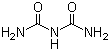
Structurally, biuret consists of two urea units joined by an NH group, making it a compound with both amide and amine groups. This structure gives biuret the ability to form hydrogen bonds and interact with other molecules, a characteristic that enhances its solubility and reactivity in aqueous solutions. Its formation occurs when urea is heated to temperatures above 150°C, producing biuret along with ammonia as a byproduct. This reaction is relevant in fertilizer manufacturing, where biuret sometimes forms as an unintended component in high-temperature urea production, impacting its suitability for sensitive crops.
In agriculture, biuret has a dual role. While it is often considered an impurity in urea-based fertilizers due to potential phytotoxic effects, controlled amounts of biuret are beneficial as a slow-release nitrogen source. When applied to soil, biuret undergoes gradual microbial breakdown, releasing nitrogen slowly, which can improve plant nitrogen use efficiency. Biuret is especially used in foliar sprays for specific crops, like citrus, where it promotes growth and leaf longevity. However, care is required in managing biuret concentrations, as excessive amounts can lead to toxicity in plants, affecting crop yield.
Biuret’s unique interaction with proteins is applied in the biuret test, a common assay in biochemistry for detecting peptide bonds. In this test, biuret reacts with copper(II) ions under alkaline conditions, producing a violet complex that indicates the presence of proteins or peptides. This reaction is sensitive and specific to peptide bonds, making the biuret assay a valuable tool in laboratories for protein quantification.
The discovery and development of biuret have underscored its versatile role in scientific and agricultural applications. While its presence in fertilizers is managed carefully, biuret’s application in analytical chemistry remains significant, reflecting the compound’s value as a biochemical tool and a component in nitrogen-based fertilizers.
References
1998. Comparison of Different Methods of Cell Lysis and Protein Measurements in Clostridium perfringens: Application to the Cell Volume Determination. Current Microbiology.
DOI: 10.1007/pl00006756
1979. Perinatal development of 3-hydroxy-3-methylglutaryl coenzyme a reductase activity in rat lung, liver and brain. Lipids.
DOI: 10.1007/bf02533460
1979. Histamine formation from 14C-L-histidine in mastocytosis [proceedings]. Inflammation Research.
DOI: 10.1007/bf02024101
|




 GHS07 Warning Details
 chemBlink Chemical Story