
Online Database of Chemicals from Around the World
| Cayman Chemical Company | USA | |||
|---|---|---|---|---|
 | www.caymanchem.com | |||
 | +1 (734) 971-3335 | |||
 | +1 (734) 971-3640 | |||
 | sales@caymanchem.com | |||
| Chemical manufacturer | ||||
| Classification | Organic raw materials >> Heterocyclic compound >> Indoles |
|---|---|
| Name | 1H-Indol-3-yl-1-naphthalenylmethanone |
| Synonyms | Ketone indol-3-yl 1-naphthyl |
| Molecular Structure | 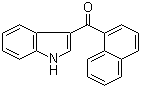 |
| Molecular Formula | C19H13NO |
| Molecular Weight | 271.31 |
| CAS Registry Number | 109555-87-5 |
| SMILES | C1=CC=C2C(=C1)C=CC=C2C(=O)C3=CNC4=CC=CC=C43 |
| Density | 1.3±0.1 g/cm3, Calc.*, 1.267 g/cm3 |
|---|---|
| Index of Refraction | 1.738, Calc.* |
| Melting point | 236 °C |
| Boiling Point | 512.2±23.0 °C (760 mmHg), Calc.* |
| Flash Point | 264.0±30.0 °C, Calc.* |
| Hazard Symbols |  GHS07 Warning Details GHS07 Warning Details |
|---|---|
| Risk Statements | H315-H319-H335 Details |
| Safety Statements | P261-P305+P351+P338-P302+P352 Details |
| SDS | Available |
 chemBlink Chemical Story
|
1H-Indol-3-yl-1-naphthalenylmethanone, commonly referred to as WIN 55,212-2, was first synthesized in the early 1990s. Researchers at Sterling-Winthrop aimed to create compounds that could interact with cannabinoid receptors in the brain, leading to potential therapeutic applications. This compound was part of a series of synthetic cannabinoids designed to study the endocannabinoid system and explore their potential as therapeutic agents. WIN 55,212-2 emerged as a significant compound due to its strong agonistic activity at both CB1 and CB2 receptors. WIN 55,212-2 is extensively used in neuroscientific research to study the endocannabinoid system, which plays a crucial role in regulating various physiological processes, including pain sensation, mood, appetite, and memory. By acting as an agonist at both CB1 and CB2 receptors, WIN 55,212-2 helps researchers understand the effects of cannabinoid receptor activation. One of the significant applications of WIN 55,212-2 is in pain management research. The compound has been shown to produce analgesic effects by modulating cannabinoid receptors in the nervous system. Research involving WIN 55,212-2 has provided insights into how cannabinoids can be used to alleviate various types of pain, including neuropathic and inflammatory pain. WIN 55,212-2 has shown potential neuroprotective properties, making it a valuable tool in studying neurodegenerative diseases such as Alzheimer's, Parkinson's, and multiple sclerosis. The compound's interaction with cannabinoid receptors can help reduce neuroinflammation and oxidative stress, both of which are implicated in the progression of neurodegenerative conditions. The endocannabinoid system is known to regulate appetite and metabolism. WIN 55,212-2 has been used in research to investigate how activation of cannabinoid receptors influences these processes. Studies have shown that cannabinoids can stimulate appetite and alter metabolic functions, which could have implications for treating conditions like cachexia (wasting syndrome) in cancer or AIDS patients, as well as metabolic disorders such as obesity. WIN 55,212-2 is also employed in psychopharmacological research to explore the effects of cannabinoids on behavior and mental health. Its potent activity at cannabinoid receptors allows researchers to study the impacts of cannabinoids on anxiety, depression, and cognitive function. References 2018. The Chemistry and Pharmacology of Synthetic Cannabinoid Receptor Agonist New Psychoactive Substances: Evolution. Handbook of Experimental Pharmacology. DOI: 10.1007/164_2018_144 2016. New psychoactive substances: an overview on recent publications on their toxicodynamics and toxicokinetics. Archives of Toxicology. DOI: 10.1007/s00204-016-1812-x 2015. High-resolution mass spectrometric determination of the synthetic cannabinoids MAM-2201, AM-2201, AM-2232, and their metabolites in postmortem plasma and urine by LC/Q-TOFMS. International Journal of Legal Medicine. DOI: 10.1007/s00414-015-1257-4 |
| Market Analysis Reports |