
Online Database of Chemicals from Around the World
| BOC Sciences | USA | |||
|---|---|---|---|---|
 | www.bocsci.com | |||
 | +1 (631) 485-4226 | |||
 | +1 (631) 614-7828 | |||
 | info@bocsci.com | |||
| Chemical manufacturer | ||||
| chemBlink Standard supplier since 2010 | ||||
| Porphyrin Systems | Germany | |||
|---|---|---|---|---|
| www.porphyrin-systems.de | |||
| +49 (40) 6466-5860 | |||
| +49 (40) 6466-5861 | |||
| hombrecher@porphyrin-systems.de | |||
| Chemical manufacturer since 1999 | ||||
| chemBlink Standard supplier since 2010 | ||||
| Hangzhou Leap Chem Co., Ltd. | China | |||
|---|---|---|---|---|
| www.leapchem.com | |||
| +86 (571) 8771-1850 | |||
| market19@leapchem.com | |||
 | QQ Chat | |||
| Chemical manufacturer since 2006 | ||||
| chemBlink Standard supplier since 2015 | ||||
| Shanghai Suifu Chemical Technology Co., Ltd. | China | |||
|---|---|---|---|---|
| www.suifuhuagong.com | |||
| +86 (21) 3373-8187 +86 19945655289 | |||
| +86 (21) 3373-8187 | |||
| suifuchemical@163.com | |||
| QQ Chat | |||
 | Skype Chat | |||
| Chemical manufacturer since 2017 | ||||
| chemBlink Standard supplier since 2019 | ||||
| Chengdu Aslee Biopharmaceuticals, Inc. | China | |||
|---|---|---|---|---|
| www.asleechem.com | |||
| +86 (28) 8530-5008 +86 15102825326 | |||
| may.yang@asleechem.com | |||
| QQ Chat | |||
| Skype Chat | |||
| Chemical manufacturer since 2013 | ||||
| chemBlink Standard supplier since 2020 | ||||
| Luminescence Technology Corp. | Taiwan | |||
|---|---|---|---|---|
| www.lumtec.com.tw | |||
| +886 (2) 2697-5600 | |||
| +886 (2) 2697-5601 | |||
| sales@lumtec.com.tw | |||
| Chemical manufacturer since 1999 | ||||
| chemBlink Standard supplier since 2024 | ||||
| Classification | Organic raw materials >> Organometallic compound >> Organic hafnium, mercury, silver, platinum, etc. |
|---|---|
| Name | Platinum tetrakis(pentafluorophenyl)porphyrin |
| Synonyms | Pt(II) meso-Tetra(pentafluorophenyl)porphine; meso-5,10,15,20-Tetrakis(pentafluorophenyl)porphyrinatoplatinum |
| Molecular Structure | 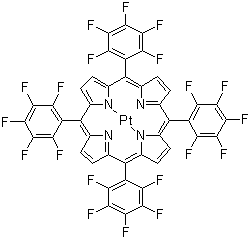 |
| Molecular Formula | C44H8F20N4Pt |
| Molecular Weight | 1167.61 |
| CAS Registry Number | 109781-47-7 |
| EC Number | 844-206-6 |
| SMILES | C1=CC2=C(C3=NC(=C(C4=CC=C([N-]4)C(=C5C=CC(=N5)C(=C1[N-]2)C6=C(C(=C(C(=C6F)F)F)F)F)C7=C(C(=C(C(=C7F)F)F)F)F)C8=C(C(=C(C(=C8F)F)F)F)F)C=C3)C9=C(C(=C(C(=C9F)F)F)F)F.[Pt+2] |
| Hazard Symbols |   GHS07;GHS08 Warning Details GHS07;GHS08 Warning Details | ||||||||||||||||
|---|---|---|---|---|---|---|---|---|---|---|---|---|---|---|---|---|---|
| Risk Statements | H302+H312+H332-H315-H319-H361 Details | ||||||||||||||||
| Safety Statements | P501-P261-P270-P202-P201-P271-P264-P280-P308+P313-P337+P313-P305+P351+P338-P362+P364-P332+P313-P301+P312+P330-P302+P352+P312-P304+P340+P312-P405 Details | ||||||||||||||||
| Hazard Classification | |||||||||||||||||
| |||||||||||||||||
| SDS | Available | ||||||||||||||||
 chemBlink Chemical Story
|
Platinum tetrakis(pentafluorophenyl)porphyrin is a platinum-based metalloporphyrin complex known for its distinctive photophysical and electronic properties. The discovery of this compound stems from extensive research into porphyrin derivatives and their potential as functional materials. Porphyrins, with their conjugated macrocyclic structure, have long been studied for their ability to coordinate various metals. The introduction of pentafluorophenyl groups enhances the compound’s electron-withdrawing characteristics, providing new avenues for application in fields such as photonics and sensing. The synthesis of platinum tetrakis(pentafluorophenyl)porphyrin typically involves the reaction of platinum salts, such as platinum(II) acetylacetonate, with free-base tetrakis(pentafluorophenyl)porphyrin under reflux conditions. This metallation process yields a complex where the platinum ion is centrally coordinated within the porphyrin ring. The presence of pentafluorophenyl substituents increases the stability of the complex and modulates its electronic properties. The final product is characterized using techniques such as UV-Vis spectroscopy, nuclear magnetic resonance (NMR), and X-ray crystallography. This compound has significant applications in oxygen sensing and optoelectronics. Platinum tetrakis(pentafluorophenyl)porphyrin exhibits strong phosphorescence, particularly under low-oxygen conditions, making it an ideal candidate for oxygen sensors in medical and industrial environments. Its long-lived phosphorescence allows accurate detection of oxygen concentrations, useful for monitoring biological tissues and environmental samples. In addition, the compound’s photostability and tunable emission properties enable its use in organic light-emitting diodes (OLEDs) and photodynamic therapy. The introduction of pentafluorophenyl groups also facilitates the compound’s solubility in organic solvents, expanding its potential for use in solution-based applications. Researchers continue to explore its utility in energy conversion, molecular electronics, and as a catalyst in organic synthesis. The unique combination of platinum’s coordination chemistry and the porphyrin framework ensures that platinum tetrakis(pentafluorophenyl)porphyrin remains a versatile tool in modern scientific research. References 2020. Nanodiagnostics to monitor biofilm oxygen metabolism for antibiotic susceptibility testing. The Analyst. DOI: 10.1039/d0an00479k 2018. Amphiphilic Fluorine-Containing Block Copolymers as Carriers for Hydrophobic PtTFPP for Dissolved Oxygen Sensing, Cell Respiration Monitoring and In Vivo Hypoxia Imaging with High Quantum Efficiency and Long Lifetime. Sensors (Basel, Switzerland). DOI: 10.3390/s18113752 2011. Intracellular O2 Sensing Probe Based on Cell-Penetrating Phosphorescent Nanoparticles. ACS Nano. DOI: 10.1021/nn200807g |
| Market Analysis Reports |