
Online Database of Chemicals from Around the World
| Enki Biopharmaceuticals (Shanghai) Limited | China | |||
|---|---|---|---|---|
 | www.enkibiopharma.com | |||
 | +86 (21) 5768-0965 +86 13916707528 | |||
 | +86 (21) 5768-0922 | |||
 | info@enkibiopharma.com | |||
 | QQ Chat | |||
| Chemical distributor since 2014 | ||||
| chemBlink Standard supplier since 2015 | ||||
| Name | 5-(3,5-Difluorobenzyl)-2-fluorobenzonitrile |
|---|---|
| Molecular Structure | 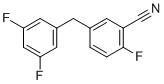 |
| Molecular Formula | C14H8F3N |
| Molecular Weight | 247.22 |
| CAS Registry Number | 1108745-25-0 |
| EC Number | 849-911-2 |
| SMILES | C1=CC(=C(C=C1CC2=CC(=CC(=C2)F)F)C#N)F |
| Hazard Symbols |  GHS07 Warning Details GHS07 Warning Details | ||||||||
|---|---|---|---|---|---|---|---|---|---|
| Risk Statements | H317 Details | ||||||||
| Safety Statements | P261-P272-P280-P302+P352-P321-P333+P317-P362+P364-P501 Details | ||||||||
| Hazard Classification | |||||||||
| |||||||||
| SDS | Available | ||||||||
 chemBlink Chemical Story
|
The compound 5-(3,5-Difluorobenzyl)-2-fluorobenzonitrile was discovered through targeted synthetic chemistry efforts aimed at creating new molecules with potential pharmaceutical applications. This compound emerged from research focusing on incorporating multiple fluorine atoms into benzyl and benzonitrile frameworks, aiming to enhance the compound's biological activity and pharmacokinetic properties. The discovery is part of an ongoing exploration of fluorinated organic molecules, which are known for their stability and enhanced interactions with biological targets. This compound represents a significant advancement in the field, offering a new scaffold for drug development and chemical research. The chemical 5-(3,5-Difluorobenzyl)-2-fluorobenzonitrile exhibits significant potential across various pharmaceutical and industrial applications, primarily due to its unique structural features and the presence of multiple fluorine atoms. One of the primary applications of this compound lies in the development of anti-cancer therapies. The incorporation of fluorine atoms into the molecular structure enhances the compound's ability to interact with specific cancer-related enzymes and proteins, potentially inhibiting their activity and preventing cancer cell proliferation. Its specificity and binding affinity make it a promising candidate for targeted cancer therapies, particularly in cases where conventional treatments are ineffective. Additionally, this compound shows promise in the field of anti-inflammatory drugs. The unique structure of 5-(3,5-Difluorobenzyl)-2-fluorobenzonitrile allows it to modulate inflammatory pathways effectively. It can inhibit key enzymes involved in the inflammatory response, reducing inflammation and providing relief from chronic inflammatory diseases such as rheumatoid arthritis and inflammatory bowel disease. This capability not only helps manage symptoms but also addresses the underlying inflammatory processes, improving patient outcomes. In neurological research, the compound's potential to cross the blood-brain barrier makes it an attractive candidate for treating central nervous system (CNS) disorders. Its ability to interact with specific neurotransmitter receptors and enzymes can help regulate neurotransmitter levels, providing therapeutic benefits for conditions such as depression, anxiety, and other neurodegenerative diseases. By modulating these pathways, the compound can help restore balance in brain chemistry and improve neurological health. Moreover, 5-(3,5-Difluorobenzyl)-2-fluorobenzonitrile can serve as a valuable tool in biochemical research. Its interactions with various biological targets can provide insights into enzyme functions, receptor binding mechanisms, and cellular processes. Researchers can use this compound to study the effects of fluorination on biological activity and develop new hypotheses for drug development. Lastly, the chemical properties of this compound, particularly its stability and specificity, make it suitable for use in designing advanced drug delivery systems. These systems can ensure that therapeutic agents are delivered directly to the target site, maximizing efficacy while minimizing side effects. This targeted approach is particularly beneficial in treating localized conditions, ensuring that higher concentrations of the drug reach the affected area without impacting healthy tissues. References 2020. Entrectinib. Pharmaceutical Substances. URL: https://pharmaceutical-substances.thieme.com/ps/search-results?docUri=KD-05-0141 |
| Market Analysis Reports |