
Online Database of Chemicals from Around the World
| Hangzhou Verychem Science And Technology Co., Ltd. | China | |||
|---|---|---|---|---|
 | www.verychem.com | |||
 | +86 (571) 8816-2785 +86 13606544505 | |||
 | +86 (571) 8816-2787 | |||
 | lucy@verychem.com | |||
| Chemical manufacturer since 2004 | ||||
| chemBlink Massive supplier since 2021 | ||||
| Fraken Biochem Co., Ltd. | China | |||
|---|---|---|---|---|
| www.fraken.cn | |||
| +86 (532) 8389-9718 | |||
| +86 (532) 8362-3236 | |||
| fraken@fraken.cn | |||
| Chemical manufacturer | ||||
| chemBlink Standard supplier since 2006 | ||||
| BOC Sciences | USA | |||
|---|---|---|---|---|
| www.bocsci.com | |||
| +1 (631) 485-4226 | |||
| +1 (631) 614-7828 | |||
| info@bocsci.com | |||
| Chemical manufacturer | ||||
| chemBlink Standard supplier since 2010 | ||||
| Beijing Four Principles Technology Co., Ltd. | China | |||
|---|---|---|---|---|
| www.fourprinciple.cn | |||
| +86 (10) 8494-7198 | |||
| +86 (10) 8494-7198 | |||
| fourprinciple@gmail.com | |||
| Chemical manufacturer since 2004 | ||||
| Classification | API >> Vitamins and minerals >> Vitamin AD drugs |
|---|---|
| Name | Vitamin A |
| Synonyms | Aquasol A; 3,7-Dimethyl-9-(2,6,6-trimethyl-1-cyclohexenyl)-nona-2,4,6,8-tetraen-1-ol |
| Molecular Structure | 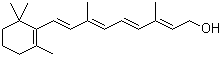 |
| Molecular Formula | C20H30O |
| Molecular Weight | 286.46 |
| CAS Registry Number | 11103-57-4 |
| EC Number | 234-328-2 |
| SMILES | CC1=C(C(CCC1)(C)C)/C=C/C(=C/C=C/C(=C/CO)/C)/C |
| Density | 1.0±0.1 g/cm3, Calc.* |
|---|---|
| Melting point | 61-63 °C (Expl.) |
| Index of Refraction | 1.549, Calc.*, 1.641 (Expl.) |
| Boiling Point | 421.2±14.0 °C (760 mmHg), Calc.* |
| Flash Point | 147.3±16.4 °C, Calc.* |
| * | Calculated using Advanced Chemistry Development (ACD/Labs) Software. |
| Hazard Symbols |   GHS07;GHS08 Danger Details GHS07;GHS08 Danger Details |
|---|---|
| Risk Statements | H302-H317-H319-H60-H360D-H413 Details |
| Safety Statements | P203-P261-P264-P264+P265-P270-P272-P273-P280-P301+P317-P302+P352-P305+P351+P338-P318-P321-P330-P333+P317-P337+P317-P362+P364-P405-P501 Details |
 chemBlink Chemical Story
|
Vitamin A is a fat-soluble compound essential for various physiological functions, including vision, immune response, and cellular differentiation. It was first discovered in the early 20th century during studies on dietary deficiencies and their effects on growth and vision. Researchers found that certain food sources, such as butter and cod liver oil, contained an unknown substance that prevented blindness and stunted growth in experimental animals. This discovery led to the identification of Vitamin A as a crucial nutrient in human health. The primary forms of Vitamin A include retinol, retinal, and retinoic acid, which play distinct roles in biological processes. Retinol, the most active form, is crucial for vision and is stored in the liver. Retinal is a key component of rhodopsin, a pigment in the retina necessary for low-light vision. Retinoic acid is essential for gene regulation and cellular differentiation, influencing skin health, embryonic development, and immune function. One of the most well-known applications of Vitamin A is in ophthalmology, particularly in preventing and treating night blindness and xerophthalmia. A deficiency in this vitamin leads to impaired vision, corneal damage, and an increased risk of infections. To combat global Vitamin A deficiency, supplementation programs and biofortified foods, such as genetically engineered golden rice, have been developed to improve dietary intake in vulnerable populations. Vitamin A also plays a significant role in dermatology. Retinoids, derivatives of Vitamin A, are widely used in the treatment of acne, psoriasis, and other skin conditions. Tretinoin and isotretinoin, synthetic retinoids, are effective in regulating keratinocyte differentiation and reducing inflammation. These compounds are commonly found in prescription medications for severe acne and aging-related skin treatments. In immunology, Vitamin A is recognized for its role in maintaining immune system function. It enhances the production and function of white blood cells, helping the body fight infections. Studies have shown that adequate Vitamin A intake reduces the severity of infectious diseases such as measles and respiratory infections. Beyond medical applications, Vitamin A is used in the food and cosmetic industries. It is commonly added to fortified foods, including dairy products, cereals, and infant formulas, to prevent deficiencies. In the cosmetic industry, retinoid-based formulations are widely incorporated into anti-aging creams and serums due to their ability to stimulate collagen production and improve skin texture. Ongoing research continues to explore new therapeutic applications of Vitamin A and its derivatives, particularly in cancer treatment and regenerative medicine. Studies are investigating its potential in modulating cell proliferation and differentiation in various cancers, while its role in stem cell biology suggests promising avenues for tissue regeneration. References 1979. Therapy of psoriasis with retinoid plus PUVA: Clinical and histologic data. Archives of Dermatological Research. DOI: 10.1007/bf00412661 1979. Systemic treatment of Darier's disease with a new retinoid (RO 10-9359). Archives of Dermatological Research. DOI: 10.1007/bf00412666 1979. The influence of vitamin A status on the response of chickens to aflatoxin B1 and changes in liver lipid metabolism associated with aflatoxicosis. The British Journal of Nutrition. DOI: 10.1079/bjn19790068 |
| Market Analysis Reports |