
Online Database of Chemicals from Around the World
| Hangzhou Verychem Science And Technology Co., Ltd. | China | |||
|---|---|---|---|---|
 | www.verychem.com | |||
 | +86 (571) 8816-2785 +86 13606544505 | |||
 | +86 (571) 8816-2787 | |||
 | lucy@verychem.com | |||
| Chemical manufacturer since 2004 | ||||
| chemBlink Massive supplier since 2021 | ||||
| Nanjing Lanya Chemical Co., Ltd. | China | |||
|---|---|---|---|---|
| www.lanyachem.com | |||
| +86 (25) 8331-5620 +86 13814071850 | |||
| +86 (25) 8331-5629 | |||
| lanyachem@gmail.com | |||
| Chemical manufacturer since 2007 | ||||
| chemBlink Standard supplier since 2007 | ||||
| Simagchem Corporation | China | |||
|---|---|---|---|---|
| www.simagchem.com | |||
| +86 13806087780 | |||
| +86 (592) 268-0237 | |||
| sale@simagchem.com | |||
| Chemical manufacturer since 2002 | ||||
| chemBlink Standard supplier since 2008 | ||||
| Hefei TNJ Chemical Industry Co., Ltd. | China | |||
|---|---|---|---|---|
| www.tnjchem.com | |||
| +86 (551) 6541-8684 | |||
| +86 (551) 6541-8697 | |||
| sales@tnjchem.com | |||
| Chemical manufacturer since 2001 | ||||
| chemBlink Standard supplier since 2010 | ||||
| 2A Pharmachem USA | USA | |||
|---|---|---|---|---|
| www.2apharmachem.com | |||
| +1 (630) 322-8887 | |||
| +1 (630) 322-8885 | |||
| sales@2abiotech.com | |||
| Chemical distributor | ||||
| chemBlink Standard supplier since 2010 | ||||
| Zhengzhou Yi Bang Co., Ltd. | China | |||
|---|---|---|---|---|
| www.zzyibang.cn | |||
| +86 (371) 6677-7261 | |||
| +86 (371) 6603-1338 | |||
| paulinecao2010@zzyibang.cn | |||
| Chemical manufacturer | ||||
| chemBlink Standard supplier since 2010 | ||||
| Hangzhou Leap Chem Co., Ltd. | China | |||
|---|---|---|---|---|
| www.leapchem.com | |||
| +86 (571) 8771-1850 | |||
| market19@leapchem.com | |||
 | QQ Chat | |||
| Chemical manufacturer since 2006 | ||||
| chemBlink Standard supplier since 2015 | ||||
| Whyte Chemicals | UK | |||
|---|---|---|---|---|
| www.whytechemicals.co.uk | |||
| +44 (20) 8346-5946 | |||
| +44 (20) 8349-4589 | |||
| sales@whytechemicals.co.uk | |||
| Chemical distributor | ||||
| Anvia Chemicals, LLC | USA | |||
|---|---|---|---|---|
| www.anviachem.com | |||
| +1 (414) 534-7845 | |||
| +1 (414) 762-5539 | |||
| sales@anviachem.com | |||
| Chemical manufacturer | ||||
| Classification | Organic raw materials >> Carboxylic compounds and derivatives >> Acyclic carboxylic acid |
|---|---|
| Name | Nonanoic acid |
| Synonyms | Pelargonic acid |
| Molecular Structure | 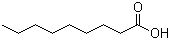 |
| Molecular Formula | C9H18O2 |
| Molecular Weight | 158.24 |
| CAS Registry Number | 112-05-0 |
| EC Number | 203-931-2 |
| FEMA | 2784 |
| SMILES | CCCCCCCCC(=O)O |
| Density | 0.906 |
|---|---|
| Melting point | 12.5 °C |
| Boiling point | 254 °C |
| Refractive index | 1.4299-1.4339 |
| Flash point | 114 °C |
| Water solubility | NEGLIGIBLE |
| Hazard Symbols |   GHS05;GHS07 Danger Details GHS05;GHS07 Danger Details | ||||||||||||||||||||||||||||||||||||
|---|---|---|---|---|---|---|---|---|---|---|---|---|---|---|---|---|---|---|---|---|---|---|---|---|---|---|---|---|---|---|---|---|---|---|---|---|---|
| Risk Statements | H315-H319-H412 Details | ||||||||||||||||||||||||||||||||||||
| Safety Statements | P260-P264-P264+P265-P273-P280-P301+P330+P331-P302+P352-P302+P361+P354-P304+P340-P305+P351+P338-P305+P354+P338-P316-P317-P321-P332+P317-P337+P317-P362+P364-P363-P405-P501 Details | ||||||||||||||||||||||||||||||||||||
| Hazard Classification | |||||||||||||||||||||||||||||||||||||
| |||||||||||||||||||||||||||||||||||||
| Transport Information | UN 3265 | ||||||||||||||||||||||||||||||||||||
| SDS | Available | ||||||||||||||||||||||||||||||||||||
 chemBlink Chemical Story
|
Nonanoic acid, also known as pelargonic acid, is a nine-carbon fatty acid with the molecular formula C9H18O2. This compound belongs to the carboxylic acid family and is commonly found as a colorless, oily liquid with a mildly pungent odor. Nonanoic acid occurs naturally in some plants and oils, and it can also be synthesized for commercial purposes. Its discovery and applications are rooted in the agricultural and chemical industries, where its properties as a herbicide, antifungal agent, and intermediate in various syntheses are widely utilized. Nonanoic acid was initially recognized for its occurrence in essential oils, particularly in pelargonium plants, from which its alternative name, pelargonic acid, is derived. This natural origin piqued the interest of researchers in the 19th century, who began studying its structure and potential applications in agriculture and industry. Since then, the compound has been synthesized chemically for use in broader applications, providing a more accessible route for industries requiring larger quantities. In agriculture, nonanoic acid serves as an effective non-selective herbicide, targeting a broad range of weeds without the need for toxic or persistent chemicals. Due to its relatively low toxicity to animals and humans, nonanoic acid is often employed in organic farming and in environmentally conscious weed control strategies. When applied to plant foliage, nonanoic acid disrupts cell membranes, causing rapid desiccation and death in target weeds. This mechanism offers a biodegradable alternative to synthetic herbicides, reducing potential soil and water contamination. Nonanoic acid is also used in pest control as a fungicide and insect repellent. It has demonstrated efficacy against common plant pathogens, and in formulations with other fatty acids, it can help manage fungal infections on crops. Additionally, its repellent properties are beneficial in protecting stored goods and crops from insects, especially in organic agricultural settings where synthetic pesticides are restricted. The use of nonanoic acid in this capacity capitalizes on its relatively low environmental persistence, aligning with sustainability practices in modern farming. Another important application of nonanoic acid is as an intermediate in organic synthesis. It is frequently used as a building block for producing esters, salts, and other derivatives used in industrial processes. Nonanoic acid esters, for instance, are valued in the fragrance and flavor industries for their fruity, fatty scent and are often included in personal care products, lubricants, and food additives. In polymer chemistry, nonanoic acid derivatives serve as plasticizers and stabilizers, enhancing the flexibility and longevity of polymeric materials. In recent years, nonanoic acid has gained interest as a renewable and biodegradable option in formulations for cleaning products, disinfectants, and solvents. Its fatty acid structure enables it to dissolve oils and organic compounds effectively, making it a useful ingredient in household and industrial cleaning solutions. Due to its non-persistent nature and low toxicity, nonanoic acid is particularly attractive in environmentally friendly product lines. Nonanoic acid continues to be a subject of study, particularly in terms of its efficacy as a bio-based herbicide and its utility in biodegradable product development. Its applications across agriculture, industrial chemistry, and consumer goods underscore its versatility as a naturally derived, eco-friendly compound. References 2019. Antimicrobial activity of a selection of organic acids, their salts and essential oils against swine enteropathogenic bacteria. Porcine Health Management. DOI: 10.1186/s40813-019-0139-4 2020. Effects of the entomopathogenic fungus Metarhizium flavoviride on the fat body lipid composition of Zophobas morio larvae (Coleoptera: Tenebrionidae). Die Naturwissenschaften. DOI: 10.1007/s00114-019-1662-5 2021. Volatile and semi-volatile organic compounds may help reduce pollinator-prey overlap in the carnivorous plant Drosophyllum lusitanicum (Drosophyllaceae). Journal of Chemical Ecology. DOI: 10.1007/s10886-020-01235-w |
| Market Analysis Reports |