
Online Database of Chemicals from Around the World
| Smartchem (Beijing) Ltd. | China | |||
|---|---|---|---|---|
 | www.smartchembeijing.com | |||
 | +86 (10) 5720-3829 5130-5129 +86 13301124250 | |||
 | +86 (10) 5130-5388 | |||
 | sales@smartchembeijing.com | |||
 | QQ Chat | |||
| Chemical manufacturer since 2005 | ||||
| chemBlink Standard supplier since 2014 | ||||
| Shanghai Worldyang Chemical Co., Ltd. | China | |||
|---|---|---|---|---|
| www.worldyachem.com | |||
| +86 13651600618 +86 (21) 5679-5779 | |||
| +86 (21) 5679-5266 | |||
| sales7777@worldyachem.com | |||
| QQ Chat | |||
 | WeChat: 13651600618 | |||
 | WhatsApp:+86 13651600618 | |||
| Chemical manufacturer since 2012 | ||||
| Classification | Organic raw materials >> Heterocyclic compound |
|---|---|
| Name | Urolithin B |
| Synonyms | 3-Hydroxy-6H-dibenzo[b,d]pyran-6-one; 3-Hydroxy-6H-benzo[c]chromen-6-one; 3-Hydroxydibenzo-alpha-pyrone; 3-Hydroxyurolithin; 7-Hydroxy-3,4-benzocoumarin; NSC 94726 |
| Molecular Structure | 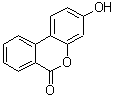 |
| Molecular Formula | C13H8O3 |
| Molecular Weight | 212.20 |
| CAS Registry Number | 1139-83-9 |
| EC Number | 808-493-1 |
| SMILES | C1=CC=C2C(=C1)C3=C(C=C(C=C3)O)OC2=O |
| Solubility | Practically insoluble (0.093 g/L) (25 °C), Calc.* |
|---|---|
| Density | 1.395±0.06 g/cm3 (20 °C 760 Torr), Calc.* |
| Melting point | 255-256 °C** |
| Index of Refraction | 1.679, Calc.* |
| Boiling Point | 432.5±24.0 °C (760 mmHg), Calc.* |
| Flash Point | 196.6±15.7 °C, Calc.* |
| * | Calculated using Advanced Chemistry Development (ACD/Labs) Software V11.02 (©1994-2017 ACD/Labs) |
| ** | Garazd, Ya. L. |
| Hazard Symbols |  GHS07 Warning Details GHS07 Warning Details | ||||||||||||||||||||
|---|---|---|---|---|---|---|---|---|---|---|---|---|---|---|---|---|---|---|---|---|---|
| Risk Statements | H302 Details | ||||||||||||||||||||
| Safety Statements | P264-P270-P301+P317-P330-P501 Details | ||||||||||||||||||||
| Hazard Classification | |||||||||||||||||||||
| |||||||||||||||||||||
| SDS | Available | ||||||||||||||||||||
 chemBlink Chemical Story
|
Urolithin B is a naturally occurring phenolic compound derived from the metabolism of ellagitannins and ellagic acid, polyphenols abundantly found in fruits like pomegranates, berries, and nuts. As a urolithin, it is formed in the human gut microbiota through enzymatic reactions. Structurally, it belongs to the class of benzocoumarins and is known for its health-promoting bioactivities. The discovery of urolithin B traces back to studies on dietary polyphenols and their biotransformation by gut bacteria. While ellagitannins and ellagic acid were already recognized for their antioxidant properties, their metabolites, particularly urolithins, gained attention in the early 2000s. Urolithin B emerged as one of the most significant compounds due to its robust biological activity, including its antioxidant, anti-inflammatory, and anti-proliferative properties. Urolithin B has shown significant promise in biomedical research, particularly for its potential role in mitigating oxidative stress and inflammation. Its antioxidant capabilities involve scavenging free radicals and upregulating endogenous antioxidant defenses, making it a candidate for managing oxidative stress-related diseases. These properties are of particular interest in conditions such as cardiovascular disease, neurodegenerative disorders, and certain cancers. In cellular studies, urolithin B exhibits anti-inflammatory activity by modulating key inflammatory pathways. It inhibits the activation of nuclear factor-kappa B (NF-κB), a transcription factor that regulates inflammatory gene expression. This mechanism underpins its potential in addressing chronic inflammatory diseases like arthritis and inflammatory bowel disease. In addition to its anti-inflammatory effects, urolithin B has been studied for its potential benefits in skeletal muscle health. Research has shown that it can enhance muscle protein synthesis and reduce protein degradation by modulating molecular pathways involved in muscle homeostasis. This has implications for aging-related muscle loss (sarcopenia) and other muscle-wasting conditions. Another area of application is cancer research. Urolithin B has demonstrated anti-proliferative effects in cancer cell lines, particularly breast and prostate cancer. Its mechanism of action involves inducing cell cycle arrest and promoting apoptosis in tumor cells, suggesting potential as an adjuvant in cancer therapy. The pharmaceutical and nutraceutical industries have recognized the potential of urolithin B for developing dietary supplements and functional foods aimed at promoting health and preventing disease. Its safety profile, derived from its natural origin and occurrence in foods, supports its use in these applications. Despite its promising bioactivities, the clinical translation of urolithin B faces challenges. Its bioavailability and metabolic variability depend on the gut microbiota composition, which can vary widely among individuals. Addressing these issues through advanced formulations or microbiome-targeted approaches is a key area of ongoing research. Urolithin B represents a significant advance in the study of dietary metabolites and their role in human health. Its diverse applications and mechanisms of action highlight its potential as a therapeutic agent in oxidative stress, inflammation, muscle health, and cancer management. References 2024. Development of metabolic signatures of plant-rich dietary patterns using plant-derived metabolites. European Journal of Nutrition. DOI: 10.1007/s00394-024-03511-x 2024. Therapeutic efficacy of gut microbiota-derived polyphenol metabolite Urolithin A. Beni-Suef University Journal of Basic and Applied Sciences. DOI: 10.1186/s43088-024-00492-y 2023. The anti-tumor effect of synthesized Urolithin B liposome on lung adenocarcinoma. Polymer Bulletin. DOI: 10.1007/s00289-023-05067-y |
| Market Analysis Reports |