
Online Database of Chemicals from Around the World
| Shenzhen Geneseqtools Bioscience & Technology Co. Ltd. | China | |||
|---|---|---|---|---|
 | geneseqtools.com | |||
 | +86 (0755) 2325-1735 | |||
 | sales@geneseqtools.com | |||
 | QQ Chat | |||
 | WeChat: 13302967066 | |||
| Chemical manufacturer since 2015 | ||||
| chemBlink Standard supplier since 2025 | ||||
| Classification | Biochemical >> Nucleoside drugs >> Deoxynucleotides and their analogues |
|---|---|
| Name | 5-Propargylamino-ddCTP |
| Synonyms | [[(2S,5R)-5-[4-amino-5-(3-aminoprop-1-ynyl)-2-oxopyrimidin-1-yl]oxolan-2-yl]methoxy-hydroxyphosphoryl] phosphono hydrogen phosphate |
| Molecular Structure | 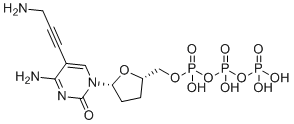 |
| Molecular Formula | C12H19N4O12P3 |
| Molecular Weight | 504.22 |
| CAS Registry Number | 114748-56-0 |
| SMILES | C1C[C@@H](O[C@@H]1COP(=O)(O)OP(=O)(O)OP(=O)(O)O)N2C=C(C(=NC2=O)N)C#CCN |
| Density | 2.1±0.1 g/cm3 Calc.* |
|---|---|
| Boiling point | 776.1±70.0 °C 760 mmHg (Calc.)* |
| Flash point | 423.2±35.7 °C (Calc.)* |
| Index of refraction | 1.725 (Calc.)* |
| * | Calculated using Advanced Chemistry Development (ACD/Labs) Software. |
 chemBlink Chemical Story
|
5-Propargylamino-2′,3′-dideoxycytidine 5′-triphosphate (5-Propargylamino-ddCTP) is a chemically modified nucleotide derivative of 2′,3′-dideoxycytidine triphosphate (ddCTP), a compound known for its chain-terminating properties in DNA synthesis. The structural modification at the 5-position of the cytosine base, where a propargylamino moiety is introduced, imparts unique chemical reactivity that is highly valuable in nucleic acid labeling and detection applications. The introduction of the propargyl group, which contains a terminal alkyne functionality, permits bioorthogonal labeling via copper(I)-catalyzed azide-alkyne cycloaddition (CuAAC), also known as click chemistry. The chemical foundation of 5-Propargylamino-ddCTP is rooted in the development of dideoxynucleotide analogs that lack the 3′-hydroxyl group necessary for the formation of phosphodiester bonds during DNA elongation. ddNTPs, including ddCTP, have been integral components in DNA sequencing methods such as Sanger sequencing. In this method, the incorporation of ddNTPs into a growing DNA strand by DNA polymerase results in chain termination, thereby enabling determination of the nucleotide sequence based on the resulting fragment lengths. The innovation of introducing a functional group into ddCTP without compromising its chain-terminating capacity was a significant milestone in expanding the utility of nucleotide analogs. The synthesis of 5-Propargylamino-ddCTP involves the site-selective substitution of the cytosine base at the 5-position with a propargylamino group, followed by phosphorylation steps to generate the corresponding triphosphate. This derivative retains sufficient substrate activity for various DNA polymerases, enabling its incorporation into DNA strands during primer extension reactions. The resulting DNA products contain the alkyne-functionalized cytosine analog at the site of incorporation, which can be selectively targeted for further chemical modification. The principal application of 5-Propargylamino-ddCTP lies in its role as a precursor for the introduction of reporter groups into DNA. Through CuAAC reactions, azide-functionalized fluorophores, biotin, or other probes can be covalently linked to the alkyne moiety of the incorporated nucleotide. This enables precise labeling of DNA molecules for visualization, detection, and quantification in a variety of experimental platforms. The use of fluorophore-azide conjugates, for instance, allows for fluorescence-based analysis of DNA synthesis, hybridization, or localization, which is especially useful in fluorescence in situ hybridization (FISH), molecular beacon assays, and other imaging-based techniques. The commercial availability of 5-Propargylamino-ddCTP has facilitated its integration into numerous molecular biology protocols. Several variants of this compound, pre-labeled with fluorescent dyes such as fluorescein (6-FAM), rhodamine (TAMRA), or cyanine derivatives (Cy3, Cy5), have been developed to provide immediate utility in applications requiring direct fluorescence detection. These fluorescently labeled analogs exhibit spectral properties suitable for use in multi-color detection assays and are compatible with standard instrumentation for fluorescence microscopy, flow cytometry, and capillary electrophoresis. In addition to its utility in DNA labeling, 5-Propargylamino-ddCTP serves as a tool in research on DNA-protein interactions, epigenetic modifications, and the study of DNA replication mechanisms. Because of its chemical reactivity and compatibility with standard DNA polymerases, it is also employed in experimental strategies designed to investigate nucleotide incorporation specificity, termination efficiency, and polymerase kinetics. The discovery and development of 5-Propargylamino-ddCTP represent a convergence of synthetic organic chemistry and nucleic acid biochemistry. It exemplifies the strategic design of modified nucleotides that retain biological function while introducing chemically reactive handles. The compound has become a valuable component of the molecular biology toolkit, supporting advancements in nucleic acid research, diagnostics, and molecular imaging. |
| Market Analysis Reports |