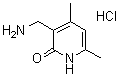
3-(Aminomethyl)-4,6-dimethyl-2(1H)-pyridinone hydrochloride is a member of the 2-pyridinone family of heterocyclic compounds, a group known for their stability, chelating ability, and versatility as intermediates in organic and medicinal chemistry. The compound consists of a pyridinone ring bearing two methyl groups and an aminomethyl substituent, and it is commonly handled in the form of its hydrochloride salt to improve stability and solubility in aqueous media. Its structure places it within a class of molecules that have long been investigated for roles in coordination chemistry, as building blocks for bioactive derivatives, and as key intermediates in synthetic pathways where functionalized heterocycles are required.
The discovery of pyridinone derivatives dates back to work in the early twentieth century, when substituted pyridines and their oxygenated analogues began to attract attention for their tautomeric behavior and reactivity under mild conditions. Over the following decades, the 2-pyridinone framework became a focus due to its capacity to participate in hydrogen bonding and metal binding, leading to its use in the development of ligands and chelators. Within this broader class, substituted 2-pyridinones with electron-donating groups were particularly valued for enhanced binding properties and predictable reactivity in substitution and condensation reactions. Though 3-(aminomethyl)-4,6-dimethyl-2(1H)-pyridinone hydrochloride itself does not appear in early foundational studies, it belongs to a lineage of compounds derived from this well-established chemistry.
Applications of the compound are tied mainly to its status as a functionalized heterocyclic intermediate. The aminomethyl group provides a convenient handle for further derivatization, enabling amide formation, reductive alkylation, and coupling reactions widely used in both small-molecule and polymer chemistry. The dimethyl-substituted pyridinone core offers steric and electronic properties useful for the design of ligands with controlled donor characteristics. Because the pyridinone ring can coordinate to a variety of metal centers, derivatives of this class have been used in exploring catalytic systems, including transition-metal complexes employed in hydrogenation, cross-coupling, and selective oxidation reactions. Although the specific compound described here is not itself a widely used ligand, its structural features are consistent with those used to generate analogues for such research.
In medicinal chemistry, 2-pyridinone derivatives have been investigated for antibacterial, antiviral, and enzyme-inhibitory activity, largely due to the ring’s resemblance to naturally occurring heterocycles that interact with biological targets. The incorporation of an aminomethyl substituent often enhances water solubility and can improve binding affinity in biological assays. Compounds bearing this type of modification have been studied as intermediates in the synthesis of drug candidates, particularly in the context of designing molecules capable of interacting with nucleotide-processing enzymes or metal-dependent proteins. While no specific therapeutic role has been documented for 3-(aminomethyl)-4,6-dimethyl-2(1H)-pyridinone hydrochloride itself in the peer-reviewed literature, its structural class has supported a broad range of research into bioactive heterocycles.
The hydrochloride salt form plays an important role in laboratory handling. Pyridinone derivatives containing primary amines often exhibit variable solubility depending on pH, and forming the hydrochloride enables easier purification, crystallization, and long-term storage. This form also facilitates its use in aqueous reaction systems and in analytical studies, where consistent ionic composition is required. Hydrochloride salts of aminomethyl heterocycles have traditionally been selected for stability during transport and for reproducibility in kinetic or mechanistic studies.
Because the compound incorporates both nucleophilic and electrophilic functional groups, it participates readily in transformations such as acylation, alkylation, and condensation with carbonyl-containing species. These properties make it valuable in multistep synthetic sequences where heterocycles are expanded, rearranged, or used as scaffolds for more complex targets. Its compatibility with standard protecting-group strategies further supports its use in contemporary organic synthesis.
|




 GHS07 Warning Details
 chemBlink Chemical Story