
Online Database of Chemicals from Around the World
| CAS: 117528-65-1 Product: 7-Chloro-8-cyano-1-cyclopropyl-6-fluoro-4-oxo-1,4-dihydroquinoline-3-carboxylic acid No suppliers available. |
| Classification | Pharmaceutical intermediate >> Heterocyclic compound intermediate >> Quinoline compound |
|---|---|
| Name | 7-Chloro-8-cyano-1-cyclopropyl-6-fluoro-4-oxo-1,4-dihydroquinoline-3-carboxylic acid |
| Molecular Structure | 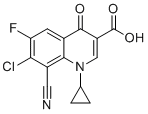 |
| Molecular Formula | C14H8ClFN2O3 |
| Molecular Weight | 306.68 |
| CAS Registry Number | 117528-65-1 |
| EC Number | 810-133-3 |
| SMILES | C1CC1N2C=C(C(=O)C3=CC(=C(C(=C32)C#N)Cl)F)C(=O)O |
| Solubility | 152.1 mg/L (25 °C water) |
|---|---|
| Density | 1.7±0.0 g/cm3, Calc.* |
| Index of Refraction | 1.684, Calc.* |
| Melting point | 192.31 °C |
| Boiling Point | 456.56 °C, 540.0±0.0 °C (760 mmHg), Calc.* |
| Flash Point | 280.4±0.0 °C, Calc.* |
| * | Calculated using Advanced Chemistry Development (ACD/Labs) Software. |
| Hazard Symbols |  GHS02 Warning Details GHS02 Warning Details | ||||||||||||
|---|---|---|---|---|---|---|---|---|---|---|---|---|---|
| Risk Statements | H228-H252 Details | ||||||||||||
| Safety Statements | P210-P235-P240-P241-P280-P370+P378-P407-P410-P413-P420 Details | ||||||||||||
| Hazard Classification | |||||||||||||
| |||||||||||||
 chemBlink Chemical Story
|
7-Chloro-8-cyano-1-cyclopropyl-6-fluoro-4-oxo-1,4-dihydroquinoline-3-carboxylic acid is a synthetic compound belonging to the fluoroquinolone class of antibiotics. This class is characterized by a bicyclic quinoline core substituted with a fluorine atom, which enhances antibacterial activity and pharmacokinetic properties. The compound represents a structurally advanced quinolone derivative and is related to the core pharmacophores used in the design of potent antimicrobial agents. The structure of this molecule incorporates several key features typical of second-generation fluoroquinolones. The cyclopropyl group at the N-1 position is known to enhance Gram-positive antibacterial activity and improve oral bioavailability. The fluorine atom at the 6-position increases lipophilicity, aiding in cell penetration and enhancing potency against a broad spectrum of bacterial pathogens. The 7-chloro substituent is relatively uncommon in fluoroquinolones but contributes to the fine-tuning of pharmacological activity, particularly in modulating efflux pump recognition and target binding affinity. The 8-cyano group adds an electron-withdrawing feature that influences the compound’s photostability and potentially reduces phototoxicity compared to other analogues. The 3-carboxylic acid and 4-oxo groups are essential for DNA gyrase and topoisomerase IV inhibition, which is the primary mechanism of antibacterial action for quinolones. The synthesis of 7-chloro-8-cyano-1-cyclopropyl-6-fluoro-4-oxo-1,4-dihydroquinoline-3-carboxylic acid typically involves the cyclization of substituted anilines with ethyl acetoacetate derivatives followed by electrophilic fluorination, chlorination, nitrile introduction, and installation of the cyclopropyl ring. Such synthetic routes are common in medicinal chemistry laboratories exploring new quinolone antibiotics with modified side chains to overcome resistance and improve drug-like properties. Although this specific compound is not widely marketed as a standalone drug, it serves as a valuable intermediate or structural motif in the discovery and development of experimental fluoroquinolone candidates. Structural analogues with similar substitutions have shown efficacy in preclinical models against both Gram-positive and Gram-negative pathogens, including resistant strains of *Escherichia coli*, *Pseudomonas aeruginosa*, *Klebsiella pneumoniae*, *Staphylococcus aureus*, and *Streptococcus pneumoniae*. The compound may also be used in SAR (structure–activity relationship) studies to probe the impact of different substituents on the biological activity and physicochemical properties of quinolone antibiotics. In terms of pharmacological application, compounds of this type are typically intended for the treatment of infections such as urinary tract infections, respiratory tract infections, skin and soft tissue infections, and gastrointestinal infections. However, the presence of a nitrile group at the 8-position also suggests attention to mitigating phototoxic effects, which are common with earlier fluoroquinolones like lomefloxacin and sparfloxacin. Research into analogues of this compound may further lead to the discovery of new-generation antibiotics capable of combating multidrug-resistant bacteria. The optimization of such molecules focuses on increasing the binding affinity to bacterial DNA gyrase and topoisomerase IV, enhancing cell permeability, reducing susceptibility to bacterial efflux mechanisms, and improving metabolic stability. This compound exemplifies the strategic modifications used in quinolone development to enhance spectrum of activity, reduce adverse effects, and improve resistance profiles, reflecting ongoing medicinal chemistry efforts to extend the therapeutic utility of this important class of antibiotics. References 2020. Synthetic Approaches to Contemporary Drugs that Contain the Cyclopropyl Moiety. Synthesis. DOI: 10.1055/s-0039-1690058 2016. Finafloxacin. Pharmaceutical Substances. URL: https://pharmaceutical-substances.thieme.com/ps/search-results?docUri=KD-06-0134 |
| Market Analysis Reports |