
Online Database of Chemicals from Around the World
| Wuhan Kemi-works Chemical Co., Ltd. | China | |||
|---|---|---|---|---|
 | www.kemiworks.net | |||
 | +86 (27) 8573-6489 | |||
 | +86 (27) 8573-6485 | |||
 | info@kemiworks.net sales@kemiworks.com | |||
| Chemical manufacturer | ||||
| chemBlink Premium supplier since 2011 | ||||
| Classification | Catalysts and additives >> Antioxidant |
|---|---|
| Name | 4,4'-Methylenebis(2,6-di-tert-butylphenol) |
| Synonyms | 3,3',5,5'-Tetra-tert-butyl-4,4'-dihydroxydiphenylmethane; Antioxidant 702 |
| Molecular Structure | 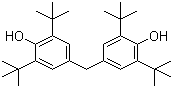 |
| Molecular Formula | C29H44O2 |
| Molecular Weight | 424.67 |
| CAS Registry Number | 118-82-1 |
| EC Number | 204-279-1 |
| SMILES | CC(C)(C)C1=CC(=CC(=C1O)C(C)(C)C)CC2=CC(=C(C(=C2)C(C)(C)C)O)C(C)(C)C |
| Density | 1.0±0.1 g/cm3 Calc.* |
|---|---|
| Melting point | 155 - 159 °C (Expl.) |
| Boiling point | 459.5±40.0 °C 760 mmHg (Calc.)*, 439.9 °C (Expl.) |
| Flash point | 178.1±21.9 °C (Calc.)* |
| Index of refraction | 1.527 (Calc.)* |
| * | Calculated using Advanced Chemistry Development (ACD/Labs) Software. |
| Hazard Symbols |  GHS07 Warning Details GHS07 Warning Details | ||||||||||||||||||||||||||||
|---|---|---|---|---|---|---|---|---|---|---|---|---|---|---|---|---|---|---|---|---|---|---|---|---|---|---|---|---|---|
| Risk Statements | H315-H319-H413 Details | ||||||||||||||||||||||||||||
| Safety Statements | P264-P273-P280-P302+P352+P332+P313+P362+P364-P305+P351+P338+P337+P313-P501 Details | ||||||||||||||||||||||||||||
| Hazard Classification | |||||||||||||||||||||||||||||
| |||||||||||||||||||||||||||||
| SDS | Available | ||||||||||||||||||||||||||||
 chemBlink Chemical Story
|
4,4'-Methylenebis(2,6-di-tert-butylphenol) is a sterically hindered bisphenol antioxidant widely used in industrial and polymer chemistry. This compound consists of two 2,6-di-tert-butylphenol groups linked through a central methylene bridge, giving it a symmetrical and bulky structure. It is typically classified among the phenolic antioxidants and is sometimes referred to by its commercial names or identifiers, such as antioxidant 2246 or AO 2246. The discovery and use of hindered phenols as stabilizers began in the mid-20th century as researchers sought efficient compounds to protect materials—especially polymers—from degradation caused by heat, oxygen, and light. The incorporation of large tert-butyl groups at the ortho positions of the phenol rings in 4,4'-methylenebis(2,6-di-tert-butylphenol) greatly enhances its stability and antioxidant performance. These bulky groups hinder the approach of reactive species to the phenolic hydroxyl, making the compound highly resistant to oxidative degradation itself while still able to donate hydrogen atoms to stabilize free radicals. One of the key applications of this compound is as a stabilizer in plastics and rubber, including polyethylene, polypropylene, synthetic rubbers, and elastomers. Its primary function is to act as a free-radical scavenger, interrupting the radical chain reactions that lead to oxidative degradation of the polymer chains. This improves the thermal and oxidative stability of the material, extending its useful life and preserving its physical properties such as flexibility, color, and tensile strength. In addition to its widespread use in polymer stabilization, 4,4'-methylenebis(2,6-di-tert-butylphenol) has also been employed in lubricants, adhesives, and fuel additives. Its antioxidant properties help prevent the formation of sludge and varnish in engine oils and fuels by inhibiting the oxidation of hydrocarbons during high-temperature operation. It is also used in waxes, greases, and resins where long-term oxidative resistance is required. The compound’s structure also imparts some UV stabilizing properties, though it is generally not used as a primary UV absorber. It can, however, be used in combination with other stabilizers, including phosphites and benzotriazoles, to create synergistic effects that enhance overall protection of materials against environmental stressors. From a synthetic standpoint, 4,4'-methylenebis(2,6-di-tert-butylphenol) is prepared through the condensation of two equivalents of 2,6-di-tert-butylphenol with formaldehyde under acidic conditions. This process results in the formation of a methylene bridge connecting the two phenolic units at their para positions. The synthesis is relatively straightforward and efficient, contributing to the commercial viability and widespread availability of the compound. Toxicological and environmental evaluations of this compound have been conducted to assess its safety in various applications. While it is considered effective and relatively stable, concerns over its persistence and potential bioaccumulation in the environment have led to research into alternative, more biodegradable antioxidants in some applications. Nonetheless, it remains an important material in sectors where durability and resistance to oxidative breakdown are critical. Overall, 4,4'-methylenebis(2,6-di-tert-butylphenol) represents a key development in the field of antioxidant chemistry, combining steric hindrance and reactive phenolic functionality to protect a wide range of materials from oxidative damage. Its synthesis, structural features, and broad utility underscore its importance in both industrial applications and the evolution of stabilizer technology. References 2003. Antioxidant Activity of o-Bisphenols: the Role of Intramolecular Hydrogen Bonding. The Journal of Organic Chemistry. DOI: 10.1021/jo0342931 2011. Natural and Synthetic Antioxidant Additives for Improving the Performance of New Biolubricant Formulations. Journal of Agricultural and Food Chemistry. DOI: 10.1021/jf2035737 2015. Voltammetric determination of antioxidant 4,4'-methylenebis(2,6-di-tert-butylphenol) in lubricating oils using gold disc electrode. Monatshefte für Chemie - Chemical Monthly. DOI: 10.1007/s00706-015-1562-0 |
| Market Analysis Reports |