
Online Database of Chemicals from Around the World
| Shanghai Tensus Biotech Co., Ltd. | China | |||
|---|---|---|---|---|
 | www.tqbio.net | |||
 | +86 18616507272 | |||
 | +86 (21) 5089-5067 | |||
 | tensus@163.com | |||
| Chemical distributor since 2014 | ||||
| chemBlink Standard supplier since 2018 | ||||
| Fenhe Chemical Co., Ltd. | China | |||
|---|---|---|---|---|
| www.fenhechem.com | |||
| +86 (021) 3392-6068 | |||
| julius.wei@fenhechem.com | |||
| Chemical manufacturer since 1997 | ||||
| chemBlink Standard supplier since 2024 | ||||
| Classification | Natural product >> Natural phenols |
|---|---|
| Name | Tetra(4-hydroxyphenyl)ethylene |
| Synonyms | 4,4',4'',4'''-(1,2-Ethenediylidene)tetrakis[phenol] |
| Molecular Structure | 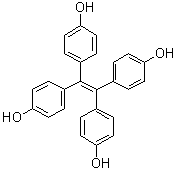 |
| Molecular Formula | C26H20O4 |
| Molecular Weight | 396.43 |
| CAS Registry Number | 119301-59-6 |
| SMILES | C1=CC(=CC=C1C(=C(C2=CC=C(C=C2)O)C3=CC=C(C=C3)O)C4=CC=C(C=C4)O)O |
| Solubility | Insoluble (3.3E-3 g/L) (25 °C), Calc.* |
|---|---|
| Density | 1.324±0.06 g/cm3 (20 °C 760 Torr), Calc.* |
| * | Calculated using Advanced Chemistry Development (ACD/Labs) Software V11.02 (©1994-2018 ACD/Labs) |
| Hazard Symbols |  GHS07 Warning Details GHS07 Warning Details |
|---|---|
| Risk Statements | H302-H315-H319-H335 Details |
| Safety Statements | P261-P305+P351+P338 Details |
| SDS | Available |
 chemBlink Chemical Story
|
Tetra(4-hydroxyphenyl)ethylene, commonly known as THPE, is a fascinating organic compound that has garnered significant attention in the fields of materials science and organic chemistry. This compound is characterized by its unique structure, featuring four hydroxyphenyl groups attached to an ethylene backbone. Its discovery and subsequent applications have paved the way for advancements in various areas, including organic electronics and photonics. The discovery of THPE can be traced back to research focused on phenolic compounds and their derivatives. Scientists have long been interested in the synthesis of polyfunctional organic compounds due to their potential applications in materials science. The introduction of hydroxy groups into the phenyl rings enhances the compound’s properties, making it an attractive candidate for various applications. One of the most notable applications of THPE lies in the development of organic light-emitting diodes (OLEDs). OLEDs are semiconductor devices that emit light in response to an electric current, and THPE has been identified as a promising material for use in these devices. Its strong photoluminescence properties, combined with its ability to form stable thin films, make it suitable for use as an emissive layer in OLEDs. Researchers have found that incorporating THPE into OLED designs can significantly improve the efficiency and color purity of the emitted light, paving the way for advancements in display technologies. Additionally, THPE has shown potential in the field of organic photovoltaics (OPVs). OPVs are solar cells that utilize organic materials to convert sunlight into electricity. The incorporation of THPE into the active layer of these cells can enhance their light absorption and charge transport properties, leading to improved energy conversion efficiency. As the demand for renewable energy sources continues to grow, materials like THPE that enhance the performance of OPVs are of great interest to researchers and manufacturers alike. Beyond its applications in electronics and energy, THPE is also being explored for its potential in biomedical fields. The compound's hydroxyl groups may facilitate interactions with biological molecules, making it a candidate for drug delivery systems or as a scaffold for tissue engineering. The ability to modify its structure further opens up possibilities for tailoring its properties for specific biomedical applications. In summary, tetra(4-hydroxyphenyl)ethylene is a versatile compound with significant implications in various fields, particularly in materials science and organic electronics. Its unique properties make it an exciting area of research for developing next-generation technologies, from efficient light-emitting devices to renewable energy solutions. As studies continue to uncover its potential, THPE stands as a testament to the innovative spirit of modern chemistry. References 2010. Fluorescence Turn-On Sensing of Lectins with Mannose-Substituted Tetraphenylethenes Based on Aggregation-Induced Emission. Chemistry - An Asian Journal. DOI: 10.1002/asia.200900430 2011. Tetraphenylethylene-based Glycoconjugate as a Fluorescence “Turn-On” Sensor for Cholera Toxin. Chemistry - An Asian Journal. DOI: 10.1002/asia.201100141 2019. Aggregation Induced Emission (AIE) Effect Based on Fluorescent Amino-Siloxane Copolymers. Journal of Inorganic and Organometallic Polymers and Materials. DOI: 10.1007/s10904-019-01344-4 |
| Market Analysis Reports |