
Online Database of Chemicals from Around the World
| BOC Sciences | USA | |||
|---|---|---|---|---|
 | www.bocsci.com | |||
 | +1 (631) 485-4226 | |||
 | +1 (631) 614-7828 | |||
 | info@bocsci.com | |||
| Chemical manufacturer | ||||
| chemBlink Standard supplier since 2010 | ||||
| Shanghai Hohance Chemical Co., Ltd. | China | |||
|---|---|---|---|---|
| www.hohance.com | |||
| +86 (21) 3111-5312 | |||
| +86 (21) 3111-5317 | |||
| info@hohance.com | |||
| Chemical manufacturer | ||||
| chemBlink Standard supplier since 2011 | ||||
| Ningbo NFC Chemical Co., Ltd. | China | |||
|---|---|---|---|---|
| www.nfcchem.com | |||
| +86 (574) 8799-1182 | |||
| +86 (574) 8799-1185 | |||
| sales@nfcchem.com | |||
 | QQ Chat | |||
| Chemical distributor since 2013 | ||||
| chemBlink Standard supplier since 2013 | ||||
| Hangzhou Leap Chem Co., Ltd. | China | |||
|---|---|---|---|---|
| www.leapchem.com | |||
| +86 (571) 8771-1850 | |||
| market19@leapchem.com | |||
| QQ Chat | |||
| Chemical manufacturer since 2006 | ||||
| chemBlink Standard supplier since 2015 | ||||
| Finetech Industry Limited | China | |||
|---|---|---|---|---|
| www.finetechchem.com | |||
| +86 (27) 8746-5837 +86 18971612321 | |||
| +86 (27) 8777-2287 | |||
| sales@finetechnology-ind.com | |||
| QQ Chat | |||
| Chemical manufacturer since 2009 | ||||
| chemBlink Standard supplier since 2019 | ||||
| Hangzhou Loop Biotech Co., Ltd. | China | |||
|---|---|---|---|---|
| www.looppharm.com | |||
| +86 (0571) 8526-0761 | |||
| sales01@looppharm.com | |||
| QQ Chat | |||
| Chemical manufacturer since 2015 | ||||
| chemBlink Standard supplier since 2023 | ||||
| Hangzhou Zentra Bio-Chemical Co., Ltd. | China | |||
|---|---|---|---|---|
| www.zentrachem.com | |||
| +86 18321999949 | |||
| steven@zentrachem.com | |||
| QQ Chat | |||
 | WeChat: Hangzhou Zentra Bio-Chemical Co., Ltd. | |||
| Chemical distributor since 2025 | ||||
| chemBlink Standard supplier since 2025 | ||||
| Wako Pure Chemical Industries, Ltd. | Japan | |||
|---|---|---|---|---|
| www.wako-chem.co.jp | |||
| +81 (6) 6203-3741 | |||
| +81 (6) 6201-5964 | |||
| wkhk.info@fujifilm.com | |||
| Chemical manufacturer since 1922 | ||||
| Kingchem Inc. | USA | |||
|---|---|---|---|---|
| www.kingchem.com | |||
| +1 (800) 211-4330 (201) 825-9988 | |||
| +1 (201) 825-9148 | |||
| customer-service@kingchem.com | |||
| Chemical manufacturer since 1994 | ||||
| Classification | Organic raw materials >> Heterocyclic compound >> Pyrroles |
|---|---|
| Name | 4-Phenyl-2-pyrrolidinone |
| Molecular Structure | 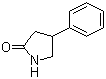 |
| Molecular Formula | C10H11NO |
| Molecular Weight | 161.20 |
| CAS Registry Number | 1198-97-6 |
| EC Number | 842-165-9 |
| SMILES | C1C(CNC1=O)C2=CC=CC=C2 |
| Density | 1.1±0.1 g/cm3 Calc.* |
|---|---|
| Boiling point | 362.3±31.0 °C 760 mmHg (Calc.)* |
| Flash point | 212.4±9.8 °C (Calc.)* |
| Index of refraction | 1.551 (Calc.)* |
| * | Calculated using Advanced Chemistry Development (ACD/Labs) Software. |
| Hazard Symbols |  GHS07 Warning Details GHS07 Warning Details | ||||||||||||||||
|---|---|---|---|---|---|---|---|---|---|---|---|---|---|---|---|---|---|
| Risk Statements | H315-H319-H335 Details | ||||||||||||||||
| Safety Statements | P261-P264-P264+P265-P271-P280-P302+P352-P304+P340-P305+P351+P338-P319-P321-P332+P317-P337+P317-P362+P364-P403+P233-P405-P501 Details | ||||||||||||||||
| Hazard Classification | |||||||||||||||||
| |||||||||||||||||
| SDS | Available | ||||||||||||||||
 chemBlink Chemical Story
|
4-Phenyl-2-pyrrolidinone is an organic compound with the molecular formula C10H11NO. It features a five-membered lactam ring known as a pyrrolidinone, substituted at the 4-position with a phenyl group. Structurally, it consists of a 2-pyrrolidinone (a cyclic amide) core with an aromatic phenyl ring attached to the fourth carbon, creating a molecule that combines both hydrophilic and hydrophobic properties. The compound belongs to the class of N-substituted γ-lactams, which are important motifs in both synthetic and medicinal chemistry. 2-Pyrrolidinone itself is a well-known scaffold found in various natural and synthetic compounds, and the introduction of a phenyl group at the 4-position significantly alters its chemical and biological properties. This modification increases the compound’s lipophilicity and allows for π-π interactions, enhancing its potential to interact with biological targets. 4-Phenyl-2-pyrrolidinone can be synthesized via different routes. One common method involves the cyclization of 4-phenylbutyric acid derivatives with ammonia or amines under dehydrating conditions. Another approach is through the reaction of phenylsuccinic anhydride with ammonia or primary amines, forming the lactam ring in a single step. Additionally, reductive amination and catalytic hydrogenation strategies have also been reported for preparing derivatives of this compound. This compound has been studied for its pharmacological potential. Structurally similar pyrrolidinones have demonstrated a variety of biological activities, including nootropic (cognitive-enhancing), anticonvulsant, and anxiolytic effects. While 4-phenyl-2-pyrrolidinone itself is not an approved drug, it serves as a key intermediate in the synthesis of bioactive molecules and pharmaceuticals. In particular, its analogs have been explored as modulators of the central nervous system, due to their ability to cross the blood-brain barrier and influence neurotransmitter systems. One of the most closely related drug classes includes the racetam family, such as piracetam and phenylpiracetam, which are derivatives of 2-pyrrolidinone. These compounds have been studied for improving cognitive function, memory, and learning, though their clinical efficacy remains under discussion. The presence of the phenyl ring in 4-phenyl-2-pyrrolidinone contributes to its potential binding affinity for neurological receptors and enzymes, providing a structural basis for further pharmacological investigation. In synthetic chemistry, 4-phenyl-2-pyrrolidinone is a versatile intermediate used in the construction of more complex heterocyclic frameworks. The carbonyl group on the pyrrolidinone ring is reactive toward nucleophilic substitution and condensation reactions, allowing the molecule to participate in a variety of synthetic transformations. It can also be functionalized at the phenyl ring or further modified at the nitrogen atom to introduce additional groups, expanding its utility in medicinal chemistry. The compound can be characterized using standard analytical techniques. Proton nuclear magnetic resonance (²H NMR) shows signals corresponding to the pyrrolidinone ring protons and the aromatic phenyl group. Carbon-13 NMR (³C NMR) displays distinct peaks for the amide carbonyl carbon, aromatic carbons, and the aliphatic backbone. Infrared (IR) spectroscopy reveals characteristic amide C=O stretching near 1650 cm−1, while mass spectrometry confirms the molecular weight and fragmentation pattern. 4-Phenyl-2-pyrrolidinone is typically a solid at room temperature and may be soluble in common organic solvents such as ethanol, methanol, acetone, and dimethylformamide (DMF). Due to its cyclic amide structure, it displays moderate polarity and can form hydrogen bonds, affecting its solubility and crystal properties. In summary, 4-phenyl-2-pyrrolidinone is a synthetically and pharmacologically relevant compound that serves as an intermediate and structural scaffold in the development of central nervous system agents and other bioactive molecules. Its combination of a stable lactam ring and an aromatic substituent contributes to both its chemical reactivity and potential biological function. References 2023. The Antidepressant Activity of a Taurine-Containing Derivative of 4-Phenylpyrrolidone-2 in a Model of Chronic Unpredictable Mild Stress. International Journal of Molecular Sciences, 24(23). DOI: 10.3390/ijms242316564 2023. Baclofen and 4-Phenylpyrrolidone Derivative GIZH-290 Attenuates Compulsive-Like Behavior in Mice. Journal of Evolutionary Biochemistry and Physiology, 59(6). DOI: 10.1134/s0022093023060352 2019. Synthesis of 4-Phenylpyrrolidone Derivatives with Anticonvulsant and Nootropic Activity. Pharmaceutical Chemistry Journal, 53(6). DOI: 10.1007/s11094-019-02015-x |
| Market Analysis Reports |