
Online Database of Chemicals from Around the World
| E-fine Bio Technology Co., Ltd. | China | |||
|---|---|---|---|---|
 | www.efine-bio.com | |||
 | +86 15251778053 | |||
 | William.efine@hotmail.com | |||
| Chemical manufacturer since 2021 | ||||
| chemBlink Standard supplier since 2022 | ||||
| Pure Bio Medical Jiangsu Ltd. | China | |||
|---|---|---|---|---|
| www.purejs.cn | |||
| +86 (025) 8560-7383 | |||
| jiangziwei@purejs.cn | |||
| Chemical manufacturer since 2019 | ||||
| chemBlink Standard supplier since 2026 | ||||
| Classification | API >> Other chemicals |
|---|---|
| Name | Etrasimod |
| Synonyms | (R)-2-(7-(4-cyclopentyl-3-(trifluoromethyl)benzyloxy)-1,2,3,4-tetrahydrocyclopenta[b]indol-3-yl)acetic acid; APD 334 |
| Molecular Structure | 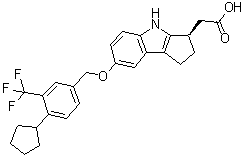 |
| Molecular Formula | C26H26F3NO3 |
| Molecular Weight | 457.48 |
| CAS Registry Number | 1206123-37-6 |
| SMILES | C1CCC(C1)C2=C(C=C(C=C2)COC3=CC4=C(C=C3)NC5=C4CC[C@@H]5CC(=O)O)C(F)(F)F |
| Solubility | Insoluble (8.2E-5 g/L) (25 °C), Calc.* |
|---|---|
| Density | 1.326±0.06 g/cm3 (20 °C 760 Torr), Calc.* |
| Boiling point | 621.4±50.0 °C 760 mmHg (Calc.)* |
| Flash point | 329.6±30.1 °C (Calc.)* |
| Index of refraction | 1.606 (Calc.)* |
| * | Calculated using Advanced Chemistry Development (ACD/Labs) Software. |
| Hazard Symbols |  GHS07 Warning Details GHS07 Warning Details |
|---|---|
| Risk Statements | H302-H315-H319-H335 Details |
| Safety Statements | P261-P305+P351+P338 Details |
| SDS | Available |
 chemBlink Chemical Story
|
Etrasimod is a synthetic, small-molecule drug developed as a selective modulator of sphingosine-1-phosphate (S1P) receptors. Its mechanism of action targets immune cell trafficking by binding specifically to the S1P1, S1P4, and S1P5 subtypes, leading to internalization and functional antagonism of these receptors. This action prevents lymphocytes from exiting lymphoid tissues, thereby reducing their presence in systemic circulation. The immunomodulatory effect is therapeutically beneficial in chronic inflammatory diseases where lymphocyte infiltration into affected tissues exacerbates pathology. The compound was developed through medicinal chemistry efforts that followed the successful application of earlier S1P receptor modulators such as fingolimod. Compared to fingolimod, which is a non-selective S1P modulator requiring phosphorylation for activity and has broader receptor engagement, etrasimod was designed to offer improved selectivity, oral bioavailability, and a more favorable safety profile. It avoids action on the S1P3 receptor, which is associated with cardiac adverse effects, making it more suitable for long-term use in autoimmune conditions. Etrasimod was discovered by Arena Pharmaceuticals, a biotechnology company focused on small-molecule therapeutics. Preclinical development showed that etrasimod had promising pharmacokinetic properties, including oral absorption and a suitable half-life for once-daily dosing. The compound entered clinical development for a variety of immune-mediated inflammatory diseases, such as ulcerative colitis, Crohn’s disease, atopic dermatitis, and eosinophilic esophagitis. Among these, its most advanced indication is ulcerative colitis, a chronic inflammatory bowel disease characterized by mucosal inflammation of the colon and rectum. In clinical trials, etrasimod demonstrated significant efficacy in reducing disease activity in patients with moderate-to-severe ulcerative colitis. The reduction in lymphocyte counts was dose-dependent and reversible upon cessation of therapy, indicating that its effects could be tightly controlled. The compound improved both clinical remission and endoscopic outcomes compared to placebo, supporting its use as an oral alternative to biologics or steroids that are commonly used in such diseases. The favorable selectivity profile of etrasimod was a key factor in its advancement. It spares S1P2 and S1P3 receptor subtypes, thus avoiding common adverse effects such as bradycardia and hypertension. Clinical data confirmed a favorable safety and tolerability profile, with manageable side effects such as mild infections, nasopharyngitis, and elevated liver enzymes. Importantly, the compound did not require a dose titration regimen, in contrast to some other S1P modulators that need to gradually reach therapeutic levels to avoid cardiovascular risks. In 2021, Pfizer acquired Arena Pharmaceuticals and, with it, the rights to develop and commercialize etrasimod. This acquisition highlighted the pharmaceutical industry's strong interest in targeted immunomodulators for chronic diseases. Etrasimod represents a new generation of S1P modulators optimized for safety and efficacy, and its development has encouraged further exploration of selective S1P receptor engagement as a therapeutic strategy. Besides ulcerative colitis, etrasimod is being investigated in other inflammatory diseases, including Crohn’s disease and dermatologic conditions such as atopic dermatitis and alopecia areata. Its mode of action, which reduces circulating effector immune cells while sparing innate immunity, suggests a broad potential for conditions driven by adaptive immune dysregulation. As of now, etrasimod has emerged as a promising addition to the therapeutic arsenal against autoimmune and inflammatory diseases. Its development underscores the importance of receptor subtype selectivity in designing safer and more effective immunotherapies. References 2014. Discovery of APD334: Design of a Clinical Stage Functional Antagonist of the Sphingosine-1-phosphate-1 Receptor. ACS Medicinal Chemistry Letters, 5(12). DOI: 10.1021/ml500389m 2024. Etrasimod: First Approval. Drugs, 84(2). DOI: 10.1007/s40265-024-01997-7 2024. Design and synthesis of etrasimod derivatives as potent antibacterial agents against Gram-positive bacteria. European Journal of Medicinal Chemistry, 263. DOI: 10.1016/j.ejmech.2023.115921 |
| Market Analysis Reports |