
Online Database of Chemicals from Around the World
| wuhan chemi Pharmacy Chemical Technology Co., Ltd. | China | |||
|---|---|---|---|---|
 | www.chemipharm.com.cn | |||
 | +86 13971619949 | |||
 | gmn424@chemipharm.com.cn | |||
 | QQ Chat | |||
 | WeChat: 13971619949 | |||
| Chemical manufacturer since 2014 | ||||
| chemBlink Standard supplier since 2026 | ||||
| Classification | Organic raw materials >> Heterocyclic compound |
|---|---|
| Name | N-Iodomorpholine hydriodide |
| Synonyms | 4-iodomorpholine hydroiodide |
| Molecular Structure | 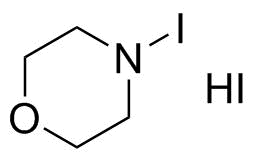 |
| Molecular Formula | C4H9I2NO |
| Molecular Weight | 340.93 |
| CAS Registry Number | 120972-13-6 |
| EC Number | 662-883-4 |
| SMILES | C1COCCN1I.I |
| Melting point | 92 - 96 °C (Expl.) |
|---|---|
| Hazard Symbols |  GHS07 Warning Details GHS07 Warning Details | ||||||||||||||||
|---|---|---|---|---|---|---|---|---|---|---|---|---|---|---|---|---|---|
| Risk Statements | H315-H319-H335 Details | ||||||||||||||||
| Safety Statements | P261-P264-P264+P265-P271-P280-P302+P352-P304+P340-P305+P351+P338-P319-P321-P332+P317-P337+P317-P362+P364-P403+P233-P405-P501 Details | ||||||||||||||||
| Hazard Classification | |||||||||||||||||
| |||||||||||||||||
| SDS | Available | ||||||||||||||||
 chemBlink Chemical Story
|
N-Iodomorpholine hydriodide is an organic iodine-containing salt derived from morpholine, a six-membered heterocyclic compound containing both oxygen and nitrogen atoms. The structure consists of a morpholine ring in which the nitrogen atom is substituted with iodine, forming an N-iodoamine functionality, and the compound exists as a hydriodide salt. Compounds of this type belong to the broader class of N-haloamines, which have been studied in organic chemistry for their oxidative and halogen-transfer properties. The chemistry of N-haloamines, including N-iodo derivatives, developed significantly during the twentieth century as researchers explored electrophilic halogen sources for organic synthesis. It was found that nitrogen-bound halogens could act as transferable electrophilic species under suitable conditions, enabling selective halogenation reactions that were difficult to achieve using molecular halogens alone. Morpholine-based N-halo compounds were among the heterocyclic systems investigated because morpholine offers a stable ring structure with a balanced combination of nucleophilicity and resistance to decomposition. N-Iodomorpholine hydriodide is typically generated through the reaction of morpholine or its protonated form with iodine under controlled conditions, often in the presence of hydrogen iodide. The resulting species is stabilized in salt form as a hydriodide, which can influence its handling and reactivity. N-iodoamines are generally considered relatively reactive and can undergo decomposition or disproportionation depending on temperature, solvent, and pH conditions. The hydriodide form provides ionic stabilization that can improve storage and isolation compared with neutral N-iodo species. The primary significance of N-iodo morpholine derivatives lies in their role as electrophilic iodine transfer reagents. In organic synthesis, such compounds can serve as sources of “I+” equivalents, enabling iodination of nucleophilic substrates. The N–I bond is relatively weak compared with typical covalent bonds, which allows iodine to be transferred to other molecules. This property has made N-haloamines useful in halogenation chemistry, particularly in reactions requiring mild and selective conditions. Morpholine-based N-iodo compounds have been investigated in the context of organic iodination reactions, including the functionalization of activated aromatic systems, alkenes, and enolizable carbonyl compounds. In such processes, the reagent acts as an electrophilic iodine donor, facilitating substitution reactions without the need for molecular iodine or strong oxidizing conditions. These characteristics have made N-iodomorpholine derivatives of interest in synthetic methodology development. In addition to direct halogenation chemistry, N-haloamines have been studied as intermediates in oxidative transformation reactions. The nitrogen–halogen bond can participate in redox processes, and such compounds may act as mild oxidizing agents under certain conditions. The reactivity of N-iodo morpholine systems is influenced by both the electron-withdrawing effect of the iodine atom and the electronic properties of the morpholine ring, which can stabilize or modulate the reactive intermediate. The compound is also relevant in mechanistic studies of N-haloamine chemistry. Because N-iodo derivatives are generally less stable than their chloro and bromo analogs, they provide insight into bond strength, halogen transfer processes, and decomposition pathways. Investigations of such compounds have contributed to a broader understanding of electrophilic halogen chemistry and the behavior of heterocyclic N-halo species. From a physicochemical standpoint, N-iodomorpholine hydriodide is expected to be highly polar and ionic due to the presence of a protonated amine and iodide counterion. The compound is typically handled under conditions that minimize decomposition, as N–I bonds can be sensitive to heat, light, and reducing environments. Its reactivity profile reflects the general characteristics of N-haloamine systems, which are valued for their ability to deliver electrophilic halogen atoms under controlled conditions. Overall, N-iodomorpholine hydriodide is a representative example of an N-haloamine salt used in organic chemistry. Its significance lies in its role as a source of electrophilic iodine and as a model compound for studying N–halogen bond reactivity. Through applications in iodination chemistry and mechanistic research, it contributes to the broader field of halogen transfer reactions and heterocyclic N-halo compound chemistry. References 2015. A modular synthesis of 1,4,5-trisubstituted 1,2,3-triazoles with ferrocene moieties. Monatshefte für Chemie - Chemical Monthly. DOI: 10.1007/s00706-015-1490-z |
| Market Analysis Reports |