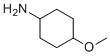
The chemical substance (trans-4-methoxycyclohexyl)amine is a cyclohexane derivative with a trans-configured amine and methoxy group, recognized in organic chemistry as a synthetic intermediate, particularly in pharmaceutical and fine chemical synthesis. Its discovery and applications are well-documented in the literature, rooted in the development of substituted cyclohexanes and stereoselective synthesis.
The origins of (trans-4-methoxycyclohexyl)amine are tied to the study of cyclohexane derivatives, which have been explored since the early 20th century for their conformational properties and utility as building blocks in organic synthesis. The introduction of functional groups, such as amines and ethers, to cyclohexane rings gained prominence in the mid-20th century, driven by the pharmaceutical industry’s need for polar, conformationally defined intermediates. The trans-1,4-disubstitution pattern, with an amine and methoxy group, became significant in the 1970s and 1980s with advances in stereoselective synthesis, enabling control over the relative stereochemistry of substituents. These advancements allowed the synthesis of (trans-4-methoxycyclohexyl)amine to meet the demand for rigid, functionalized scaffolds in drug design.
Synthetically, (trans-4-methoxycyclohexyl)amine is typically prepared through a multi-step process. A common route starts with 4-methoxycyclohexanone, which is synthesized by methylation of 4-hydroxycyclohexanone or oxidation of 4-methoxycyclohexanol. The ketone is converted to the amine via reductive amination using ammonia and a reducing agent, such as sodium borohydride or hydrogen with a palladium catalyst, under conditions that favor the trans isomer due to steric or thermodynamic control. Alternatively, the synthesis can involve 4-methoxycyclohexanol, where the hydroxyl group is converted to an amine precursor (e.g., via azide formation and reduction) with stereoselective methods to ensure the trans configuration. These steps rely on well-established protocols in cyclohexane functionalization, reductive amination, and stereoselective synthesis, ensuring high stereochemical purity and yields.
The primary application of (trans-4-methoxycyclohexyl)amine is as a synthetic intermediate in pharmaceutical chemistry. The cyclohexane ring provides a rigid, conformationally defined scaffold that enhances binding specificity to biological targets, such as receptors or enzymes. The trans-1,4-disubstitution ensures a specific spatial arrangement, critical for stereospecific interactions in drug molecules. The amine group serves as a versatile handle for forming amides, amines, or heterocycles, while the methoxy group enhances polarity and can participate in hydrogen-bonding interactions. This compound is frequently used in the synthesis of drug candidates, including analgesics, antipsychotics, and anti-inflammatory agents, where the trans configuration and polar functionalities optimize pharmacokinetic properties and target affinity.
In academic research, the compound is employed to study stereoselective synthesis, cyclohexane conformational analysis, and amine reactivity. Its synthesis has contributed to the development of new reductive amination and stereocontrolled functionalization methods. The compound also finds use in the synthesis of specialty chemicals, such as ligands or polymer additives, where the rigid cyclohexane and polar groups are advantageous.
The significance of (trans-4-methoxycyclohexyl)amine lies in its role as a stereospecific, multifunctional intermediate that combines the rigidity of a trans-disubstituted cyclohexane with the synthetic versatility of amine and methoxy groups. Its development reflects progress in stereoselective synthesis and cyclohexane chemistry. By enabling the efficient synthesis of conformationally defined, biologically active molecules, it has become a critical tool in advancing pharmaceutical and chemical research.
|






 GHS02;GHS05;GHS07 Danger Details
 chemBlink Chemical Story