
Online Database of Chemicals from Around the World
| Nanjing Fred Technology Co., Ltd. | China | |||
|---|---|---|---|---|
 | www.fredbio.com | |||
 | +86 (25) 8469-6168 | |||
 | Austin@fredchem.cn | |||
 | QQ Chat | |||
 | Skype Chat | |||
 | WeChat: NJFred01 | |||
 | WhatsApp:+86 17302533743 | |||
| Chemical manufacturer since 2020 | ||||
| chemBlink Standard supplier since 2025 | ||||
| Classification | Organic raw materials >> Carboxylic compounds and derivatives >> Carboxylic esters and their derivatives |
|---|---|
| Name | (S)-tert-butyl 2-(5-(6-bromonaphthalen-2-yl)-1H-imidazol-2-yl)pyrrolidine-1-carboxylate |
| Synonyms | tert-butyl (2S)-2-[5-(6-bromonaphthalen-2-yl)-1H-imidazol-2-yl]pyrrolidine-1-carboxylate |
| Molecular Structure | 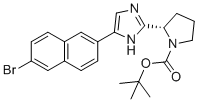 |
| Molecular Formula | C22H24BrN3O2 |
| Molecular Weight | 442.35 |
| CAS Registry Number | 1228551-96-9 |
| SMILES | CC(C)(C)OC(=O)N1CCC[C@H]1C2=NC=C(N2)C3=CC4=C(C=C3)C=C(C=C4)Br |
| Density | 1.4±0.1 g/cm3 Calc.* |
|---|---|
| Boiling point | 631.7±55.0 °C 760 mmHg (Calc.)* |
| Flash point | 335.8±31.5 °C (Calc.)* |
| Index of refraction | 1.635 (Calc.)* |
| * | Calculated using Advanced Chemistry Development (ACD/Labs) Software. |
| Hazard Symbols |  GHS07 Warning Details GHS07 Warning Details |
|---|---|
| Risk Statements | H302-H315-H319-H335 Details |
| Safety Statements | P261-P305+P351+P338 Details |
| SDS | Available |
 chemBlink Chemical Story
|
(S)-tert-butyl 2-(5-(6-bromonaphthalen-2-yl)-1H-imidazol-2-yl)pyrrolidine-1-carboxylate is a chiral, nitrogen-containing heterocyclic compound characterized by a complex molecular structure that combines several key functional groups. The molecule contains a substituted imidazole ring linked to a 6-bromonaphthyl moiety and a pyrrolidine ring bearing a tert-butyl carbamate (Boc) protecting group. Its stereochemistry is defined at the 2-position of the pyrrolidine ring, which adopts the (S)-configuration, making this compound relevant in enantioselective synthesis and medicinal chemistry. The compound’s synthesis involves several steps, typically beginning with the preparation of the pyrrolidine core in enantiomerically pure form, often via asymmetric synthesis or resolution. The pyrrolidine nitrogen is protected with a tert-butyl carbamate to yield the Boc-protected form, which improves handling, enhances solubility in organic solvents, and prevents side reactions during subsequent transformations. The imidazole ring is constructed through condensation reactions involving α-amino ketones or aldehydes with formamide derivatives or amidines. Coupling of the imidazole unit with the 6-bromonaphthalen-2-yl group is achieved through electrophilic aromatic substitution or palladium-catalyzed cross-coupling reactions such as Suzuki or Buchwald-Hartwig coupling. Each structural component of the molecule contributes specific properties. The imidazole ring is a common motif in biologically active molecules due to its ability to act as a hydrogen bond donor and acceptor and its compatibility with metal coordination in enzyme binding sites. The 6-bromonaphthyl group introduces hydrophobicity and π-electron density, which can enhance interactions with aromatic residues in biological targets. The presence of the bromine atom provides a synthetic handle for further functionalization through halogen-metal exchange or cross-coupling chemistry. The (S)-pyrrolidine ring imparts chirality and rigidity to the molecule, making it a useful scaffold in asymmetric catalysis and chiral ligand design. It is often used in medicinal chemistry for its conformational properties and ability to interact with enzymes and receptors in a stereochemically defined manner. The tert-butyl carbamate group protects the nitrogen atom from premature reaction or degradation and can be removed under acidic conditions to regenerate the free amine when desired. In medicinal chemistry, derivatives of this compound class have been explored for their potential activity against a range of targets, including G-protein-coupled receptors, kinases, and proteases. The compound’s rigid and lipophilic aromatic structure, combined with its hydrogen bonding and steric features, makes it a valuable intermediate or pharmacophore in the design of molecules with optimized binding affinity and selectivity. Although (S)-tert-butyl 2-(5-(6-bromonaphthalen-2-yl)-1H-imidazol-2-yl)pyrrolidine-1-carboxylate itself is not an approved therapeutic agent, it serves as an intermediate in the synthesis of compounds under investigation for therapeutic applications. The physicochemical properties of the compound reflect its mixed polarity: while the carbamate and imidazole groups contribute polar character, the bulky naphthyl group enhances hydrophobicity. The molecule is expected to be soluble in polar aprotic organic solvents such as dimethylformamide, dichloromethane, and acetonitrile, and sparingly soluble in water. It is typically isolated as a crystalline or amorphous solid. Standard laboratory handling procedures are required for the compound, including use of gloves, goggles, and a fume hood. While specific toxicological data may not be widely available, caution should be observed due to the presence of halogenated aromatics and nitrogen heterocycles, which may pose irritant or sensitization risks. In summary, (S)-tert-butyl 2-(5-(6-bromonaphthalen-2-yl)-1H-imidazol-2-yl)pyrrolidine-1-carboxylate is a structurally complex, chiral compound with defined synthetic and functional roles. It is used as an intermediate in the synthesis of biologically active molecules and offers diverse reactivity through its protected amine, brominated aromatic system, and imidazole functionality. Its defined stereochemistry and multifunctional framework make it a valuable tool in the development of pharmaceuticals and advanced organic materials. |
| Market Analysis Reports |