
Online Database of Chemicals from Around the World
| Hangzhou Verychem Science And Technology Co., Ltd. | China | |||
|---|---|---|---|---|
 | www.verychem.com | |||
 | +86 (571) 8816-2785 +86 13606544505 | |||
 | +86 (571) 8816-2787 | |||
 | lucy@verychem.com | |||
| Chemical manufacturer since 2004 | ||||
| chemBlink Massive supplier since 2021 | ||||
| Hefei TNJ Chemical Industry Co., Ltd. | China | |||
|---|---|---|---|---|
| www.tnjchem.com | |||
| +86 (551) 6541-8684 | |||
| +86 (551) 6541-8697 | |||
| sales@tnjchem.com | |||
| Chemical manufacturer since 2001 | ||||
| chemBlink Standard supplier since 2010 | ||||
| Handan Huajun Chemical Co., Ltd. | China | |||
|---|---|---|---|---|
| www.huajunchem.com | |||
| +86 (310) 738-8929 +86 13373407683 | |||
| +86 (310) 738-8177 | |||
| 884971191@qq.com | |||
| Chemical manufacturer since 2007 | ||||
| chemBlink Standard supplier since 2014 | ||||
| Hangzhou Leap Chem Co., Ltd. | China | |||
|---|---|---|---|---|
| www.leapchem.com | |||
| +86 (571) 8771-1850 | |||
| market19@leapchem.com | |||
 | QQ Chat | |||
| Chemical manufacturer since 2006 | ||||
| chemBlink Standard supplier since 2015 | ||||
| Celanese Chemicals | USA | |||
|---|---|---|---|---|
| www.celanese.com | |||
| +1 (972) 443-4000 | |||
| +1 (972) 443-2060 | |||
| info@celanese.com | |||
| Chemical manufacturer | ||||
| Classification | Chemical reagent >> Organic reagent >> Carboxylic anhydride |
|---|---|
| Name | Propionic anhydride |
| Synonyms | propanoyl propanoate |
| Molecular Structure | 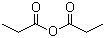 |
| Molecular Formula | C6H10O3 |
| Molecular Weight | 130.14 |
| CAS Registry Number | 123-62-6 |
| EC Number | 204-638-2 |
| SMILES | CCC(=O)OC(=O)CC |
| Density | 1.015 |
|---|---|
| Melting point | -42 °C |
| Boiling point | 167-170 °C |
| Refractive index | 1.403-1.405 |
| Flash point | 63 °C |
| Water solubility | hydrolyses |
| Hazard Symbols |  GHS05 Danger Details GHS05 Danger Details | ||||||||||||
|---|---|---|---|---|---|---|---|---|---|---|---|---|---|
| Risk Statements | H314-H318 Details | ||||||||||||
| Safety Statements | P260-P264-P264+P265-P280-P301+P330+P331-P302+P361+P354-P304+P340-P305+P354+P338-P316-P317-P321-P363-P405-P501 Details | ||||||||||||
| Hazard Classification | |||||||||||||
| |||||||||||||
| Transport Information | UN 2496 | ||||||||||||
| SDS | Available | ||||||||||||
 chemBlink Chemical Story
|
Propionic anhydride is synthesized by reacting propionic acid with acetic anhydride under controlled conditions. This synthetic route produces a clear, colorless liquid with a unique molecular structure characterized by its anhydride functional group (-C(O)OC(O)-), which is more reactive and stable than its parent acid. The discovery of propionic anhydride marked a milestone in organic chemistry, making it widely used in various industrial applications. Chemically, propionic anhydride has its anhydride structure, which includes two carbonyl groups bonded to oxygen atoms. This molecular structure affects its physical properties such as boiling point, density, and solubility in organic solvents, making it suitable for various chemical processes. Propionic anhydride is used as a versatile acylating agent in organic synthesis, which helps in modifying organic compounds to produce derivatives with desired properties. It is widely used in the pharmaceutical and agrochemical industries for the synthesis of intermediates and active ingredients. The compound can be used as a reagent in polymer chemistry, which helps in the synthesis of specialty polymers and resins. Its acylation properties can modify the polymer chain, thereby improving its mechanical properties and thermal stability. Propionic anhydride is used as a solvent in chemical reactions and as a reagent in the preparation of esters and amides. Its uses extend to a variety of organic transformations, including esterification, amidation, and acylation reactions, which are essential for fine chemical synthesis. Ongoing research explores the potential of propionic anhydride in the following areas: investigating its catalytic properties in selective organic transformations, aiming to improve reaction efficiency and selectivity in industrial processes; exploring its role in the development of advanced materials, such as functional coatings and composites, taking advantage of its chemical reactivity and compatibility; evaluating its environmental impact and exploring sustainable synthetic pathways to minimize waste and improve resource efficiency. Research on the safety and regulatory compliance of propionic anhydride ensures its safe handling and use in industrial applications. The regulatory framework ensures compliance with environmental and occupational health standards to mitigate potential risks associated with its handling and disposal. References 2023. Insights into reaction kinetics and autocatalysis behavior of propionic anhydride hydrolysis using real-time reaction calorimetry method. Journal of Thermal Analysis and Calorimetry. DOI: 10.1007/s10973-023-12319-6 2024. Introducing Propionate and 2-Dimethylammonium Chloride Ethyl Substituents onto Cornstarch for Acquiring Good Film Properties and Easy Desizing from Sized Warps. Fibers and Polymers. DOI: 10.1007/s12221-024-00476-w 2024. Comparative analysis of kinetic-free thermal runaway criteria for semi-batch isoperibolic homogeneous exothermic reaction. Journal of Thermal Analysis and Calorimetry. DOI: 10.1007/s10973-024-13517-6 |
| Market Analysis Reports |