
Online Database of Chemicals from Around the World
| Simagchem Corporation | China | |||
|---|---|---|---|---|
 | www.simagchem.com | |||
 | +86 13806087780 | |||
 | +86 (592) 268-0237 | |||
 | sale@simagchem.com | |||
| Chemical manufacturer since 2002 | ||||
| chemBlink Standard supplier since 2008 | ||||
| Taizhou Crene Biotechnology Co., Ltd. | China | |||
|---|---|---|---|---|
| www.pharm-intermediates.com | |||
| +86 (576) 8881-3233 8820-5808 +86 13396860566 | |||
| +86 (576) 8822-9589 | |||
| sales@pharm-intermediates.com | |||
 | QQ Chat | |||
| Chemical manufacturer since 2011 | ||||
| chemBlink Standard supplier since 2009 | ||||
| BOC Sciences | USA | |||
|---|---|---|---|---|
| www.bocsci.com | |||
| +1 (631) 485-4226 | |||
| +1 (631) 614-7828 | |||
| info@bocsci.com | |||
| Chemical manufacturer | ||||
| chemBlink Standard supplier since 2010 | ||||
| Qingdao Kingway Pharmtech Co., Ltd. | China | |||
|---|---|---|---|---|
| www.kingwaypharm.com | |||
| +86 (532) 8711-8899 | |||
| +86 (532) 8411-7788 | |||
| sales@kingwaypharm.com kingwaypharm@hotmail.com | |||
| QQ Chat | |||
| Chemical manufacturer since 2012 | ||||
| chemBlink Standard supplier since 2013 | ||||
| Hangzhou Leap Chem Co., Ltd. | China | |||
|---|---|---|---|---|
| www.leapchem.com | |||
| +86 (571) 8771-1850 | |||
| market19@leapchem.com | |||
| QQ Chat | |||
| Chemical manufacturer since 2006 | ||||
| chemBlink Standard supplier since 2015 | ||||
| Turtle Pharma Private Limited | India | |||
|---|---|---|---|---|
| www.turtlepharma.com | |||
| +91 9850998504 | |||
| info@turtlepharma.com | |||
| Chemical manufacturer since 2015 | ||||
| chemBlink Standard supplier since 2024 | ||||
| Shandong Chenghui Shuangda Pharmaceutical Co., Ltd. | China | |||
|---|---|---|---|---|
| www.chsdpharma.com | |||
| +86-531-58897029 | |||
| ericqiao@jnchsd.com | |||
| QQ Chat | |||
 | WeChat: 15550412551 | |||
 | WhatsApp:15550412551 | |||
| Chemical manufacturer since 2014 | ||||
| chemBlink Standard supplier since 2025 | ||||
| Ivy Fine Chemicals | USA | |||
|---|---|---|---|---|
| www.ivychem.com | |||
| +1 (856) 465-8550 | |||
| +1 (856) 616-1161 | |||
| sales@ivychem.com | |||
| Chemical manufacturer | ||||
| LKT Laboratories, Inc. | USA | |||
|---|---|---|---|---|
| www.lktlabs.com | |||
| +1 (888) 558-5227 | |||
| +1 (651) 644-8357 | |||
| peacerli@mbolin-lktlabs.com | |||
| Chemical manufacturer | ||||
| Kemprotec Limited | UK | |||
|---|---|---|---|---|
| www.kemprotec.com | |||
| +44 (1642) 591-764 | |||
| +44 (1845) 550-001 | |||
| sales@kemprotec.co.uk | |||
| Chemical distributor since 1998 | ||||
| Classification | API >> Synthetic anti-infective drugs >> Quinolone |
|---|---|
| Name | Nadifloxacin |
| Synonyms | (+/-)-9-Fluoro-6,7-dihydro-8-(4-hydroxypiperidino)-5-methyl-1-oxo-1H,5H-benzo[ij]quinolizine-2-carboxylic acid |
| Molecular Structure | 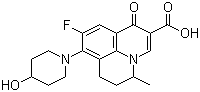 |
| Molecular Formula | C19H21FN2O4 |
| Molecular Weight | 360.38 |
| CAS Registry Number | 124858-35-1 |
| EC Number | 638-863-6 |
| SMILES | CC1CCC2=C3N1C=C(C(=O)C3=CC(=C2N4CCC(CC4)O)F)C(=O)O |
| Hazard Symbols |  GHS08 Warning Details GHS08 Warning Details | ||||||||||||
|---|---|---|---|---|---|---|---|---|---|---|---|---|---|
| Risk Statements | H362-H373 Details | ||||||||||||
| Safety Statements | P203-P260-P263-P264-P270-P318-P319-P501 Details | ||||||||||||
| Hazard Classification | |||||||||||||
| |||||||||||||
| SDS | Available | ||||||||||||
 chemBlink Chemical Story
|
Nadifloxacin is a topical antibiotic that belongs to the fluoroquinolone class of antimicrobial agents. Its discovery and development have provided a valuable tool for treating various skin infections, particularly those caused by Gram-positive bacteria. Known for its effectiveness in dermatological applications, nadifloxacin has become an essential component of therapeutic regimens for managing skin conditions. The discovery of nadifloxacin emerged from ongoing research into improving fluoroquinolones, which are well-known for their broad-spectrum antibacterial properties. Fluoroquinolones were first introduced in the 1980s with the development of drugs like ciprofloxacin and norfloxacin. Nadifloxacin was developed as a topical agent, offering a new approach to the treatment of localized infections. Nadifloxacin is specifically designed to be used in topical formulations, which means it is applied directly to the skin. This application method allows for high local concentrations of the drug at the site of infection, which enhances its effectiveness while minimizing systemic side effects. The drug acts by inhibiting bacterial DNA gyrase and topoisomerase IV—key enzymes required for bacterial DNA replication and repair. By disrupting these processes, nadifloxacin prevents the growth and proliferation of bacteria. One of the primary uses of nadifloxacin is in the treatment of bacterial skin infections, such as impetigo, folliculitis, and certain types of dermatitis. It is particularly effective against Gram-positive bacteria like *Staphylococcus aureus* and *Streptococcus pyogenes*. Nadifloxacin is commonly used in patients who have localized infections that do not require systemic antibiotic treatment. Its topical application helps to deliver high drug concentrations directly to the infection site, improving therapeutic outcomes and reducing the risk of systemic adverse effects. Nadifloxacin is available in various topical formulations, including creams, ointments, and gels. These formulations are designed for ease of application and optimal patient compliance. The choice of formulation can be tailored to the specific needs of the patient and the characteristics of the skin infection being treated. In addition to its primary use in treating bacterial skin infections, nadifloxacin has been studied for its potential benefits in treating acne vulgaris. Research has shown that it can be effective in reducing the bacterial load associated with acne, although it is less commonly used for this indication compared to other topical treatments like benzoyl peroxide or topical retinoids. The development and use of nadifloxacin also highlight the importance of targeting specific bacterial pathogens while minimizing the risk of developing antibiotic resistance. By focusing on topical administration, nadifloxacin reduces the likelihood of resistance developing compared to systemic antibiotics, where broader exposure can lead to increased resistance. Despite its benefits, nadifloxacin is not without potential side effects. The most common side effects are related to local skin reactions, such as redness, itching, or irritation at the site of application. These side effects are generally mild and transient, but patients are advised to discontinue use and consult a healthcare provider if they experience severe or persistent reactions. In summary, nadifloxacin is a valuable topical antibiotic used primarily for treating bacterial skin infections. Its development represents a significant advancement in dermatological therapy, offering targeted treatment with a favorable safety profile. As with all antibiotics, appropriate use is crucial to maintain its effectiveness and minimize the risk of resistance. References 1990. Synthesis and antibacterial activity of the metabolites of 9-fluoro-6,7-dihydro-8-(4-hydroxy-1-piperidyl)-5-methyl-1-oxo-1H,5H-benzo(i,j)quinolizine-2-carboxylic acid (OPC-7251). Chemical and Pharmaceutical Bulletin, 38(7). DOI: 10.1248/cpb.38.2027 1992. Comparative activity of the topical quinolone OPC-7251 against bacteria associated with acne vulgaris. European Journal of Clinical Microbiology & Infectious Diseases, 11(10). DOI: 10.1007/bf01962381 2024. A DoE-based development and characterization of Nadifloxacin-loaded transethosomal gel for the treatment of Acne vulgaris. Future Journal of Pharmaceutical Sciences, 10(1). DOI: 10.1186/s43094-024-00616-2 |
| Market Analysis Reports |