
Online Database of Chemicals from Around the World
| Tianjin Zhongxin Chem-tech Co., Ltd. | China | |||
|---|---|---|---|---|
 | www.tjzxchem.com | |||
 | +86 (22) 6688-0623 | |||
 | +86 (22) 8988-0739 ex 8030 | |||
 | sales@tjzxchem.com | |||
| Chemical manufacturer since 2007 | ||||
| chemBlink Premium supplier since 2009 | ||||
| Classification | Organic raw materials >> Organometallic compound >> Organic titanium |
|---|---|
| Name | Bis(cyclopenta-1,3-diene)bis(1-(2,4-difluorophenyl)-3H-pyrrol-3-yl)titanium |
| Molecular Structure | 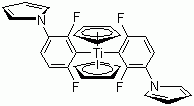 |
| Molecular Formula | C30H22F4N2Ti |
| Molecular Weight | 534.37 |
| CAS Registry Number | 125051-32-3 |
| EC Number | 603-024-5 |
| SMILES | [cH-]1cccc1.[cH-]1cccc1.c1cn(c[c-]1)c2ccc(cc2F)F.c1cn(c[c-]1)c2ccc(cc2F)F.[Ti+4] |
| Melting point | 160-170 °C |
|---|---|
| Hazard Symbols |    GHS02;GHS07;GHS09 Danger Details GHS02;GHS07;GHS09 Danger Details | ||||||||||||||||
|---|---|---|---|---|---|---|---|---|---|---|---|---|---|---|---|---|---|
| Risk Statements | H228-H350-H411 Details | ||||||||||||||||
| Safety Statements | P201-P210-P273-P308+P313 Details | ||||||||||||||||
| Hazard Classification | |||||||||||||||||
| |||||||||||||||||
| Transport Information | UN 1325 | ||||||||||||||||
| SDS | Available | ||||||||||||||||
 chemBlink Chemical Story
|
Bis(cyclopenta-1,3-diene)bis(1-(2,4-difluorophenyl)-3H-pyrrol-3-yl)titanium is a sophisticated chemical compound notable for its unique structure and applications in catalysis and materials science. This compound, characterized by its titanium center coordinated by two cyclopentadiene ligands and two 1-(2,4-difluorophenyl)-3H-pyrrol-3-yl groups, represents a class of metallocene derivatives with distinct properties and uses. The discovery of this compound emerged from the ongoing study of titanium-based catalysts and their ability to facilitate various chemical reactions. The synthesis involves the coordination of cyclopenta-1,3-diene and 1-(2,4-difluorophenyl)-3H-pyrrol-3-yl ligands to a titanium center, resulting in a stable and reactive organometallic complex. This synthesis highlights the compound's potential as a catalyst in chemical transformations. One of the primary applications of bis(cyclopenta-1,3-diene)bis(1-(2,4-difluorophenyl)-3H-pyrrol-3-yl)titanium is in the field of catalysis. The compound is used as a catalyst in various polymerization reactions, including olefin polymerization. Its unique ligand environment provides a versatile coordination sphere that facilitates the formation of polymer chains with controlled molecular weights and architectures. This property is particularly valuable in the production of high-performance polymers and specialty materials. In addition to polymerization, the compound is also utilized in other catalytic processes such as hydrogenation and hydroboration. Its titanium center, combined with the cyclopentadiene and pyrrole ligands, offers a robust and efficient catalytic system for these reactions. This versatility makes the compound a valuable tool in both academic research and industrial applications. The compound's unique structure and reactivity also make it suitable for use in materials science. It can be employed in the development of advanced materials with tailored electronic and optical properties. For example, the compound's ability to form stable coordination complexes with various substrates enables its use in the design of materials for sensors and electronic devices. Despite its advanced applications, bis(cyclopenta-1,3-diene)bis(1-(2,4-difluorophenyl)-3H-pyrrol-3-yl)titanium must be handled with care due to the reactivity of its components. Proper safety protocols are essential to ensure safe handling and use in both research and industrial settings. Overall, the discovery and application of bis(cyclopenta-1,3-diene)bis(1-(2,4-difluorophenyl)-3H-pyrrol-3-yl)titanium underscore its significance in advancing catalysis and materials science. Its unique chemical properties and versatility highlight its role in facilitating complex chemical transformations and developing advanced materials. References 2017. UV-assisted reduction of graphite oxide to graphene by using a photoinitiator. Journal of Materials Science. DOI: 10.1007/s10853-016-0721-y 2019. Polymer-chalcogenide glass nanocomposites for amplitude-phase modulated optical relief recording. Journal of Materials Science: Materials in Electronics. DOI: 10.1007/s10854-019-01309-w |
| Market Analysis Reports |