
Online Database of Chemicals from Around the World
| Wuhan Kemi-works Chemical Co., Ltd. | China | |||
|---|---|---|---|---|
 | www.kemiworks.net | |||
 | +86 (27) 8573-6489 | |||
 | +86 (27) 8573-6485 | |||
 | info@kemiworks.net sales@kemiworks.com | |||
| Chemical manufacturer | ||||
| chemBlink Premium supplier since 2011 | ||||
| Classification | Organic raw materials >> Organometallic compound |
|---|---|
| Name | Indium(III) methanesulfonate |
| Synonyms | bis(methylsulfonyloxy)indiganyl methanesulfonate |
| Molecular Structure | 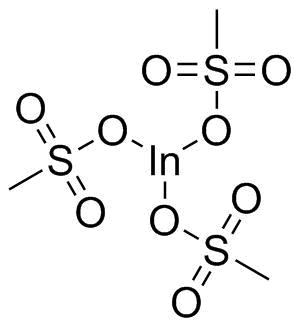 |
| Molecular Formula | C3H9InO9S3 |
| Molecular Weight | 400.11 |
| CAS Registry Number | 125923-01-5 |
| EC Number | 986-947-9 |
| SMILES | CS(=O)(=O)O[In](OS(=O)(=O)C)OS(=O)(=O)C |
 chemBlink Chemical Story
|
Indium(III) methanesulfonate is an organosulfonate salt of trivalent indium, consisting of an indium(III) cation coordinated by methanesulfonate (mesylate) anions. Its empirical composition is commonly represented as In(CH3SO3)3, although the actual solid-state structure may contain coordinated solvent molecules or polymeric coordination networks depending on the method of preparation and crystallization. The compound contains indium in the +3 oxidation state, which is the most stable and predominant oxidation state of indium chemistry. The counterions are methanesulfonate groups (CH3SO3−), derived from methanesulfonic acid. Each methanesulfonate anion consists of a methyl group attached to a sulfonate functionality, with the negative charge delocalized over the three oxygen atoms of the SO3 group. Structurally, indium(III) typically exhibits coordination numbers ranging from four to eight, depending on the ligands present. In indium(III) methanesulfonate, the sulfonate oxygen atoms may coordinate directly to the indium center, either as monodentate ligands or as bridging ligands linking multiple metal centers. As a result, the compound may exist as a coordination polymer in the solid state rather than as discrete molecular units. The methanesulfonate anion is considered a weakly coordinating anion compared with halides or carboxylates. This property contributes to the usefulness of indium(III) methanesulfonate as a Lewis acid catalyst because the indium center remains relatively accessible for interaction with substrates. The high stability and non-oxidizing nature of the mesylate group further enhance its utility. Indium(III) methanesulfonate is widely employed in organic synthesis as a Lewis acid catalyst. Lewis acids are electron-pair acceptors that activate carbonyl compounds, epoxides, acetals, and other functional groups toward nucleophilic attack. Indium-based catalysts are often valued because they can operate under relatively mild conditions and frequently tolerate the presence of moisture better than many traditional Lewis acids. Catalytic applications include carbon–carbon bond-forming reactions, acetalization and deacetalization reactions, Friedel–Crafts-type transformations, allylation reactions, and various heterocycle-forming processes. The combination of moderate Lewis acidity and water tolerance makes indium salts attractive alternatives to more moisture-sensitive catalysts. The compound is generally prepared by reacting indium oxide, indium hydroxide, or indium metal with methanesulfonic acid under controlled conditions. The resulting solution can be concentrated to obtain the methanesulfonate salt, often as a hydrate or solvated form depending on the isolation procedure. From a physicochemical perspective, indium(III) methanesulfonate is typically a hygroscopic ionic solid with good solubility in water and many polar organic solvents. The highly polar sulfonate groups contribute to ionic dissociation in solution, facilitating catalytic activity through generation of accessible indium species. The sulfonate groups themselves are chemically stable and resistant to oxidation or reduction under ordinary conditions. The catalytic properties of the compound arise primarily from the Lewis acidity of the In3+ center rather than from the methanesulfonate ligands. Historically, indium compounds gained increasing attention in synthetic chemistry during the late 20th century as chemists sought milder and more environmentally compatible Lewis acid catalysts. Indium salts, including indium(III) methanesulfonate, became notable for combining catalytic effectiveness with relatively low toxicity and improved operational simplicity. Overall, indium(III) methanesulfonate is a trivalent indium salt containing methanesulfonate counterions. Its combination of water tolerance, solubility, and Lewis acidity has made it a valuable catalyst and reagent in modern organic synthesis and coordination chemistry. References 2024. Electrodeposition of indium antimonide (InSb) from dimethyl sulfoxide-based electrolytes. Journal of Solid State Electrochemistry. DOI: 10.1007/s10008-024-05947-x 2008. Lewis Acid Catalyzed Coupling of Allylsilanes and Allylstannanes. Science of Synthesis. URL: https://science-of-synthesis.thieme.com/app/text/?id=SD-246-00105 |
| Market Analysis Reports |