
Online Database of Chemicals from Around the World
| Hangzhou Verychem Science And Technology Co., Ltd. | China | |||
|---|---|---|---|---|
 | www.verychem.com | |||
 | +86 (571) 8816-2785 +86 13606544505 | |||
 | +86 (571) 8816-2787 | |||
 | lucy@verychem.com | |||
| Chemical manufacturer since 2004 | ||||
| chemBlink Massive supplier since 2021 | ||||
| Mascot I.E. CO.,Ltd. | China | |||
|---|---|---|---|---|
| www.mascotchem.com | |||
| +86 (519) 8501-0339 +86 13584504415 | |||
| +86 (519) 8501-0366 | |||
| info@mascotchem.com | |||
 | QQ Chat | |||
| Chemical distributor since 2006 | ||||
| chemBlink Standard supplier since 2006 | ||||
| Classification | Organic raw materials >> Organoboron compounds |
|---|---|
| Name | 3-(Dibenzofuran-4-yl)phenylboronic acid |
| Synonyms | B-[3-(4-Dibenzofuranyl)phenyl]boronic acid |
| Molecular Structure | 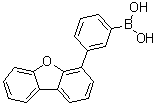 |
| Molecular Formula | C18H13BO3 |
| Molecular Weight | 288.11 |
| CAS Registry Number | 1271726-52-3 |
| SMILES | B(C1=CC(=CC=C1)C2=CC=CC3=C2OC4=CC=CC=C34)(O)O |
| Solubility | Insoluble (7.8E-6 g/L) (25 °C), Calc.* |
|---|---|
| Density | 1.33±0.1 g/cm3 (20 °C 760 Torr), Calc.* |
| Index of Refraction | 1.721, Calc.* |
| Boiling Point | 550.8±52.0 °C (760 mmHg), Calc.* |
| Flash Point | 286.9±30.7 °C, Calc.* |
| * | Calculated using Advanced Chemistry Development (ACD/Labs) Software V11.02 (©1994-2018 ACD/Labs) |
| Hazard Symbols |  GHS07 Warning Details GHS07 Warning Details |
|---|---|
| Risk Statements | H302-H315-H319-H335 Details |
| Safety Statements | P261-P264-P270-P271-P280-P301+P312-P302+P352-P304+P340-P305+P351+P338-P330-P332+P313-P337+P313-P362-P403+P233-P405-P501 Details |
 chemBlink Chemical Story
|
3-(Dibenzofuran-4-yl)phenylboronic acid is an organic compound that features a boronic acid group attached to a phenyl ring and a dibenzofuran group at the 3-position of the phenyl ring. It is commonly used in the field of organic chemistry, particularly in Suzuki coupling reactions. The compound plays a significant role in the synthesis of various functional materials, such as pharmaceuticals, agrochemicals, and organic electronics. The discovery of boronic acids dates back to the early 20th century, with the development of the first boronic acids attributed to the work of chemists such as R. H. F. M. Wacker and L. B. Schifrin. Boronic acids, including 3-(dibenzofuran-4-yl)phenylboronic acid, are known for their ability to form reversible covalent bonds with diols and other compounds with hydroxyl groups, which is a characteristic feature that makes them versatile in organic synthesis. Boronic acids also serve as key intermediates in various catalytic processes due to their ability to participate in cross-coupling reactions. One of the primary applications of 3-(dibenzofuran-4-yl)phenylboronic acid is in the Suzuki–Miyaura cross-coupling reaction. This reaction is a widely used method in organic chemistry to form carbon-carbon bonds by coupling an organoboronic acid with an organohalide in the presence of a palladium catalyst. The use of this boronic acid allows for the formation of various biaryl compounds, which are essential in the development of pharmaceuticals, materials science, and the synthesis of natural products. In addition to its application in the Suzuki coupling reaction, 3-(dibenzofuran-4-yl)phenylboronic acid is also employed in the preparation of various functionalized organic compounds, which may serve as intermediates for the synthesis of more complex molecules. These molecules are often of interest in the fields of medicinal chemistry, materials science, and biotechnology. The ability to selectively modify the structure of aromatic compounds through reactions involving boronic acids has made them invaluable tools in chemical synthesis. The compound's role in pharmaceutical and agrochemical development is also significant. By acting as a precursor or intermediate in the synthesis of complex bioactive molecules, 3-(dibenzofuran-4-yl)phenylboronic acid can facilitate the creation of compounds with potential therapeutic properties. The versatility of boronic acids in drug discovery and development is well documented, and this particular boronic acid is no exception. Another noteworthy application of this compound is in the development of organic electronic devices, including organic light-emitting diodes (OLEDs) and organic solar cells (OSCs). The dibenzofuran group, which is an aromatic heterocycle, imparts specific electronic properties to the compound, making it suitable for inclusion in materials used in organic semiconductors. These materials are a focus of research due to their potential to replace traditional inorganic semiconductors in electronic devices, offering the possibility of flexible, lightweight, and cost-effective alternatives. In conclusion, 3-(dibenzofuran-4-yl)phenylboronic acid is an important compound in the field of organic synthesis, with well-established applications in the Suzuki coupling reaction, drug development, and the creation of functionalized materials. Its use as a boronic acid derivative facilitates the construction of complex organic molecules, with significance in the synthesis of pharmaceuticals, agrochemicals, and electronic materials. This compound's ability to participate in key chemical reactions continues to make it a valuable tool in various scientific disciplines. References 2018. Dibenzofuran and dibenzothiophene based palladium(II)/NHC catalysts - synthesis and applications in C-C bond formation. New Journal of Chemistry, 42(19), 15819. DOI: 10.1039/C8NJ02989J 2024. Access to C(sp3) borylated and silylated cyclic molecules: hydrogenation of corresponding arenes and heteroarenes. RSC Advances, 14(15), 10590. DOI: 10.1039/D4RA00491D 2025. Synthesis of phenanthroimidazole-based host materials with balanced hole-electron transport for highly efficient blue fluorescent OLEDs. Journal of Materials Chemistry C, 13(13), 4471. DOI: 10.1039/D4TC04832F |
| Market Analysis Reports |