
Online Database of Chemicals from Around the World
| Taizhou Crene Biotechnology Co., Ltd. | China | |||
|---|---|---|---|---|
 | www.pharm-intermediates.com | |||
 | +86 (576) 8881-3233 8820-5808 +86 13396860566 | |||
 | +86 (576) 8822-9589 | |||
 | sales@pharm-intermediates.com | |||
 | QQ Chat | |||
| Chemical manufacturer since 2011 | ||||
| chemBlink Standard supplier since 2009 | ||||
| Shanghai Biochempartner Co., Ltd. | China | |||
|---|---|---|---|---|
| www.biochempartner.com | |||
| +86 17754423994 | |||
| candy@biochempartner.com | |||
| QQ Chat | |||
| Chemical distributor since 2012 | ||||
| chemBlink Standard supplier since 2010 | ||||
| BOC Sciences | USA | |||
|---|---|---|---|---|
| www.bocsci.com | |||
| +1 (631) 485-4226 | |||
| +1 (631) 614-7828 | |||
| info@bocsci.com | |||
| Chemical manufacturer | ||||
| chemBlink Standard supplier since 2010 | ||||
| Apexbio Technology LLC | USA | |||
|---|---|---|---|---|
| www.apexbt.com | |||
| +1 (832) 696-8203 | |||
| +1 (855) 527-3928 | |||
| info@apexbt.com | |||
| Chemical manufacturer since 2012 | ||||
| chemBlink Standard supplier since 2013 | ||||
| Hangzhou Qichuang Chemical Co., Ltd. | China | |||
|---|---|---|---|---|
| www.qc-chemical.com | |||
| +86 (571) 8893-5129 | |||
| +86 (571) 8825-0182 | |||
| david@qc-chemical.com sales@qc-chemical.com davidw0828@gmail.com | |||
| QQ Chat | |||
| Chemical distributor since 2009 | ||||
| chemBlink Standard supplier since 2013 | ||||
| Selleck Chemicals LLC | USA | |||
|---|---|---|---|---|
| www.selleckchem.com | |||
| +1 (713) 535-9129 | |||
| +1 (832) 582-8590 | |||
| info@selleckchem.com | |||
| Chemical manufacturer | ||||
| chemBlink Standard supplier since 2014 | ||||
| Hangzhou Leap Chem Co., Ltd. | China | |||
|---|---|---|---|---|
| www.leapchem.com | |||
| +86 (571) 8771-1850 | |||
| market19@leapchem.com | |||
| QQ Chat | |||
| Chemical manufacturer since 2006 | ||||
| chemBlink Standard supplier since 2015 | ||||
| Shanghai Zehan Biopharma Technology Co., Ltd. | China | |||
|---|---|---|---|---|
| www.zehanbiopharma.com | |||
| +86 (21) 6135-0663 +86 13052117465 | |||
| +86 (21) 6135-0662 | |||
| sales@zehanbiopharma.com | |||
| QQ Chat | |||
| Chemical manufacturer since 2015 | ||||
| chemBlink Standard supplier since 2015 | ||||
| Amadis Chemical Co., Ltd. | China | |||
|---|---|---|---|---|
| www.amadischem.com | |||
| +86 (571) 8992-5085 | |||
| +86 (571) 8992-5065 | |||
| sales@amadischem.com | |||
| Chemical manufacturer since 2010 | ||||
| chemBlink Standard supplier since 2015 | ||||
| Targetmol China | China | |||
|---|---|---|---|---|
| www.targetmol.cn | |||
| +86 (400) 820-0310 | |||
| sales@targetmol.cn | |||
| Chemical manufacturer since 2015 | ||||
| chemBlink Standard supplier since 2025 | ||||
| VDM Biochemicals | USA | |||
|---|---|---|---|---|
| www.vdmbio.com | |||
| +1 (330) 252-8181 | |||
| +1 (330) 252-8171 | |||
| sales@vdmbio.com info@vdmbio.com | |||
| Chemical manufacturer | ||||
| Santa Cruz Biotechnology, Inc. | USA | |||
|---|---|---|---|---|
| www.scbt.com | |||
| +1 (831) 457-3800 | |||
| +1 (831) 457-3801 | |||
| scbt@scbt.com | |||
| Chemical manufacturer | ||||
| Classification | Biochemical >> Inhibitor >> Epigenetics >> HDAC inhibitor |
|---|---|
| Name | Romidepsin |
| Synonyms | Antibiotic FR 901228; Chromadax; FK 228; FR 901228; NSC 630176 |
| Molecular Structure | 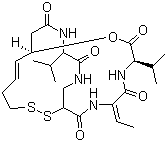 |
| Molecular Formula | C24H36N4O6S2 |
| Molecular Weight | 540.70 |
| CAS Registry Number | 128517-07-7 |
| EC Number | 686-179-1 |
| SMILES | C/C=C1/C(=O)N[C@H](C(=O)O[C@H]2CC(=O)N[C@@H](C(=O)N[C@H](CSSCC/C=C2)C(=O)N1)C(C)C)C(C)C |
| Density | 1.2±0.1 g/cm3 Calc.* |
|---|---|
| Boiling point | 942.8±65.0 °C 760 mmHg (Calc.)* |
| Flash point | 524.0±34.3 °C (Calc.)* |
| Solubility | Soluble 10 mM in DMSO (Expl.) |
| Index of refraction | 1.529 (Calc.)* |
| * | Calculated using Advanced Chemistry Development (ACD/Labs) Software. |
| Hazard Symbols |     GHS06;GHS07;GHS08;GHS09 Danger Details GHS06;GHS07;GHS08;GHS09 Danger Details | ||||||||||||||||||||||||||||||||||||
|---|---|---|---|---|---|---|---|---|---|---|---|---|---|---|---|---|---|---|---|---|---|---|---|---|---|---|---|---|---|---|---|---|---|---|---|---|---|
| Risk Statements | H301-H317-H341-H400-H410 Details | ||||||||||||||||||||||||||||||||||||
| Safety Statements | P203-P261-P264-P270-P272-P273-P280-P301+P316-P302+P352-P318-P321-P330-P333+P317-P362+P364-P391-P405-P501 Details | ||||||||||||||||||||||||||||||||||||
| Hazard Classification | |||||||||||||||||||||||||||||||||||||
| |||||||||||||||||||||||||||||||||||||
| SDS | Available | ||||||||||||||||||||||||||||||||||||
 chemBlink Chemical Story
|
Romidepsin is a natural product-derived anticancer agent that functions as a histone deacetylase (HDAC) inhibitor. It was originally isolated from the bacterium *Chromobacterium violaceum* during a screening program for compounds with potential immunosuppressive and antitumor activities. Structurally, romidepsin is a bicyclic depsipeptide featuring a disulfide bond that, upon intracellular reduction, releases a free thiol group responsible for binding the zinc ion in the active site of HDAC enzymes. This interaction leads to inhibition of HDAC activity and promotes the accumulation of acetylated histones, resulting in changes in gene expression that can induce cell cycle arrest, differentiation, or apoptosis in cancer cells. The discovery of romidepsin was closely linked to efforts in natural product research aimed at identifying biologically active compounds from microbial sources. Its potent cytotoxicity against cancer cell lines, combined with its unique mechanism of HDAC inhibition, positioned it as a strong candidate for development as an anticancer agent. Further pharmacological evaluation revealed that romidepsin selectively inhibits class I HDACs, particularly HDAC1 and HDAC2, which are commonly overexpressed in various hematologic and solid malignancies. Romidepsin entered clinical development in the early 2000s and demonstrated promising efficacy in early-phase clinical trials involving patients with T-cell lymphomas. These malignancies, particularly cutaneous T-cell lymphoma (CTCL) and peripheral T-cell lymphoma (PTCL), often have limited treatment options and poor prognoses. Romidepsin showed durable responses in a subset of patients with relapsed or refractory disease. These results led to accelerated approval by the United States Food and Drug Administration (FDA) in 2009 for the treatment of CTCL in patients who had received at least one prior systemic therapy. In 2011, the approval was extended to include PTCL under similar conditions. The mechanism of romidepsin’s antitumor effect involves reactivation of tumor suppressor genes, disruption of oncogenic transcriptional programs, and induction of apoptosis. By altering the acetylation status of histone and non-histone proteins, romidepsin affects a wide range of cellular processes, including DNA repair, chromatin remodeling, and cell cycle regulation. Its activity is particularly relevant in malignancies where epigenetic dysregulation contributes to disease progression. Romidepsin is administered intravenously, typically on days 1, 8, and 15 of a 28-day cycle. The treatment is associated with a range of adverse effects, including nausea, vomiting, fatigue, anorexia, and hematologic toxicity. Electrocardiographic changes, such as QT prolongation, have also been observed and require careful monitoring. Despite these side effects, romidepsin remains an important therapeutic option, especially in patients who are not candidates for intensive chemotherapy. In clinical practice, romidepsin is often used in combination with other agents or as part of sequential therapy strategies to manage relapsed or refractory T-cell lymphomas. Its role has also been explored in combination with other epigenetic modifiers, such as DNA methyltransferase inhibitors, to enhance therapeutic efficacy. Ongoing research aims to expand its application to other malignancies and to identify biomarkers that predict response. Romidepsin's development exemplifies the value of natural products in modern oncology and the therapeutic potential of targeting epigenetic mechanisms. As a selective HDAC inhibitor, it continues to serve as both a therapeutic agent and a tool for understanding the role of histone acetylation in cancer biology. References 2005. Chemoresistance to Depsipeptide FK228 [(E)-(1 S,4 S,10 S,21 R)-7-[(Z)-Ethylidene]-4,21-diisopropyl-2-oxa-12,13-dithia-5,8,20,23-tetraazabicyclo[8,7,6]-tricos-16-ene-3,6,9,22-pentanone] Is Mediated by Reversible MDR1 Induction in Human Cancer Cell Lines. The Journal of Pharmacology and Experimental Therapeutics, 314(1). DOI: 10.1124/jpet.105.083956 2012. Results From a Pivotal, Open-Label, Phase II Study of Romidepsin in Relapsed or Refractory Peripheral T-Cell Lymphoma After Prior Systemic Therapy. Journal of Clinical Oncology, 30(6). DOI: 10.1200/jco.2011.37.4223 2013. Alemtuzumab induced complete remission of romidepsin-refractory large cell transformation of mycosis fungoides. Annals of Hematology, 92(12). DOI: 10.1007/s00277-013-1869-z |
| Market Analysis Reports |