
Online Database of Chemicals from Around the World
| Shanghai PI Chemicals Ltd. | China | |||
|---|---|---|---|---|
 | www.pipharm.com | |||
 | +86 (21) 58953700 | |||
 | +86 (21) 58953701 | |||
 | sales@pipharm.com | |||
| Chemical distributor since 2007 | ||||
| chemBlink Standard supplier since 2026 | ||||
| Classification | Organic raw materials >> Carboxylic compounds and derivatives |
|---|---|
| Name | Mal-PEG5-acid |
| Synonyms | 3-[2-[2-[2-[2-[2-(2,5-dioxopyrrol-1-yl)ethoxy]ethoxy]ethoxy]ethoxy]ethoxy]propanoic acid |
| Molecular Structure | 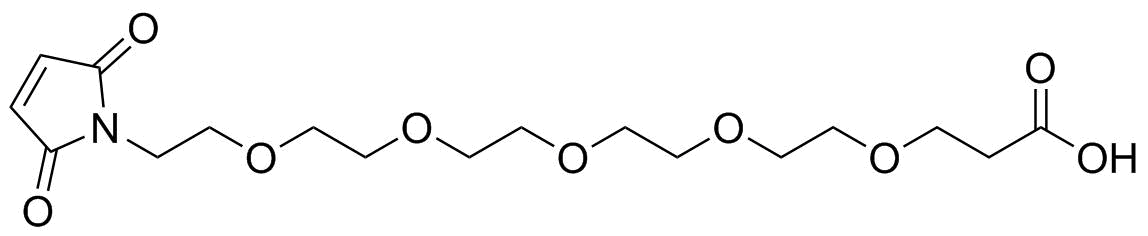 |
| Molecular Formula | C17H27NO9 |
| Molecular Weight | 389.4 |
| CAS Registry Number | 1286755-26-7 |
| SMILES | C1=CC(=O)N(C1=O)CCOCCOCCOCCOCCOCCC(=O)O |
| Density | 1.2±0.1 g/cm3 Calc.* |
|---|---|
| Boiling point | 549.3±50.0 °C 760 mmHg (Calc.)* |
| Flash point | 286.0±30.1 °C (Calc.)* |
| Index of refraction | 1.505 (Calc.)* |
| * | Calculated using Advanced Chemistry Development (ACD/Labs) Software. |
| Hazard Symbols |  GHS07 Warning Details |
|---|---|
| Risk Statements | H315-H319 Details |
| Safety Statements | P264-P280-P302+P352-P337+P313-P305+P351+P338-P362+P364-P332+P313 Details |
| SDS | Available |
 chemBlink Chemical Story
|
Mal-PEG5-acid has a maleimide at one end and a carboxylic acid at the other, joined by a chain containing five ether oxygens. Its formula is C₁₇H₂₇NO₉. The maleimide is an unsaturated five-membered ring with two carbonyl groups; it is not a free maleic acid group or an NHS ester. That ring gives the molecule a different connection chemistry from the acid-bearing terminus. A useful way to read the structure is to assign the two ends separate jobs. The maleimide double bond can undergo addition with a suitable thiol, creating a carbon–sulfur connection. The carboxylic acid can be used for amide formation with an appropriate amine after suitable activation. The supplied reagent contains an acid, not an already activated succinimidyl ester, so those two descriptions must not be exchanged simply because both occur in PEG linker catalogs. The order of attachment can matter. If the acid is used first, the resulting derivative can retain a maleimide for later thiol chemistry. If the maleimide reacts first, the acid remains another possible attachment point. Either route requires compatibility with the complete set of partners and conditions. The presence of two different functions suggests a design strategy; it does not prove that every sequence gives a single clean product. There is a less obvious materials connection as well. Patent WO2025064709A1, published in 2025, includes Mal-PEG5-acid in a table of available PEGylated maleimides while discussing surface modification of fibers and furan-containing polymers. In that broader chemistry, a maleimide can serve as the electron-poor alkene partner in a Diels–Alder cycloaddition with a suitable diene. This is a different reaction class from thiol addition to the same unsaturated ring. The distinction expands the chemical story without overstating the evidence. Being listed among candidate linkers is not proof that this exact PEG5 acid produced every surface effect reported in the disclosure. The patent's demonstrated wettability example used a different, much larger PEG methyl ether maleimide. The specific performance of that material cannot be transferred to Mal-PEG5-acid, whose acid end, chain length and overall composition are different. The shared feature is the reactive maleimide group, not an identical finished material. Addition to a thiol and cycloaddition to a diene both change the ring's original unsaturation, but they create different connectivity. A molecule already transformed at that double bond cannot simply be treated as the original intact maleimide for another independent reaction at the same site. Following which functional group has been consumed is central to interpreting the product. The chain is attached through the maleimide nitrogen, while the ring's carbon–carbon double bond remains the site involved in the addition reactions discussed here. The ring nitrogen is therefore not a spare primary amine awaiting ordinary amide coupling. This positional detail separates the maleimide end's chemistry from that of the independently available carboxylic acid. The five-unit ether segment separates the terminal functions through a flexible chain. It does not force a unique spatial arrangement or guarantee a final conjugate's solubility. What makes this building block interesting is the contrast between one defined structure and several distinct, context-dependent reaction roles. It links familiar amide coupling to sulfur chemistry and, at the level of the maleimide functional group, to a separate materials strategy. Each proposed application still needs evidence about the actual derivative, rather than only recognition of a useful ring in the starting reagent. References: 1. PubChem. Mal-PEG5-acid, CID 77078405, CAS 1286755-26-7. https://pubchem.ncbi.nlm.nih.gov/compound/77078405 2. BroadPharm. Mal-PEG5-acid, BP-21725, structural and functional-group information. https://broadpharm.com/product/bp-21725 3. WO2025064709A1. Surface-modified fibers and articles and methods of making the same, Table 1 and maleimide reaction context. https://patents.google.com/patent/WO2025064709A1/en |
| Market Analysis Reports |