
Online Database of Chemicals from Around the World
| Simagchem Corporation | China | |||
|---|---|---|---|---|
 | www.simagchem.com | |||
 | +86 13806087780 | |||
 | +86 (592) 268-0237 | |||
 | sale@simagchem.com | |||
| Chemical manufacturer since 2002 | ||||
| chemBlink Standard supplier since 2008 | ||||
| Tianjin Zhongxin Chem-tech Co., Ltd. | China | |||
|---|---|---|---|---|
| www.tjzxchem.com | |||
| +86 (22) 6688-0623 | |||
| +86 (22) 8988-0739 ex 8030 | |||
| sales@tjzxchem.com | |||
| Chemical manufacturer since 2007 | ||||
| chemBlink Standard supplier since 2009 | ||||
| Hefei TNJ Chemical Industry Co., Ltd. | China | |||
|---|---|---|---|---|
| www.tnjchem.com | |||
| +86 (551) 6541-8684 | |||
| +86 (551) 6541-8697 | |||
| sales@tnjchem.com | |||
| Chemical manufacturer since 2001 | ||||
| chemBlink Standard supplier since 2010 | ||||
| Jadechem Ningbo Co., Ltd. | China | |||
|---|---|---|---|---|
| www.jadechem-colours.com | |||
| +86 (574) 8907-5960 +86 13777214302 | |||
| +86 (574) 5687-7286 | |||
| info@jadechem-colours.com | |||
| Chemical manufacturer since 2008 | ||||
| chemBlink Standard supplier since 2012 | ||||
| Synchemer Co., Limited | China | |||
|---|---|---|---|---|
| www.synchemer.com | |||
| +86 (20) 3668-5350 +86 13556109416 | |||
| +86 (20) 3668-6430 | |||
| info@synchemer.com | |||
| Chemical manufacturer since 2013 | ||||
| chemBlink Standard supplier since 2013 | ||||
| Name | 1,4-Bis(2-cyanostyryl)benzene |
|---|---|
| Synonyms | Fluorescent Brightener ER |
| Molecular Structure | 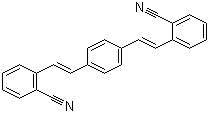 |
| Molecular Formula | C24H16N2 |
| Molecular Weight | 332.40 |
| CAS Registry Number | 13001-39-3 |
| EC Number | 235-835-1 |
| SMILES | C1=CC=C(C(=C1)/C=C/C2=CC=C(C=C2)/C=C/C3=CC=CC=C3C#N)C#N |
| Solubility | 0.02405 mg/L (25 °C water) |
|---|---|
| Density | 1.2±0.1 g/cm3, Calc.* |
| Index of Refraction | 1.661, Calc.* |
| Melting point | 208.28 °C |
| Boiling Point | 575.7±50.0 °C (760 mmHg), Calc.*, 501.94 °C |
| Flash Point | 275.3±24.0 °C, Calc.* |
| * | Calculated using Advanced Chemistry Development (ACD/Labs) Software. |
| Hazard Symbols |  GHS07 Warning Details GHS07 Warning Details | ||||||||
|---|---|---|---|---|---|---|---|---|---|
| Risk Statements | H302 Details | ||||||||
| Safety Statements | P280-P305+P351+P338 Details | ||||||||
| Hazard Classification | |||||||||
| |||||||||
| SDS | Available | ||||||||
 chemBlink Chemical Story
|
1,4-Bis(2-cyanostyryl)benzene, a member of the styrylbenzene family, is a compound that has garnered significant interest in the fields of organic electronics and materials science. This compound is characterized by its unique structure, featuring two cyano-substituted styryl groups attached to a central benzene ring. The discovery of 1,4-bis(2-cyanostyryl)benzene emerged from ongoing research into the synthesis and properties of functional organic materials, particularly those with potential applications in optoelectronic devices. The synthesis of 1,4-bis(2-cyanostyryl)benzene typically involves a multi-step process, which begins with the formation of the styryl moiety followed by the introduction of the cyano groups. This is usually achieved through a series of reactions including aldol condensation and subsequent cyanation. The ability to modify the electronic properties of the compound through substitution at the styryl positions has made it a valuable subject of study. Researchers have explored various synthetic routes to optimize the yield and purity of this compound, leading to advancements in its application in organic electronic devices. One of the primary applications of 1,4-bis(2-cyanostyryl)benzene is in organic light-emitting diodes (OLEDs). Due to its strong electron-accepting cyano groups, this compound exhibits favorable electronic properties that can enhance charge transport and light emission efficiency. When incorporated into OLED structures, 1,4-bis(2-cyanostyryl)benzene has demonstrated improved performance characteristics, making it an attractive candidate for the development of next-generation display technologies. Furthermore, its unique photophysical properties have also led to its investigation in organic photovoltaics (OPVs), where it can contribute to improved energy conversion efficiencies. In addition to its applications in optoelectronic devices, 1,4-bis(2-cyanostyryl)benzene has also been studied for its potential use in sensors and other electronic components. The compound’s sensitivity to external stimuli, such as light or electrical fields, positions it as a potential candidate for applications in sensing technologies. Researchers are investigating the use of this compound in chemosensors that can detect specific ions or small molecules, broadening its application scope in various fields. The interest in 1,4-bis(2-cyanostyryl)benzene reflects a broader trend in the development of functional organic materials with tailored electronic properties. As research progresses, the ability to fine-tune the chemical structure of compounds like 1,4-bis(2-cyanostyryl)benzene opens new possibilities for the design of advanced materials that can meet the demands of emerging technologies. In conclusion, 1,4-bis(2-cyanostyryl)benzene is a noteworthy compound in the landscape of organic electronics, with its discovery stemming from the quest for materials that enhance device performance. Its applications in OLEDs, OPVs, and sensors showcase its versatility and potential in modern technology. Ongoing research will likely reveal even more uses for this compound, contributing to advancements in organic materials science and electronic engineering. References 2014. Positional isomers of cyanostilbene: two-component molecular assembly and multiple-stimuli responsive luminescence. Scientific Reports, 4. DOI: 10.1038/srep04933 2014. CCDC 979756: Experimental Crystal Structure Determination. DOI: 10.5517/cc11wj1h 2011. CCDC 628795: Experimental Crystal Structure Determination. DOI: 10.5517/ccp39qs |
| Market Analysis Reports |