
Online Database of Chemicals from Around the World
| Guangzhou Green Cross Pharmaceutical Co., Ltd. | China | |||
|---|---|---|---|---|
 | www.m-pharma.com.cn | |||
 | +86 (20) 8222-0238 | |||
 | wangsy@m-pharma.com.cn | |||
| Chemical manufacturer since 1991 | ||||
| chemBlink Standard supplier since 2024 | ||||
| Classification | API >> Antibiotics >> Peptide drug |
|---|---|
| Name | Glycyl-L-glutamine monohydrate |
| Synonyms | (2S)-5-amino-2-[(2-aminoacetyl)amino]-5-oxopentanoic acid;hydrate |
| Molecular Structure | 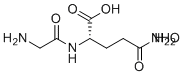 |
| Molecular Formula | C7H15N3O5 |
| Molecular Weight | 221.21 |
| Protein Sequence | GQ |
| CAS Registry Number | 131115-71-4 (172669-64-6) |
| SMILES | C(CC(=O)N)[C@@H](C(=O)O)NC(=O)CN.O |
| Hazard Symbols |  GHS07 Warning Details GHS07 Warning Details |
|---|---|
| Risk Statements | H302-H315-H319-H335 Details |
| Safety Statements | P261-P305+P351+P338 Details |
| SDS | Available |
 chemBlink Chemical Story
|
Glycyl-L-glutamine monohydrate is a dipeptide compound consisting of the amino acids glycine and L-glutamine, with one molecule of water associated as a hydrate. Its chemical structure can be described as H2NCH2CONHCH(CH2CH2CONH2)COOH·H2O. This dipeptide is of interest in both biochemical and pharmaceutical fields due to its improved stability over free L-glutamine in aqueous solution and its utility in cell culture and clinical nutrition. The compound was developed and studied primarily in the context of overcoming the instability of L-glutamine. In solution, L-glutamine is prone to spontaneous degradation into ammonia and pyrrolidone carboxylic acid, particularly under heat or over extended periods. This degradation limits its use in media for cell culture and parenteral nutrition. To address this problem, dipeptides such as glycyl-L-glutamine were investigated as stable alternatives. Glycyl-L-glutamine resists spontaneous decomposition and can release L-glutamine upon enzymatic hydrolysis in biological systems. Glycyl-L-glutamine monohydrate is commonly used in cell culture media to supply glutamine in a more stable form. It is particularly beneficial in long-term cultures or in conditions where high temperatures or storage times could compromise media quality. Once inside the cell or in the presence of extracellular peptidases, the dipeptide is cleaved to release free glutamine and glycine, both of which are essential nutrients for cell growth and function. In clinical nutrition, glycyl-L-glutamine has been incorporated into intravenous formulations to provide glutamine in a more stable and bioavailable form. This approach is particularly useful in patients requiring parenteral nutrition, such as those undergoing major surgery, suffering from trauma, burns, or severe infections, where glutamine supplementation has been associated with improved immune response and intestinal barrier function. Clinical studies have shown that glutamine dipeptides are well tolerated and effectively increase plasma glutamine levels, supporting their role in metabolic support. Pharmacokinetically, glycyl-L-glutamine is rapidly hydrolyzed by plasma and tissue peptidases. It does not accumulate in tissues and serves primarily as a precursor for glutamine supplementation. Its solubility and resistance to degradation also make it suitable for sterile injectable solutions, which is critical for its use in hospital settings. In addition to medical and cell culture applications, glycyl-L-glutamine is used in biochemical research to investigate peptide transport systems, including the PEPT1 and PEPT2 transporters in intestinal and renal epithelial cells. These transporters play an important role in the uptake of di- and tripeptides, and glycyl-L-glutamine serves as a model substrate to study their kinetics and specificity. The monohydrate form of glycyl-L-glutamine ensures ease of handling and accurate dosing in both laboratory and clinical settings. The hydrate water content is included in the molecular weight and is accounted for in formulations to ensure consistency and efficacy. In summary, glycyl-L-glutamine monohydrate is a chemically stable dipeptide used extensively as a glutamine source in cell culture and parenteral nutrition. Its resistance to degradation, high solubility, and efficient enzymatic conversion to active amino acids make it a valuable compound in both scientific research and clinical practice. |
| Market Analysis Reports |