
Online Database of Chemicals from Around the World
| Tyger Scientific Inc. | USA | |||
|---|---|---|---|---|
 | www.tygersci.com | |||
 | +1 (609) 434-0144 | |||
 | +1 (609) 434-0143 | |||
 | sales@tygersci.com | |||
| Chemical manufacturer since 1992 | ||||
| chemBlink Standard supplier since 2008 | ||||
| Porphyrin Systems | Germany | |||
|---|---|---|---|---|
| www.porphyrin-systems.de | |||
| +49 (40) 6466-5860 | |||
| +49 (40) 6466-5861 | |||
| hombrecher@porphyrin-systems.de | |||
| Chemical manufacturer since 1999 | ||||
| chemBlink Standard supplier since 2010 | ||||
| Hangzhou Leap Chem Co., Ltd. | China | |||
|---|---|---|---|---|
| www.leapchem.com | |||
| +86 (571) 8771-1850 | |||
| market19@leapchem.com | |||
 | QQ Chat | |||
| Chemical manufacturer since 2006 | ||||
| chemBlink Standard supplier since 2015 | ||||
| wuhan chemi Pharmacy Chemical Technology Co., Ltd. | China | |||
|---|---|---|---|---|
| www.chemipharm.com.cn | |||
| +86 13971619949 | |||
| gmn424@chemipharm.com.cn | |||
| QQ Chat | |||
 | WeChat: 13971619949 | |||
| Chemical manufacturer since 2014 | ||||
| chemBlink Standard supplier since 2026 | ||||
| Atlantic Research Chemicals Ltd. | UK | |||
|---|---|---|---|---|
| www.atlantic-chemicals.com | |||
| +44 (8707) 746-454 | |||
| +44 (8707) 746-455 | |||
| info@atlantic-chemicals.com | |||
| Chemical manufacturer | ||||
| Georganics Ltd. | Slovakia | |||
|---|---|---|---|---|
| www.georganics.sk | |||
| +421 (33) 640-3132 | |||
| +421 (33) 640-3133 | |||
| georganics@georganics.sk | |||
| Chemical manufacturer since 1998 | ||||
| Apollo Scientific Ltd. | UK | |||
|---|---|---|---|---|
| www.apolloscientific.co.uk | |||
| +44 (161) 406-0505 | |||
| +44 (161) 406-0506 | |||
| sales@apolloscientific.co.uk | |||
| Chemical manufacturer | ||||
| Anvia Chemicals, LLC | USA | |||
|---|---|---|---|---|
| www.anviachem.com | |||
| +1 (414) 534-7845 | |||
| +1 (414) 762-5539 | |||
| sales@anviachem.com | |||
| Chemical manufacturer | ||||
| AB Chem, Inc. | Canada | |||
|---|---|---|---|---|
| www.abcheminc.com | |||
| +1 (514) 685-8688 | |||
| +1 (514) 685-8488 | |||
| sales@abcheminc.com | |||
| Chemical manufacturer | ||||
| Classification | Pharmaceutical intermediate >> Heterocyclic compound intermediate >> Pyridine compound >> Ethylpyridine |
|---|---|
| Name | 4-(2-Aminoethyl)pyridine |
| Synonyms | 2-Pyridin-4-ylethanamine |
| Molecular Structure | 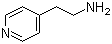 |
| Molecular Formula | C7H10N2 |
| Molecular Weight | 122.17 |
| CAS Registry Number | 13258-63-4 |
| EC Number | 625-467-3 |
| SMILES | C1=CN=CC=C1CCN |
| Density | 1.0±0.1 g/cm3 Calc.*, 1.012 g/mL (Expl.) |
|---|---|
| Boiling point | 230.7±15.0 °C 760 mmHg (Calc.)*, 260.6 °C (Expl.) |
| Flash point | 113.9±7.4 °C (Calc.)*, 100 °C (Expl.) |
| Index of refraction | 1.541 (Calc.)*, 1.538 (Expl.) |
| * | Calculated using Advanced Chemistry Development (ACD/Labs) Software. |
| Hazard Symbols |   GHS05;GHS07 Danger Details GHS05;GHS07 Danger Details | ||||||||||||||||||||||||
|---|---|---|---|---|---|---|---|---|---|---|---|---|---|---|---|---|---|---|---|---|---|---|---|---|---|
| Risk Statements | H314-H315-H319-H335 Details | ||||||||||||||||||||||||
| Safety Statements | P260-P261-P264-P264+P265-P271-P280-P301+P330+P331-P302+P352-P302+P361+P354-P304+P340-P305+P351+P338-P305+P354+P338-P316-P319-P321-P332+P317-P337+P317-P362+P364-P363-P403+P233-P405-P501 Details | ||||||||||||||||||||||||
| Hazard Classification | |||||||||||||||||||||||||
| |||||||||||||||||||||||||
| SDS | Available | ||||||||||||||||||||||||
 chemBlink Chemical Story
|
4-(2-Aminoethyl)pyridine is a bifunctional nitrogen-containing heteroaromatic compound consisting of a pyridine ring substituted at the 4-position with a two-carbon aminoethyl side chain. The molecule contains two distinct basic nitrogen centers: the ring nitrogen within the pyridine heteroaromatic system and a terminal primary aliphatic amine on the side chain. This dual-amine structure gives the compound both nucleophilic and coordinating properties that are widely relevant in organic synthesis and coordination chemistry. Pyridine and its derivatives have been known since the nineteenth century, when they were first isolated from coal tar and later recognized as fundamental heteroaromatic systems. Pyridine is a six-membered aromatic ring containing one nitrogen atom, and it exhibits aromatic stability due to delocalized π-electrons. Substitution at the 4-position is particularly significant in synthetic chemistry because it allows functional groups to be introduced without disrupting aromaticity while providing predictable electronic effects on the ring. The aminoethyl substituent in 4-(2-aminoethyl)pyridine introduces a flexible aliphatic chain terminating in a primary amine. This side chain is structurally similar to ethylamine fragments found in many biologically relevant molecules, but in this case it is directly connected to a heteroaromatic system. The presence of both a pyridine nitrogen and an aliphatic amine creates a molecule with differentiated basicity, where the aliphatic amine is generally more basic and nucleophilic than the aromatic nitrogen. Compounds containing both pyridine and alkylamine functionalities are widely used as ligands in coordination chemistry. The two nitrogen atoms can participate in metal binding either independently or cooperatively, depending on the metal center and coordination geometry. Such ligands are important in the design of transition metal complexes used in catalysis, including hydrogenation, oxidation, and cross-coupling reactions. The flexibility of the aminoethyl chain allows adaptation to different coordination environments. The synthesis of 4-(2-aminoethyl)pyridine is typically achieved through functionalization of pyridine derivatives or through construction of the side chain via alkylation or reductive amination strategies. One common approach involves introduction of a haloethyl substituent at the 4-position followed by nucleophilic substitution with ammonia or amine sources to generate the terminal amino group. Alternatively, reduction of nitrile or imine intermediates can be used to access the aminoethyl functionality. From a physicochemical perspective, 4-(2-aminoethyl)pyridine is expected to be a polar organic compound with significant solubility in water and polar organic solvents due to its two basic nitrogen atoms. The compound can form hydrogen bonds both as a donor (via the primary amine) and as an acceptor (via both nitrogen centers). Protonation under acidic conditions leads to formation of mono- or di-protonated species, which further increases aqueous solubility and ionic character. The electronic properties of the pyridine ring are influenced by the electron-donating effect of the aminoethyl substituent through inductive and, to a lesser extent, resonance effects. This can slightly increase electron density on the aromatic ring, although the overall aromatic system remains electron-deficient relative to benzene due to the presence of the ring nitrogen. In coordination chemistry, ligands like 4-(2-aminoethyl)pyridine are valued for their ability to create chelating or semi-chelating environments around metal centers. The spatial separation between the pyridine nitrogen and the aliphatic amine allows for diverse binding modes, including monodentate and bidentate coordination depending on molecular conformation and metal preference. This versatility is useful in the design of catalysts and functional metal complexes. Compounds of this general structural class are also relevant in medicinal chemistry as intermediates for the synthesis of more complex nitrogen-containing molecules. The presence of two reactive amine sites allows sequential derivatization, enabling incorporation into heterocycles, amides, and other functional frameworks commonly found in bioactive compounds. Overall, 4-(2-aminoethyl)pyridine is a bifunctional heteroaromatic compound combining a pyridine ring with a flexible primary amine side chain. Its significance lies in its dual basic nitrogen centers, which provide versatility in coordination chemistry and synthetic organic transformations, making it a useful building block in chemical research and ligand design. References 2025. Enzymatic combinatorial synthesis of E-64 and related cysteine protease inhibitors. Nature Chemical Biology. URL: https://www.ncbi.nlm.nih.gov/pmc/articles/PMC12568646 2024. Molecular Structure Tailoring of Organic Spacers for High-Performance Ruddlesden–Popper Perovskite Solar Cells. Nano-Micro Letters. URL: https://www.ncbi.nlm.nih.gov/pmc/articles/PMC11469732 2023. Syntheses, crystal structures, spectroscopic and thermal properties of 3D heteronuclear coordination polymers with 4-ethylpyridine and cyanide ligands. Structural Chemistry. DOI: 10.1007/s11224-023-02249-2 |
| Market Analysis Reports |