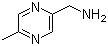
2-(Aminomethyl)-5-methylpyrazine is an aromatic heterocyclic compound composed of a pyrazine ring substituted at position 2 by an aminomethyl group and at position 5 by a methyl group. It has the molecular formula C6H9N3. The molecule contains three nitrogen atoms, two of which are located in the aromatic ring, while the third is part of a primary amine. Structurally, the pyrazine ring provides a rigid, planar core, while the aminomethyl substituent introduces a reactive site suitable for further functionalization. The methyl group at position 5 adds hydrophobic character and can influence the overall distribution of electronic density within the molecule.
The discovery of this compound arose from investigations centered on the synthesis of functionalized pyrazines intended for pharmaceutical applications. Pyrazines, since the early twentieth century, have been recognized as important aromatic heterocycles with broad potential in medicinal chemistry. The ability to introduce substituents at specific positions of the pyrazine ring has been fundamental to efforts aimed at improving biological activity, solubility, and metabolic stability. During these developments, compounds containing aminomethyl groups on heterocyclic rings were synthesized to provide reactive amino functionalities capable of participating in condensation reactions or coupling reactions. As part of these strategies, 2-(aminomethyl)-5-methylpyrazine was prepared as a building block suitable for the construction of more complex molecules.
The compound has found applications primarily in pharmaceutical synthesis. Because the aminomethyl group is nucleophilic, it can be used to form amides, ureas, or heterocyclic linkages in multistep synthetic routes. In drug discovery programs, functionalized pyrazines have been evaluated for a wide range of biological properties, including anti-inflammatory, antibacterial, antifungal, antiviral, and anticancer effects. Many of these investigations rely on derivatives produced through intermediates such as 2-(aminomethyl)-5-methylpyrazine. In several synthetic studies of bioactive pyrazine derivatives, the aminomethyl substituent serves as a convenient anchor for the introduction of pharmacophoric groups, enabling chemists to produce libraries of compounds for biological screening.
From a synthetic standpoint, 2-(aminomethyl)-5-methylpyrazine can be obtained by transforming appropriately substituted precursors. Classical routes include functionalization of the methyl group at position 2 of 2,5-dimethylpyrazine followed by conversion to a protected aminomethyl derivative and subsequent deprotection. Preparative methods may involve halogenation, nucleophilic substitution, or multi-step rearrangements depending on the intended scale and purity requirements. The presence of three nitrogen atoms confers distinct reactivity patterns, which must be considered when planning synthetic transformations that involve electrophiles or protective groups.
In practical use, the compound is valued for its role as a versatile intermediate rather than a final active ingredient. Research laboratories employ it as a starting point to access diverse pyrazine analogues through reactions such as acylation, reductive amination, or carbon–nitrogen bond formation. These reactions, conducted under controlled conditions, allow structural modification of either the amine substituent or the aromatic ring itself. Because the molecule is relatively small and structurally simple, it is well suited for structure–activity relationship studies in which systematic modifications are used to explore the influence of substituent variation on biological function.
Historically, interest in pyrazine derivatives has grown alongside advances in heterocyclic chemistry. As synthetic methodologies improved, chemists incorporated pyrazine motifs into candidate drug molecules, leading to increased demand for reliable intermediates. As a result, 2-(aminomethyl)-5-methylpyrazine remains relevant as a scaffold in pathways directed toward pharmacologically active pyrazine-containing compounds.
References
Huigens R W III, et al (2022) Pyrazine and phenazine heterocycles: platforms for total synthesis and medicinal chemistry. Molecules 27 1112 DOI: 10.3390/molecules27031112
Setyowatia W A E, et al (2023) Chemical transformation of pyrazine derivatives: nitration, acetylation, esterification and other modifications. Moroccan Journal of Chemistry 11 4 1264–1278 URL
|





 GHS05;GHS06 Danger Details
 chemBlink Chemical Story