
Online Database of Chemicals from Around the World
| Simagchem Corporation | China | |||
|---|---|---|---|---|
 | www.simagchem.com | |||
 | +86 13806087780 | |||
 | +86 (592) 268-0237 | |||
 | sale@simagchem.com | |||
| Chemical manufacturer since 2002 | ||||
| chemBlink Standard supplier since 2008 | ||||
| Sinfachem Limited | China | |||
|---|---|---|---|---|
| www.sinfachem.com | |||
| +86 (25) 8468-3399 8517-8591 | |||
| +86 (25) 8468-3112 | |||
| sinfachem@foxmail.com sinfachemltd@foxmail.com info@sinfachem.com | |||
 | QQ Chat | |||
| Chemical manufacturer | ||||
| chemBlink Standard supplier since 2009 | ||||
| BOC Sciences | USA | |||
|---|---|---|---|---|
| www.bocsci.com | |||
| +1 (631) 485-4226 | |||
| +1 (631) 614-7828 | |||
| info@bocsci.com | |||
| Chemical manufacturer | ||||
| chemBlink Standard supplier since 2010 | ||||
| Huangshi Pharma Co., Ltd. | China | |||
|---|---|---|---|---|
| www.huangshipharma.com | |||
| +86 (714) 329-3589 | |||
| xiebihuan@163.com | |||
| QQ Chat | |||
| Chemical manufacturer since 2013 | ||||
| chemBlink Standard supplier since 2025 | ||||
| Ivy Fine Chemicals | USA | |||
|---|---|---|---|---|
| www.ivychem.com | |||
| +1 (856) 465-8550 | |||
| +1 (856) 616-1161 | |||
| sales@ivychem.com | |||
| Chemical manufacturer | ||||
| Classification | Organic raw materials >> Amino compound >> Acyclic monoamines, polyamines and their derivatives and salts |
|---|---|
| Name | Methylglucamine antimonate |
| Synonyms | Meglumine antimonate; 1-Deoxy-1-(methylamino)-D-glucitol antimonate |
| Molecular Structure | 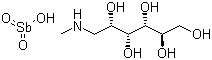 |
| Molecular Formula | C7H17NO5.HSbO3 |
| Molecular Weight | 365.98 |
| CAS Registry Number | 133-51-7 |
| EC Number | 205-108-3 |
| SMILES | CNC[C@@H]([C@H]([C@@H]([C@@H](CO)O)O)O)O.O[Sb](=O)=O |
| Hazard Symbols |   GHS07;GHS09 Warning Details GHS07;GHS09 Warning Details | ||||||||||||||||
|---|---|---|---|---|---|---|---|---|---|---|---|---|---|---|---|---|---|
| Risk Statements | H302-H332-H411 Details | ||||||||||||||||
| Safety Statements | P261-P264-P270-P271-P273-P301+P317-P304+P340-P317-P330-P391-P501 Details | ||||||||||||||||
| Hazard Classification | |||||||||||||||||
| |||||||||||||||||
| SDS | Available | ||||||||||||||||
 chemBlink Chemical Story
|
Methylglucamine antimonate is an inorganic-organic compound formed by the combination of methylglucamine, an aminopolyol derived from glucose, and antimonate, a coordination complex or salt involving antimony in an oxidized state. The compound is primarily known for its use in pharmaceutical and medicinal applications, especially as an antiprotozoal agent. Methylglucamine (also known as N-methylglucamine or meglumine) is a sugar-derived amine widely used as a counterion or carrier in various drug formulations. It enhances the solubility and bioavailability of certain drugs by forming stable complexes or salts. Antimonates, containing antimony in the +5 oxidation state, are used in medicine due to their antiparasitic properties. Antimony compounds have been historically important in the treatment of diseases such as leishmaniasis and schistosomiasis. The combination of methylglucamine with antimonate produces methylglucamine antimonate, a compound designed to optimize therapeutic effects and reduce toxicity compared to earlier antimony-based drugs. The interaction between the organic methylglucamine and inorganic antimonate results in a complex with improved solubility and pharmacokinetics, facilitating administration and patient compliance. Methylglucamine antimonate is synthesized by reacting methylglucamine with antimonic acid or other antimonate sources under controlled conditions, leading to the formation of a salt or coordination compound. This process ensures that antimony is present in a biologically active form that can be delivered effectively. The primary application of methylglucamine antimonate is in the treatment of protozoan infections, particularly leishmaniasis, a disease caused by protozoa of the genus Leishmania. These infections affect the skin, mucous membranes, and internal organs, and effective therapy is critical to prevent severe morbidity. Methylglucamine antimonate works by interfering with the parasite’s metabolism and replication processes, though the exact molecular mechanism is complex and involves multiple cellular targets. Due to its therapeutic importance, methylglucamine antimonate is administered under medical supervision, often by injection, to ensure proper dosing and minimize side effects. The compound has been favored for its enhanced efficacy and reduced toxicity profile compared to earlier pentavalent antimony drugs, though adverse reactions can still occur. Analytical characterization of methylglucamine antimonate involves various techniques. Infrared spectroscopy (IR) can detect functional groups associated with methylglucamine and the antimonate moiety. Nuclear magnetic resonance (NMR) spectroscopy provides structural information about the organic portion, while elemental analysis and atomic absorption spectroscopy quantify antimony content. The compound’s solubility, stability, and pharmacological properties are routinely assessed to ensure quality and efficacy. In summary, methylglucamine antimonate is a medically significant compound combining the organic sugar amine methylglucamine with antimony in an oxidized antimonate form. It serves as an important antiparasitic agent, particularly against leishmaniasis, offering improved solubility, bioavailability, and reduced toxicity relative to earlier antimony-based treatments. References 2024. Topical application of ozonated sunflower oil accelerates the healing of lesions of cutaneous leishmaniasis in mice under meglumine antimoniate treatment. Medical Microbiology and Immunology, 213(1). DOI: 10.1007/s00430-024-00788-x 2024. Effectiveness of Antileishmanial Treatments in Three Endemic Areas of Colombia: A Community-Based Cohort Study. The American Journal of Tropical Medicine and Hygiene, 111(6). DOI: 10.4269/ajtmh.24-0367 2024. In silico and experimental potentials of 6-shogaol and meglumine antimoniate on Leishmania major: multiple synergistic combinations through modulation of biological properties. Immunologic Research. DOI: 10.1007/s12026-024-09530-4 |
| Market Analysis Reports |