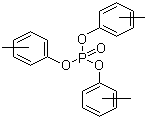
Tritolyl phosphate (TTP), also known as tricresyl phosphate (TCP), is an organophosphorus compound widely used as a plasticizer, flame retardant, and lubricant additive. It consists of a phosphate core bonded to three cresol (methylphenol) groups, which can vary in their position (ortho, meta, or para) on the phenyl ring, leading to different isomeric forms of the substance. TTP’s versatility and functional properties have made it an important chemical in various industrial applications.
The discovery and initial use of tritolyl phosphate trace back to the early 20th century, primarily during the rise of industrial chemistry. The substance was first employed as a plasticizer, an additive that enhances the flexibility, durability, and workability of polymers like plastics and resins. The demand for TTP increased with the growth of industries requiring durable and flexible plastic materials, such as construction, automotive, and electronics. Its ability to impart flexibility without affecting the structural integrity of polymers makes it a valuable component in products like polyvinyl chloride (PVC) and synthetic rubbers.
One of the most significant uses of tritolyl phosphate is as a flame retardant. This application is particularly critical in industries where fire safety is paramount, including textiles, coatings, and electronics. TTP works by inhibiting the ignition and spread of fire, a property derived from its phosphorus content, which promotes the formation of a protective char layer on the material’s surface. This layer acts as a barrier, slowing down the combustion process and providing additional time for fire containment.
Tritolyl phosphate is also widely used in lubricants, especially in industrial and aviation applications. It acts as an extreme pressure additive in lubricants, enhancing their ability to withstand high temperatures and pressures. This feature is particularly beneficial in high-performance environments, such as aircraft engines and heavy machinery. In aviation hydraulic fluids, TTP provides necessary thermal stability and anti-wear properties, ensuring the smooth operation of complex systems under extreme conditions.
In addition to its roles as a plasticizer and flame retardant, tritolyl phosphate has applications as a solvent in various chemical processes. It is used as an extraction solvent in the separation and purification of metals, particularly rare earth elements and uranium, which are critical to several high-tech industries. TTP’s solvent properties allow it to effectively isolate target metals from ore or other complex mixtures, making it an integral part of the metal extraction process.
TTP’s role in industrial chemistry extends to its use as a stabilizer for synthetic resins. In this capacity, it helps prevent the degradation of polymers by heat, light, or chemical agents. Its stabilizing action ensures that polymers maintain their desired physical and mechanical properties over time, extending the life of products in which they are used. This function is especially important in applications where materials are exposed to harsh environmental conditions.
Despite its widespread use, tritolyl phosphate has faced scrutiny due to potential health and environmental concerns. Some isomers of tricresyl phosphate, particularly ortho-isomers, are associated with neurotoxicity. Prolonged exposure to these compounds has been linked to organophosphate-induced delayed neurotoxicity (OPIDN), a condition that affects the nervous system. As a result, regulations have been put in place to limit the use of certain isomeric forms of TTP, especially in consumer products like toys and household items, to reduce the risk of human exposure.
In response to these concerns, efforts have been made to develop safer alternatives or refine manufacturing processes to minimize the production of hazardous isomers. However, the unique properties of tritolyl phosphate continue to make it a valuable substance in many industrial applications. The development of safer isomeric mixtures, along with more stringent handling and disposal guidelines, helps balance the benefits of TTP with the need for safety and environmental protection.
In conclusion, tritolyl phosphate is a multifaceted chemical compound with a wide range of applications, from enhancing the flexibility of plastics to improving fire safety and acting as a high-performance lubricant additive. Its historical development and industrial importance underscore its role as a critical component in various manufacturing processes. However, as industries and regulatory bodies become increasingly aware of the health risks associated with certain isomers, the focus on safer applications and alternatives for TTP continues to grow.
References
1932. Polyneuritis nach Gebrauch eines Abortivums (Tri-Ortho-Kresyl-Phosphat-Vergiftung). Deutsche Zeitschrift für Nervenheilkunde, 126(5).
DOI: 10.1007/bf01767782
2024. Organophosphorus flame retardants in the Qiantang River of China: occurrence, source and ecological risk assessment. Environmental Geochemistry and Health, 46(9).
DOI: 10.1007/s10653-024-02172-3
2024. Nicotinamide mononucleotide maintains cytoskeletal stability and fortifies mitochondrial function to mitigate oocyte damage induced by Triocresyl phosphate. Ecotoxicology and Environmental Safety, 274.
DOI: 10.1016/j.ecoenv.2024.116264
|





 GHS07;GHS09 Warning Details
 chemBlink Chemical Story