
Online Database of Chemicals from Around the World
| Creative Peptides | USA | |||
|---|---|---|---|---|
 | www.creative-peptides.com | |||
 | +1 (631) 624-4882 | |||
 | +1 (631) 614-7828 | |||
 | info@creative-peptides.com | |||
| Chemical manufacturer | ||||
| chemBlink Standard supplier since 2010 | ||||
| Hangzhou Leap Chem Co., Ltd. | China | |||
|---|---|---|---|---|
| www.leapchem.com | |||
| +86 (571) 8771-1850 | |||
| market19@leapchem.com | |||
 | QQ Chat | |||
| Chemical manufacturer since 2006 | ||||
| chemBlink Standard supplier since 2015 | ||||
| Carbosynth China Ltd. | China | |||
|---|---|---|---|---|
| www.carbosynth.cn | |||
| +86 (512) 6260-5585 | |||
| +86 (512) 6260-5576 | |||
| sales@carbosynth.com | |||
| QQ Chat | |||
| Chemical manufacturer since 2006 | ||||
| chemBlink Standard supplier since 2016 | ||||
| Changzhou Jiuwu Chemical Co., Ltd. | China | |||
|---|---|---|---|---|
| www.jiuwuchem.com | |||
| +86 (519) 8512-1086 +86 13775162768 | |||
| +86 (519) 8512-5369 | |||
| info@jiuwuchem.cn | |||
| QQ Chat | |||
| Chemical manufacturer since 2009 | ||||
| chemBlink Standard supplier since 2023 | ||||
| Classification | Biochemical >> Amino acids and their derivatives >> Cysteine derivative |
|---|---|
| Name | N-(9-Fluorenylmethoxycarbonyl)-L-cysteine |
| Synonyms | N-[(9H-Fluoren-9-ylmethoxy)carbonyl]-L-cysteine; Fmoc-L-Cys-OH; Fmoc-cysteine |
| Molecular Structure | 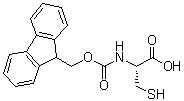 |
| Molecular Formula | C18H17NO4S |
| Molecular Weight | 343.40 |
| Protein Sequence | C |
| CAS Registry Number | 135248-89-4 |
| SMILES | C1=CC=C2C(=C1)C(C3=CC=CC=C32)COC(=O)N[C@@H](CS)C(=O)O |
| Solubility | Insoluble (8.9E-3 g/L) (25 °C), Calc.* |
|---|---|
| Density | 1.337±0.06 g/cm3 (20 °C 760 Torr), Calc.* |
| Boiling point | 574.4±50.0 °C 760 mmHg (Calc.)* |
| Flash point | 301.2±30.1 °C (Calc.)* |
| Index of refraction | 1.634 (Calc.)* |
| * | Calculated using Advanced Chemistry Development (ACD/Labs) Software. |
| Hazard Symbols |  GHS07 Warning Details |
|---|---|
| Risk Statements | H302-H315-H319-H335 Details |
| Safety Statements | P261-P305+P351+P338 Details |
| SDS | Available |
 chemBlink Chemical Story
|
Protecting an amino group does not mean protecting every reactive part of an amino acid. N-(9-Fluorenylmethoxycarbonyl)-L-cysteine, CAS 135248-89-4, makes that distinction unusually clear. Its alpha-amino group carries Fmoc, but its sulfur remains a free thiol. The difference between this compound and an S-protected cysteine derivative is therefore a change in available chemistry, not merely a longer product name. Cysteine has a CH2SH side chain. Adding Fmoc at nitrogen leaves that S-H bond intact, as reflected in the structure assigned to this CAS. It should not be silently substituted for Fmoc-Cys(Trt)-OH, Fmoc-Cys(Acm)-OH, or another derivative whose sulfur bears an additional protecting group. Those compounds are separately defined materials with different behavior during synthesis. The Fmoc concept has a documented history. In 1970, Louis Carpino and Grace Han introduced the fluorenylmethoxycarbonyl function as a base-sensitive amino-protecting group. This historical development explains the temporary nitrogen protection in the present molecule; it is not a claim that this particular cysteine CAS entry was first reported in that paper. A protecting-group invention and the history of every derivative using it are different subjects. The free thiol provides chemistry that a protected sulfur cannot display in the same form. Two thiols can be oxidized to a disulfide, linking sulfur atoms while changing the molecules' connectivity. Conversely, reduction can regenerate thiols. A sample's oxidation state is consequently relevant to what it actually contains. An amino-protection label alone cannot establish that all sulfur is still present as the reduced monomer. In peptide chemistry, such sulfur reactivity can be either the desired handle or an unwanted competing pathway. Selective labeling and disulfide construction require access to sulfur, whereas many chain-assembly strategies deliberately mask it until a later stage. The appropriate derivative depends on the reaction sequence. Free sulfur does not make this reagent a universal replacement for the side-chain-protected building blocks used in routine Fmoc synthesis. Cysteine also warrants attention to stereochemistry during activation and coupling. Technical literature on cysteinyl peptide synthesis describes epimerization and other side reactions under particular conditions. These concerns belong to the chosen transformation and substrate, rather than proving that every preparation loses stereochemical integrity. For L-cysteine, the usual absolute configuration is R, illustrating why the L/D convention should not be treated as an automatic translation into S/R. This material's most instructive feature is selective incompleteness of protection. One nitrogen has been deliberately masked while a sulfur remains available. Reading that structure correctly reveals both a potential synthetic opportunity and the analytical questions needed to distinguish the intended compound from oxidation products or differently protected relatives. References: 1. PubChem. Fmoc-L-cysteine, CID 11024349; CAS 135248-89-4 and free-thiol structure. https://pubchem.ncbi.nlm.nih.gov/compound/11024349 2. Carpino LA, Han GY. The 9-Fluorenylmethoxycarbonyl Function, a New Base-Sensitive Amino-Protecting Group. JACS (1970). https://doi.org/10.1021/ja00722a043 3. Merck/Novabiochem. Protocols for the Fmoc SPPS of Cysteine-Containing Peptides. https://www.sigmaaldrich.com/BI/en/technical-documents/protocol/chemistry-and-synthesis/peptide-synthesis/fmoc-spps-cysteine-peptides |
| Market Analysis Reports |