
Online Database of Chemicals from Around the World
| Lengshi Chemical (Qingzhou) Co., Ltd. | China | |||
|---|---|---|---|---|
 | www.xinnuopharma.cn | |||
 | +86 18615688656 | |||
 | sales@xinnuopharma.com | |||
 | WeChat: 18615688656 | |||
| Chemical distributor since 2024 | ||||
| chemBlink Standard supplier since 2026 | ||||
| Classification | Biochemical >> Inhibitor >> G protein coupled receptor(GPCR & G Protein) |
|---|---|
| Name | Rimegepant Sulfate |
| Synonyms | bis([(5S,6S,9R)-5-amino-6-(2,3-difluorophenyl)-6,7,8,9-tetrahydro-5H-cyclohepta[b]pyridin-9-yl] 4-(2-oxo-3H-imidazo[4,5-b]pyridin-1-yl)piperidine-1-carboxylate);sulfuric acid trihydrate |
| Molecular Structure | 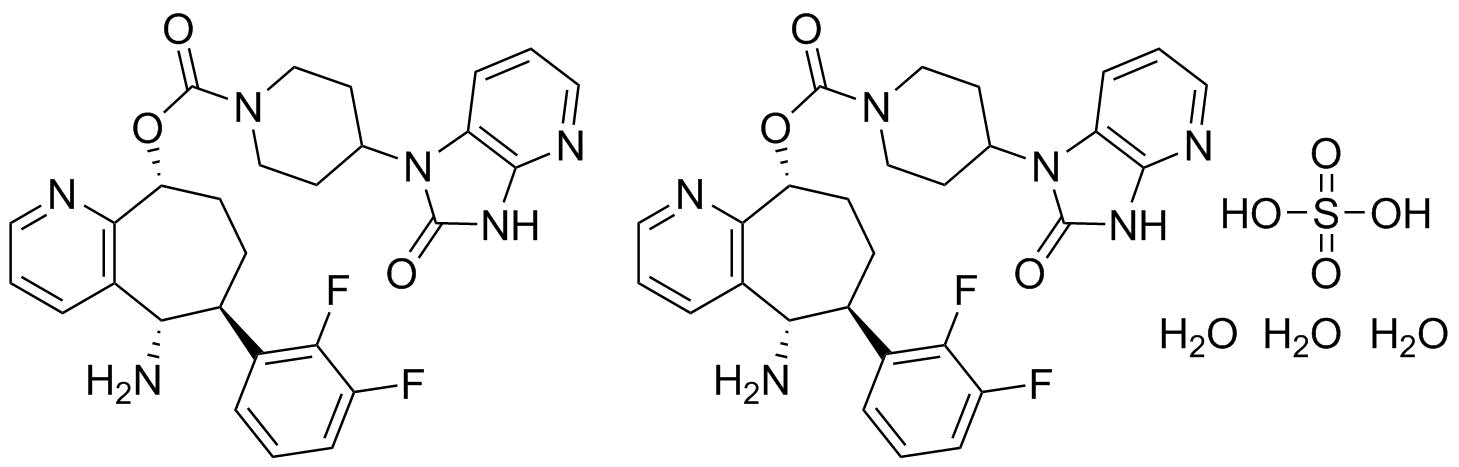 |
| Molecular Formula | C56H64F4N12O13S |
| Molecular Weight | 1221.24 |
| CAS Registry Number | 1374024-48-2 |
| EC Number | 822-372-0 |
| SMILES | C1C[C@H](C2=C(C=CC=N2)[C@H]([C@@H]1C3=C(C(=CC=C3)F)F)N)OC(=O)N4CCC(CC4)N5C6=C(NC5=O)N=CC=C6.C1C[C@H](C2=C(C=CC=N2)[C@H]([C@@H]1C3=C(C(=CC=C3)F)F)N)OC(=O)N4CCC(CC4)N5C6=C(NC5=O)N=CC=C6.O.O.O.OS(=O)(=O)O |
| Hazard Symbols |   GHS07;GHS08 Warning Details GHS07;GHS08 Warning Details | ||||||||||||
|---|---|---|---|---|---|---|---|---|---|---|---|---|---|
| Risk Statements | H302-H361-H361d-H373 Details | ||||||||||||
| Safety Statements | P203-P260-P264-P270-P280-P301+P317-P318-P319-P330-P405-P501 Details | ||||||||||||
| Hazard Classification | |||||||||||||
| |||||||||||||
 chemBlink Chemical Story
|
Rimegepant sulfate is the sulfate salt form of rimegepant, a small-molecule calcitonin gene-related peptide (CGRP) receptor antagonist developed for the treatment of migraine. Rimegepant itself belongs to the class of “gepant” compounds, which were developed in response to increasing understanding of the role of CGRP in migraine pathophysiology. The sulfate form is used to improve the compound’s solid-state stability and handling characteristics in pharmaceutical formulations. The development of rimegepant was part of a broader research effort beginning in the late twentieth and early twenty-first centuries aimed at targeting the CGRP pathway for migraine therapy. CGRP is a neuropeptide widely distributed in the trigeminovascular system and is strongly implicated in the transmission of pain signals during migraine attacks. Pharmacological research demonstrated that blocking CGRP receptors could reduce migraine symptoms without the vasoconstrictive effects associated with earlier migraine therapies such as triptans. This discovery led to the identification and optimization of several CGRP receptor antagonists, including rimegepant. Rimegepant was developed through medicinal chemistry optimization of earlier CGRP receptor antagonist scaffolds, focusing on improving oral bioavailability, receptor affinity, and metabolic stability. The compound acts by selectively binding to the CGRP receptor complex, thereby inhibiting the binding of endogenous CGRP. This prevents downstream signaling associated with neurogenic inflammation and pain transmission in migraine pathways. The mechanism of action has been confirmed through pharmacological studies in both preclinical and clinical settings. The sulfate salt form of rimegepant is used in pharmaceutical manufacturing to obtain a stable and well-characterized solid form suitable for formulation. Salt formation is a common strategy in drug development, used to improve properties such as crystallinity, solubility, stability, and manufacturability. In the case of rimegepant, conversion to the sulfate salt provides a defined solid-state structure that supports consistent dosing and formulation performance. Rimegepant sulfate has been developed and evaluated in clinical research for both acute treatment and preventive treatment of migraine. Clinical studies have shown that CGRP receptor antagonists can reduce the frequency and severity of migraine attacks. Unlike earlier migraine therapies that act on serotonin receptors and may cause vasoconstriction, CGRP antagonists operate through a non-vasoconstrictive mechanism, which has been an important advancement in migraine pharmacotherapy. The compound is administered orally in pharmaceutical formulations designed to deliver the active free base after absorption. Once in systemic circulation, rimegepant binds to CGRP receptors located in the trigeminal system, blocking the action of CGRP. This reduces neurogenic inflammation and modulates pain signaling pathways associated with migraine episodes. The pharmacological profile of rimegepant includes a relatively long duration of action compared with earlier small-molecule antagonists in the CGRP class. The discovery and development of rimegepant were part of a broader trend in modern drug discovery emphasizing targeted therapy based on molecular mechanisms of disease. The identification of CGRP as a key mediator in migraine led to significant investment in both monoclonal antibody therapies and small-molecule receptor antagonists. Rimegepant represents one of the orally active small-molecule options arising from this research area. From a chemical standpoint, rimegepant is a complex heterocyclic compound containing multiple ring systems and functional groups designed to optimize receptor binding and pharmacokinetic properties. The sulfate salt form does not fundamentally alter the pharmacological activity of the molecule but provides a practical and stable formulation for pharmaceutical use. Overall, rimegepant sulfate is a clinically used CGRP receptor antagonist developed for the treatment of migraine. Its significance lies in its role as part of a new class of migraine therapies targeting neuropeptide signaling pathways, offering an alternative to traditional vasoconstrictive treatments and contributing to advances in migraine pharmacology. References 2025. Efficacy and safety of rimegepant for the preventive treatment of |
| Market Analysis Reports |