
Online Database of Chemicals from Around the World
| Zhejiang Metallurgical Research Institute Co., Ltd. | China | |||
|---|---|---|---|---|
 | www.pgmcatalyst.com | |||
 | +86 (571) 8817-8133 +86 (578) 814-5985 | |||
 | +86 (578) 814-5986 | |||
 | xk@pgmcatalyst.com scm@pgmcatalyst.com ylq@pgmcatalyst.com | |||
| Chemical manufacturer since 1958 | ||||
| chemBlink Standard supplier since 2008 | ||||
| Simagchem Corporation | China | |||
|---|---|---|---|---|
| www.simagchem.com | |||
| +86 13806087780 | |||
| +86 (592) 268-0237 | |||
| sale@simagchem.com | |||
| Chemical manufacturer since 2002 | ||||
| chemBlink Standard supplier since 2008 | ||||
| Sinocompound Catalysts Co., Ltd. | China | |||
|---|---|---|---|---|
| www.sinocompound.com | |||
| +86 (512) 6721-6630 | |||
| +86 (512) 5631-6689 | |||
| sales@sinocompound.com | |||
| Chemical manufacturer since 2008 | ||||
| chemBlink Standard supplier since 2010 | ||||
| Baoji Rock Pharmachem Co., Ltd. | China | |||
|---|---|---|---|---|
| www.bjrock.com | |||
| +86 (10) 8487-1070 8487-1071 8487-1072 | |||
| +86 (10) 8487-1078 | |||
| bjrock@163.com | |||
| Chemical manufacturer since 2003 | ||||
| chemBlink Standard supplier since 2010 | ||||
| Intatrade Chemicals GmbH | Germany | |||
|---|---|---|---|---|
| www.intatrade.de | |||
| +49 (3493) 605-465 | |||
| +49 (3493) 605-470 | |||
| sales@intatrade.de | |||
| Chemical distributor | ||||
| chemBlink Standard supplier since 2011 | ||||
| Shaanxi Kaida Chemcial Engineering Co., Ltd. | China | |||
|---|---|---|---|---|
| www.kd-chem.com | |||
| +86 (917) 331-7143 332-2918 | |||
| +86 (917) 331-0616 | |||
| kaida@kd-chem.com | |||
| Chemical manufacturer since 1999 | ||||
| chemBlink Standard supplier since 2014 | ||||
| Colonial Metals, Inc. | USA | |||
|---|---|---|---|---|
| www.colonialmetals.com | |||
| +1 (410) 398-7200 (800) 962-1537 | |||
| +1 (410) 398-2918 | |||
| sales@colonialmetals.com | |||
| Chemical manufacturer | ||||
| ChemPur GmbH | Germany | |||
|---|---|---|---|---|
| www.chempur.de | |||
| +49 (721) 933-840 | |||
| +49 (721) 47-2001 | |||
| info@chempur.de | |||
| Chemical manufacturer | ||||
| Strem Chemicals, Inc. | USA | |||
|---|---|---|---|---|
| www.strem.com | |||
| +1 (978) 499-1600 | |||
| +1 (978) 465-3104 | |||
| info@strem.com | |||
| Chemical manufacturer | ||||
| Shanghai Worldyang Chemical Co., Ltd. | China | |||
|---|---|---|---|---|
| www.worldyachem.com | |||
| +86 13651600618 +86 (21) 5679-5779 | |||
| +86 (21) 5679-5266 | |||
| sales7777@worldyachem.com | |||
 | QQ Chat | |||
 | WeChat: 13651600618 | |||
 | WhatsApp:+86 13651600618 | |||
| Chemical manufacturer since 2012 | ||||
| Classification | Organic raw materials >> Organometallic compound >> Organic rhodium |
|---|---|
| Name | Carbonylbis(triphenylphosphine)rhodium(I) chloride |
| Synonyms | Bis(triphenylphosphine)rhodium(I) carbonyl chloride |
| Molecular Structure | 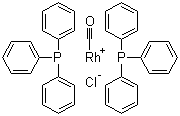 |
| Molecular Formula | C37H30ClOP2Rh |
| Molecular Weight | 690.95 |
| CAS Registry Number | 13938-94-8 |
| EC Number | 237-712-8 |
| SMILES | [C-]#[O+].C1=CC=C(C=C1)P(C2=CC=CC=C2)C3=CC=CC=C3.C1=CC=C(C=C1)P(C2=CC=CC=C2)C3=CC=CC=C3.[Cl-].[Rh] |
| Melting point | 224 - 227 °C (Decomposes) (Expl.) |
|---|---|
| Solubility | Soluble (acetone, chloroform, ethano)l (Expl.) |
| Hazard Symbols |  GHS07 Warning Details GHS07 Warning Details | ||||||||||||||||||||||||
|---|---|---|---|---|---|---|---|---|---|---|---|---|---|---|---|---|---|---|---|---|---|---|---|---|---|
| Risk Statements | H302-H312-H315-H319-H332-H335-H413 Details | ||||||||||||||||||||||||
| Safety Statements | P261-P264-P264+P265-P270-P271-P273-P280-P301+P317-P302+P352-P304+P340-P305+P351+P338-P317-P319-P321-P330-P332+P317-P337+P317-P362+P364-P403+P233-P405-P501 Details | ||||||||||||||||||||||||
| Hazard Classification | |||||||||||||||||||||||||
| |||||||||||||||||||||||||
| SDS | Available | ||||||||||||||||||||||||
 chemBlink Chemical Story
|
Carbonylbis(triphenylphosphine)rhodium(I) chloride, commonly abbreviated as RhCl(CO)(PPh3)2, is a coordination complex of rhodium featuring rhodium in the +1 oxidation state. The compound consists of a rhodium(I) center coordinated by a carbonyl (CO) ligand, two triphenylphosphine (PPh3) ligands, and a chloride ion. It typically appears as a yellow to orange crystalline solid and is soluble in common organic solvents. The synthesis of carbonylbis(triphenylphosphine)rhodium(I) chloride usually involves the reaction of rhodium(III) chloride hydrate with an excess of triphenylphosphine under a carbon monoxide atmosphere. This reduction process leads to the formation of the rhodium(I) complex. The reaction is often carried out in solvents like ethanol or acetone, and the product can be isolated by crystallization. Structurally, the rhodium center in RhCl(CO)(PPh3)2 adopts a square planar geometry, characteristic of d8 transition metal complexes. The coordination sphere includes one carbonyl ligand, two triphenylphosphine ligands, and one chloride ligand. The carbonyl ligand binds through the carbon atom with a strong metal-to-ligand backbonding interaction, while the phosphines coordinate via phosphorus atoms. The chloride ion serves as a monodentate ligand completing the coordination environment. This complex is well-known for its role as a catalyst precursor in homogeneous catalysis, especially in hydroformylation reactions. Hydroformylation, also called the oxo process, involves the addition of a formyl group and hydrogen to alkenes, producing aldehydes that are valuable intermediates in the manufacture of plastics, detergents, and other chemicals. RhCl(CO)(PPh3)2 is converted under reaction conditions into active catalytic species that enable high activity and selectivity. Besides hydroformylation, carbonylbis(triphenylphosphine)rhodium(I) chloride is employed in other catalytic processes, such as hydrogenation and carbonylation reactions. Its well-defined structure and ligand environment allow fine-tuning of catalytic properties by modifying phosphine ligands or reaction parameters. The complex is also of interest in organometallic and coordination chemistry research, serving as a model compound for studying metal-ligand bonding, reaction mechanisms, and electronic properties of rhodium complexes. Its relatively straightforward synthesis and stability facilitate such studies. Handling of RhCl(CO)(PPh3)2 requires standard precautions typical for organometallic complexes. It should be stored under inert atmosphere or in a dry environment to prevent degradation. The compound and its solutions should be handled in a fume hood due to potential toxicity and volatility of carbon monoxide. In summary, carbonylbis(triphenylphosphine)rhodium(I) chloride is a square planar rhodium(I) complex coordinated by carbonyl, two triphenylphosphine ligands, and chloride. It is synthesized by reduction of rhodium(III) chloride with triphenylphosphine under CO atmosphere and serves as an important catalyst precursor, especially in hydroformylation. Its well-characterized structure and catalytic utility make it a valuable compound in both industrial and academic chemistry. |
| Market Analysis Reports |