
Online Database of Chemicals from Around the World
| Simagchem Corporation | China | |||
|---|---|---|---|---|
 | www.simagchem.com | |||
 | +86 13806087780 | |||
 | +86 (592) 268-0237 | |||
 | sale@simagchem.com | |||
| Chemical manufacturer since 2002 | ||||
| chemBlink Standard supplier since 2008 | ||||
| Changzhou Hangyu Pharmaceutical Technology Co., Ltd. | China | |||
|---|---|---|---|---|
| www.czyys.com | |||
| +86 (519) 8880-2789 +86 13961196887 | |||
| +86 (519) 8880-2789 | |||
| sales@czyys.com zypharm78@hotmail.com | |||
| Chemical manufacturer since 1984 | ||||
| chemBlink Standard supplier since 2008 | ||||
| Discovery Fine Chemicals Ltd. | UK | |||
|---|---|---|---|---|
| www.discofinechem.com | |||
| +44 (1202) 874-517 | |||
| +44 (845) 094-4385 | |||
| pjc@discofinechem.com | |||
| Chemical manufacturer | ||||
| chemBlink Standard supplier since 2009 | ||||
| Hefei TNJ Chemical Industry Co., Ltd. | China | |||
|---|---|---|---|---|
| www.tnjchem.com | |||
| +86 (551) 6541-8684 | |||
| +86 (551) 6541-8697 | |||
| sales@tnjchem.com | |||
| Chemical manufacturer since 2001 | ||||
| chemBlink Standard supplier since 2010 | ||||
| Medilink Pharmachem | India | |||
|---|---|---|---|---|
| www.medilinkpharma.com | |||
| +91 (79) 3007-0133 | |||
| +91 (79) 4007-4175 | |||
| exports@medilinkpharma.com | |||
| Chemical distributor since 1996 | ||||
| chemBlink Standard supplier since 2014 | ||||
| Hangzhou Leap Chem Co., Ltd. | China | |||
|---|---|---|---|---|
| www.leapchem.com | |||
| +86 (571) 8771-1850 | |||
| market19@leapchem.com | |||
 | QQ Chat | |||
| Chemical manufacturer since 2006 | ||||
| chemBlink Standard supplier since 2015 | ||||
| Chemos GmbH & Co. KG | Germany | |||
|---|---|---|---|---|
| www.chemos.de | |||
| +49 871-966346-0 | |||
| +49 871-966346-13 | |||
| chemos@chemos.de | |||
| Chemical distributor | ||||
| Ivy Fine Chemicals | USA | |||
|---|---|---|---|---|
| www.ivychem.com | |||
| +1 (856) 465-8550 | |||
| +1 (856) 616-1161 | |||
| sales@ivychem.com | |||
| Chemical manufacturer | ||||
| Wako Pure Chemical Industries, Ltd. | Japan | |||
|---|---|---|---|---|
| www.wako-chem.co.jp | |||
| +81 (6) 6203-3741 | |||
| +81 (6) 6201-5964 | |||
| wkhk.info@fujifilm.com | |||
| Chemical manufacturer since 1922 | ||||
| Classification | Pharmaceutical intermediate >> Heterocyclic compound intermediate >> Pyridine compound >> Chloropyridine |
|---|---|
| Name | 1-Hexadecylpyridinium bromide |
| Synonyms | Hexadecylpyridine bromide; Hexadecylpyridinium bromide; Cetylpyridinium bromide |
| Molecular Structure | 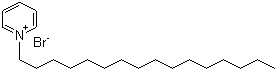 |
| Molecular Formula | C21H38BrN;C21H38N.Br |
| Molecular Weight | 384.44 |
| CAS Registry Number | 140-72-7 |
| EC Number | 205-428-3 |
| SMILES | CCCCCCCCCCCCCCCC[N+]1=CC=CC=C1.[Br-] |
| Melting point | 63-69 °C |
|---|---|
| Water solubility | 5 g/L (20 °C) |
| Hazard Symbols |   GHS06;GHS07 Danger Details GHS06;GHS07 Danger Details | ||||||||||||||||||||||||||||||||||||||||||||
|---|---|---|---|---|---|---|---|---|---|---|---|---|---|---|---|---|---|---|---|---|---|---|---|---|---|---|---|---|---|---|---|---|---|---|---|---|---|---|---|---|---|---|---|---|---|
| Risk Statements | H302-H315-H319-H330-H335 Details | ||||||||||||||||||||||||||||||||||||||||||||
| Safety Statements | P260-P261-P264-P264+P265-P270-P271-P273-P280-P284-P301+P317-P302+P352-P304+P340-P305+P351+P338-P316-P319-P320-P321-P330-P332+P317-P337+P317-P362+P364-P403+P233-P405-P501 Details | ||||||||||||||||||||||||||||||||||||||||||||
| Hazard Classification | |||||||||||||||||||||||||||||||||||||||||||||
| |||||||||||||||||||||||||||||||||||||||||||||
| SDS | Available | ||||||||||||||||||||||||||||||||||||||||||||
 chemBlink Chemical Story
|
1-Hexadecylpyridinium bromide, a quaternary ammonium salt, is a compound that has attracted significant attention due to its unique properties and diverse applications. This surfactant features a long hydrophobic alkyl chain, hexadecyl (C16H33), attached to a pyridinium ring, making it amphiphilic in nature. The compound's discovery is rooted in the broader study of surfactants and ionic liquids, which began in the mid-20th century as researchers sought to develop materials with improved surface-active properties and functional versatility. The synthesis of 1-hexadecylpyridinium bromide involves the alkylation of pyridine with hexadecyl bromide, a process that yields the desired quaternary ammonium salt. The resulting compound exhibits characteristics typical of surfactants, including the ability to reduce surface tension and stabilize emulsions. These properties make it useful in various applications across multiple industries. One of the primary applications of 1-hexadecylpyridinium bromide is in the formulation of surfactants and emulsifiers. Its amphiphilic nature allows it to effectively stabilize oil-in-water and water-in-oil emulsions, making it valuable in the cosmetic and personal care industries. It is commonly used in lotions, creams, and hair products, where it helps improve the texture and stability of formulations. In addition to its role in cosmetic formulations, 1-hexadecylpyridinium bromide has been employed in the field of pharmaceuticals. Its surfactant properties can enhance the solubility and bioavailability of poorly soluble drugs, leading to improved therapeutic efficacy. Researchers have explored its potential in drug delivery systems, particularly in the formulation of nanoparticles and liposomes, where it can facilitate the encapsulation and release of active pharmaceutical ingredients. The compound also finds applications in material science and nanotechnology. 1-Hexadecylpyridinium bromide is used as a template agent in the synthesis of mesoporous materials, which have numerous applications in catalysis and adsorption. Its ability to form organized structures at the molecular level enables the development of materials with specific pore sizes and surface characteristics, which can be tailored for particular uses. Furthermore, 1-hexadecylpyridinium bromide has shown promise in environmental applications, particularly in the field of wastewater treatment. Its surfactant properties can aid in the removal of contaminants from water, making it a potential candidate for use in remediation processes. Despite its versatility, caution should be exercised when handling 1-hexadecylpyridinium bromide due to its potential toxicity and environmental impact. Appropriate safety measures should be implemented to minimize exposure during its use and application. In summary, 1-hexadecylpyridinium bromide is a significant compound within the class of quaternary ammonium salts, recognized for its surfactant properties and broad range of applications. Its contributions to the cosmetic, pharmaceutical, and material science industries highlight its importance in the development of innovative products and processes. Ongoing research continues to explore new applications and enhancements of this compound, contributing to advancements in various fields. References 2024. Enhanced Cr(VI) removal via CPBr-modified MIL-88A@amine-functionalized GO: synthesis, performance, and mechanism. Environmental science and pollution research international. Eman N. Hammad, Abdelazeem S. Eltaweil, Saeyda A. Abouelenein, Gehan El-Subruiti. DOI: 10.1007/s11356-024-33859-w 2024. Water Contamination and Impacts of Synthetic Microfibers Pollutants to the Global Ecosystem. Sustainable Microbial Technology for Synthetic and Cellulosic Microfiber Bioremediation. Mittali Tyagi. DOI: 10.1007/978-3-031-62600-5_9 2024. The Effect of a Magnetic Field on the Generation of Free Radicals in the Interaction of Quaternary Ammonium Compounds with Hydroperoxides. Russian Journal of Physical Chemistry B. D. A. Krugovov, A. K. Gatin, N. V. Potapova, V. G. Kondratovich, E. A. Mengele, O. T. Kasaikina. DOI: 10.1134/s199079312470012x |
| Market Analysis Reports |