
Online Database of Chemicals from Around the World
| Shanghai Edu Chemical Technology Co., Ltd. | China | |||
|---|---|---|---|---|
 | www.chemido.com | |||
 | +86 19301251526 | |||
 | sales1@chemido.com | |||
 | QQ Chat | |||
| Chemical manufacturer since 2011 | ||||
| chemBlink Standard supplier since 2025 | ||||
| Classification | Organic raw materials >> Aldehyde |
|---|---|
| Name | 2-Fluoro-6-(1-trityl-1H-imidazol-4-yl)benzaldehyde |
| Molecular Structure | 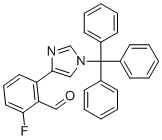 |
| Molecular Formula | C29H21FN2O |
| Molecular Weight | 432.49 |
| CAS Registry Number | 1402838-09-8 |
| SMILES | C1=CC=C(C=C1)C(C2=CC=CC=C2)(C3=CC=CC=C3)N4C=C(N=C4)C5=C(C(=CC=C5)F)C=O |
| Density | 1.1±0.1 g/cm3 Calc.* |
|---|---|
| Boiling point | 601.1±55.0 °C 760 mmHg (Calc.)* |
| Flash point | 317.3±31.5 °C (Calc.)* |
| Index of refraction | 1.615 (Calc.)* |
| * | Calculated using Advanced Chemistry Development (ACD/Labs) Software. |
| Hazard Symbols |  GHS07 Warning Details GHS07 Warning Details |
|---|---|
| Risk Statements | H302-H315-H319 Details |
| Safety Statements | P501-P270-P264-P280-P302+P352-P337+P313-P305+P351+P338-P362+P364-P332+P313-P301+P312+P330 Details |
| SDS | Available |
 chemBlink Chemical Story
|
2-Fluoro-6-(1-trityl-1H-imidazol-4-yl)benzaldehyde is a substituted aromatic aldehyde in which a benzaldehyde core is functionalized with a fluorine atom at the 2-position and a 1-trityl-1H-imidazol-4-yl group at the 6-position. The trityl-protected imidazole serves as a sterically bulky group that stabilizes the heterocyclic nitrogen and allows selective reactions at the aldehyde functionality without affecting the imidazole moiety. The fluorine atom influences the electronic properties of the aromatic ring, enhancing reactivity in electrophilic and nucleophilic reactions. Together, these features make the compound a versatile intermediate in the synthesis of heterocyclic and bioactive molecules. The synthesis of 2-fluoro-6-(1-trityl-1H-imidazol-4-yl)benzaldehyde typically begins with selective halogenation of a benzaldehyde precursor, followed by coupling with a trityl-protected imidazole derivative. The trityl group is introduced to protect the imidazole nitrogen during aldehyde functionalization and other transformations. Reaction conditions are carefully controlled to achieve regioselectivity and preserve the integrity of all functional groups. Purification is usually performed by column chromatography or recrystallization, yielding a crystalline solid suitable for further chemical reactions. In organic synthesis, this compound serves as a building block for the preparation of substituted imidazole-benzaldehyde derivatives. The aldehyde group can participate in condensation reactions, such as Schiff base formation, Knoevenagel reactions, or aldol-type condensations, enabling the construction of extended conjugated systems or heterocyclic scaffolds. The trityl-protected imidazole allows selective deprotection under acidic conditions to reveal the free imidazole for further functionalization, such as alkylation or acylation. The presence of the fluorine atom affects both reactivity and selectivity, providing additional control over chemical transformations. In medicinal chemistry, derivatives of 2-fluoro-6-(1-trityl-1H-imidazol-4-yl)benzaldehyde are used as intermediates in the synthesis of bioactive molecules, including enzyme inhibitors, receptor modulators, and ligands with heterocyclic cores. The combination of an aromatic aldehyde and an imidazole moiety enables interactions with biological macromolecules through hydrogen bonding, π–π stacking, and electrostatic interactions. Selective modification of the aldehyde or imidazole allows fine-tuning of pharmacological properties, solubility, and binding affinity. The compound is also relevant in chemical methodology research. Its dual functionality and sterically protected heterocycle make it useful for studying selective reactions, protective group strategies, and regioselective transformations. Researchers use such intermediates to explore the reactivity of fluorinated aromatics and protected heterocycles in multistep synthetic sequences, as well as in the design of functional materials or molecular probes. Physically, 2-fluoro-6-(1-trityl-1H-imidazol-4-yl)benzaldehyde is generally obtained as a crystalline solid with moderate solubility in polar organic solvents such as dichloromethane, dimethylformamide, and ethanol. It is stable under ambient laboratory conditions but should be stored protected from strong acids, bases, and oxidizing agents to preserve the aldehyde and imidazole functionalities. Proper handling ensures its suitability for synthetic transformations and subsequent deprotection steps. Overall, 2-fluoro-6-(1-trityl-1H-imidazol-4-yl)benzaldehyde is a multifunctional aromatic intermediate combining an aldehyde, a fluorine atom, and a trityl-protected imidazole. Its functional groups and steric features allow selective chemical transformations and derivatization, making it a valuable building block for the synthesis of heterocyclic compounds, bioactive molecules, and complex synthetic targets in medicinal and organic chemistry. References 2018. A class of indoleamine 2,3-dioxygenase modulating compounds and their use in pharmacy. CN Patent, 108424415. 2016. Fused-ring compounds, pharmaceutical composition and uses thereof. WO Patent, 2016131380. 2017. Cyclohexyl-ethyl substituted diaza- and triaza-tricyclic compounds as indole-amine-2,3-dioxygenase (ido) antagonists for the treatment of cancer. EP Patent, 3189054. |
| Market Analysis Reports |