
Online Database of Chemicals from Around the World
| Simagchem Corporation | China | |||
|---|---|---|---|---|
 | www.simagchem.com | |||
 | +86 13806087780 | |||
 | +86 (592) 268-0237 | |||
 | sale@simagchem.com | |||
| Chemical manufacturer since 2002 | ||||
| chemBlink Standard supplier since 2008 | ||||
| Sinocompound Catalysts Co., Ltd. | China | |||
|---|---|---|---|---|
| www.sinocompound.com | |||
| +86 (512) 6721-6630 | |||
| +86 (512) 5631-6689 | |||
| sales@sinocompound.com | |||
| Chemical manufacturer since 2008 | ||||
| chemBlink Standard supplier since 2010 | ||||
| Zhengzhou Kingorgchem Chemical Technology Co., Ltd. | China | |||
|---|---|---|---|---|
| www.kingorgchem.com | |||
| +86 (371) 6551-1006 | |||
| +86 (371) 6575-6965 | |||
| sales@kingorgchem.com | |||
 | QQ Chat | |||
 | WeChat: 18625597674 | |||
| Chemical manufacturer since 2015 | ||||
| chemBlink Standard supplier since 2016 | ||||
| Shanghai Fuxin Pharmaceutical Co., Ltd. | China | |||
|---|---|---|---|---|
| www.fuxinpharm.com | |||
| +86 (21) 3130-0828 +86 18645121291 | |||
| +86 (21) 3130-0828 | |||
| contact@fuxinpharm.com | |||
| Chemical manufacturer since 2016 | ||||
| chemBlink Standard supplier since 2018 | ||||
| Dalchem | Russia | |||
|---|---|---|---|---|
| www.dalchem.com | |||
| +7 (8312) 753-772 | |||
| +7 (8312) 750-799 | |||
| dregichy@dalchem.com | |||
| Chemical manufacturer since 1997 | ||||
| abcr GmbH | Germany | |||
|---|---|---|---|---|
| www.abcr.de | |||
| +49 (721) 950-610 | |||
| +49 (721) 950-6180 | |||
| info@abcr.de | |||
| Chemical manufacturer | ||||
| Strem Chemicals, Inc. | USA | |||
|---|---|---|---|---|
| www.strem.com | |||
| +1 (978) 499-1600 | |||
| +1 (978) 465-3104 | |||
| info@strem.com | |||
| Chemical manufacturer | ||||
| AK Scientific, Inc | USA | |||
|---|---|---|---|---|
| www.aksci.com | |||
| +1 (510) 429-8835 | |||
| +1 (510) 429-8836 | |||
| sales@aksci.com | |||
| Chemical manufacturer | ||||
| Classification | Organic raw materials >> Organometallic compound >> Organic nickel |
|---|---|
| Name | Dibromobis(triphenylphosphine)nickel(II) |
| Synonyms | Nickel(II) bromide bis(triphenylphosphine) |
| Molecular Structure | 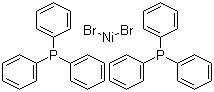 |
| Molecular Formula | C36H30Br2NiP2 |
| Molecular Weight | 743.07 |
| CAS Registry Number | 14126-37-5 |
| EC Number | 628-538-7 |
| SMILES | C1=CC=C(C=C1)P(C2=CC=CC=C2)C3=CC=CC=C3.C1=CC=C(C=C1)P(C2=CC=CC=C2)C3=CC=CC=C3.[Ni](Br)Br |
| Melting point | 219-223 °C |
|---|---|
| Hazard Symbols |  GHS07 Warning Details GHS07 Warning Details | ||||||||||||||||
|---|---|---|---|---|---|---|---|---|---|---|---|---|---|---|---|---|---|
| Risk Statements | H302-H312-H332 Details | ||||||||||||||||
| Safety Statements | P261-P264-P270-P271-P280-P301+P317-P302+P352-P304+P340-P317-P321-P330-P362+P364-P501 Details | ||||||||||||||||
| Hazard Classification | |||||||||||||||||
| |||||||||||||||||
| SDS | Available | ||||||||||||||||
 chemBlink Chemical Story
|
Dibromobis(triphenylphosphine)nickel(II) is a notable organonickel compound with significant utility in coordination chemistry and catalysis. This compound, featuring a nickel center coordinated by two bromine atoms and two triphenylphosphine ligands, represents a valuable member of the class of nickel(II) complexes that are extensively used in various chemical processes. The discovery of Dibromobis(triphenylphosphine)nickel(II) emerged from efforts to explore the coordination chemistry of nickel(II) with phosphorus-based ligands. The triphenylphosphine ligands are known for their ability to stabilize metal centers and influence the reactivity of metal complexes. When coordinated to nickel(II), these ligands impart stability to the metal center, which is crucial for various applications. One of the primary applications of Dibromobis(triphenylphosphine)nickel(II) is in catalysis. The compound is employed as a catalyst in several important organic reactions, including cross-coupling reactions and polymerization processes. Its catalytic activity is largely attributed to the ability of the nickel center to participate in oxidative addition and reductive elimination processes. This makes the compound valuable for facilitating the formation of carbon-carbon bonds, which is a key step in the synthesis of complex organic molecules. Dibromobis(triphenylphosphine)nickel(II) is also used in the field of organometallic chemistry to study the behavior of nickel(II) complexes with different ligands. The compound serves as a model system for understanding the interactions between nickel centers and various ligands, which is essential for designing new catalysts and materials. The bromine atoms in the complex play a crucial role in the reactivity of the nickel center, influencing its ability to participate in chemical reactions. Additionally, Dibromobis(triphenylphosphine)nickel(II) finds applications in materials science. The compound is used as a precursor in the synthesis of nickel-based materials with specific properties. For instance, it can be utilized to prepare nickel-containing polymers and materials with tailored electronic and optical characteristics. The ability to control the properties of these materials through the choice of ligands and metal centers is valuable for developing advanced materials for various technological applications. In summary, Dibromobis(triphenylphosphine)nickel(II) is a significant compound in the realm of organonickel chemistry. Its stability and reactivity make it a valuable tool in catalysis, materials science, and the study of nickel coordination chemistry. The compound’s ability to facilitate important organic reactions and its role in the development of new materials highlight its importance in both research and practical applications. References 2009. Use of the NiBr2(PPh3)2/Zn catalytic system for homo- and copolymerization of styrene and methyl methacrylate. Polymer Science, Series B. D. F. Grishin, I. S. Il’ichev, N. B. Valetova. DOI: 10.1134/s1560090409030038 2010. Transition-Metal-Mediated Oligomerization Reactions. Science of Synthesis. DOI: SD-045-00507 2008. Polymerization of methyl methacrylate using the NiX2(PPh3)2/Zn catalytic system. Kinetics and Catalysis. I. S. Il’ichev, N. B. Valetova, M. V. Moskalev, D. F. Grishin. DOI: 10.1134/s0023158408040125 |
| Market Analysis Reports |