
Online Database of Chemicals from Around the World
| Abosyn Chemicals Inc. | USA | |||
|---|---|---|---|---|
 | www.abosyn.com | |||
 | +1 (203) 683-8328 | |||
 | info@abosyn.com | |||
| Chemical manufacturer since 2014 | ||||
| chemBlink Standard supplier since 2025 | ||||
| Classification | Organic raw materials >> Heterocyclic compound >> Piperidines |
|---|---|
| Name | 3-(6-hydroxy-1-oxo-2,3-dihydro-1H-isoindol-2-yl)piperidine-2,6-dione |
| Synonyms | 3-(5-hydroxy-3-oxo-1H-isoindol-2-yl)piperidine-2,6-dione |
| Molecular Structure | 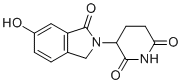 |
| Molecular Formula | C13H12N2O4 |
| Molecular Weight | 260.25 |
| CAS Registry Number | 1416990-09-4 |
| EC Number | 967-298-0 |
| SMILES | C1CC(=O)NC(=O)C1N2CC3=C(C2=O)C=C(C=C3)O |
| Density | 1.5±0.1 g/cm3, Calc.* |
|---|---|
| Index of Refraction | 1.66, Calc.* |
| Boiling Point | 623.6±55.0 °C (760 mmHg), Calc.* |
| Flash Point | 330.9±31.5 °C, Calc.* |
| * | Calculated using Advanced Chemistry Development (ACD/Labs) Software. |
| Hazard Symbols |  GHS07 Warning Details GHS07 Warning Details | ||||||||||||||||
|---|---|---|---|---|---|---|---|---|---|---|---|---|---|---|---|---|---|
| Risk Statements | H315-H319-H335 Details | ||||||||||||||||
| Safety Statements | P261-P264-P264+P265-P271-P280-P302+P352-P304+P340-P305+P351+P338-P319-P321-P332+P317-P337+P317-P362+P364-P403+P233-P405-P501 Details | ||||||||||||||||
| Hazard Classification | |||||||||||||||||
| |||||||||||||||||
| SDS | Available | ||||||||||||||||
 chemBlink Chemical Story
|
3-(6-Hydroxy-1-oxo-2,3-dihydro-1H-isoindol-2-yl)piperidine-2,6-dione is a chemical compound that features both an isoindolinone and a piperidine-2,6-dione core. These structural motifs are significant in medicinal chemistry due to their presence in numerous bioactive molecules. The compound has been studied for its potential applications in drug development, particularly in the synthesis of pharmaceutical intermediates and biologically relevant molecules. The isoindolinone core in this compound is a key structural feature found in various natural and synthetic compounds with biological activity. It contributes to molecular stability and enhances the potential for interactions with biological targets. The piperidine-2,6-dione moiety is another pharmacologically relevant structure, often involved in binding interactions with proteins and enzymes. Together, these functional groups create a framework that can be modified to develop new bioactive molecules with improved properties. This compound has been explored in pharmaceutical research as a synthetic intermediate in the preparation of biologically active molecules. Its structural features allow for selective modifications, making it a useful precursor for drug candidates targeting neurological disorders, inflammatory diseases, and cancer. The hydroxyl group in the isoindolinone ring provides an additional site for functionalization, enabling the synthesis of derivatives with optimized pharmacokinetics and efficacy. One of the key applications of this compound is in the development of proteasome inhibitors, which are important in the treatment of multiple myeloma and other cancers. The piperidine-2,6-dione moiety is found in several clinically relevant compounds that function by interfering with protein degradation pathways in cancer cells. By modifying the structure of this compound, researchers aim to design new proteasome inhibitors with enhanced selectivity and reduced toxicity. Beyond oncology, this compound has also been studied in the context of neurodegenerative diseases. The isoindolinone structure has been investigated for its role in modulating protein-protein interactions involved in neurodegenerative conditions such as Alzheimer's and Parkinson's disease. Derivatives of this compound may act on pathways that regulate protein aggregation, offering potential therapeutic benefits for these disorders. In addition to pharmaceutical applications, this compound is relevant in synthetic organic chemistry. Its reactivity allows for the introduction of various functional groups, making it a valuable intermediate in the preparation of complex molecules. Researchers have used it to develop novel methodologies for constructing heterocyclic scaffolds, which are widely utilized in medicinal chemistry. The synthesis of 3-(6-hydroxy-1-oxo-2,3-dihydro-1H-isoindol-2-yl)piperidine-2,6-dione typically involves cyclization reactions and selective functional group transformations. Synthetic strategies focus on optimizing reaction conditions to improve yield and purity while maintaining the desired stereochemistry. Advances in synthetic techniques have allowed for more efficient production of this compound and its derivatives, supporting further research into their biological activities. Overall, this compound serves as an important building block in medicinal chemistry, with applications spanning oncology, neurodegenerative disease research, and synthetic organic chemistry. Its structural versatility and potential for derivatization make it a valuable target for drug discovery efforts, as researchers continue to explore its role in developing new therapeutics. References Nowak, R. P., Che, J., Ferrao, S. et al. (2023). Structural rationalization of GSPT1 and IKZF1 degradation by thalidomide molecular glue derivatives. RSC Medicinal Chemistry, 14, 501-506. DOI: https://doi.org/10.1039/d2md00347c Ruchelman, A. L., Man, H.-W., Zhang, W. et al. (2013). Isosteric analogs of lenalidomide and pomalidomide: Synthesis and biological activity. Bioorganic & Medicinal Chemistry Letters, 23(1), 360- 365. DOI: https://doi.org/10.1016/j.bmcl.2012.10.071 Fasching, B., Ryckmans, T. and Flohr, A. (2022). Isoindolinone amide compounds useful to treat diseases associated with gspt1. WO-2022219412-A1, 2022-10-20. Priority Date: 2021-04-14. |
| Market Analysis Reports |