
Online Database of Chemicals from Around the World
| Hangzhou Verychem Science And Technology Co., Ltd. | China | |||
|---|---|---|---|---|
 | www.verychem.com | |||
 | +86 (571) 8816-2785 +86 13606544505 | |||
 | +86 (571) 8816-2787 | |||
 | lucy@verychem.com | |||
| Chemical manufacturer since 2004 | ||||
| chemBlink Massive supplier since 2021 | ||||
| Pure Research Chemicals | China | |||
|---|---|---|---|---|
| www.purerechem.com | |||
| +86 (551) 6288-8437 +86 18096409024 | |||
| info@purerechem.com | |||
 | QQ Chat | |||
 | Skype Chat | |||
 | WeChat: 18856022585 | |||
| Chemical manufacturer since 2018 | ||||
| Classification | Biochemical >> Peptide |
|---|---|
| Name | Azilsartan Impurity 6 |
| Synonyms | (5-Methyl-2-oxo-1,3-dioxol-4-yl)methyl 2-oxo-3-{[2'-(5-oxo-4,5-dihydro-1,2,4-oxadiazol-3-yl)-4-biphenylyl]methyl}-2,3-dihydro-1H-benzimidazole-4-carboxylate |
| Molecular Structure | 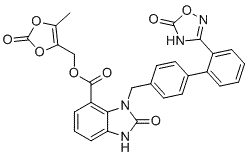 |
| Molecular Formula | C28H20N4O8 |
| Molecular Weight | 540.48 |
| CAS Registry Number | 1417576-00-1 |
| SMILES | CC1OC(=O)OC=1COC(=O)C1C=CC=C2NC(=O)N(CC3C=CC(=CC=3)C3=CC=CC=C3C3NC(=O)ON=3)C2=1 |
| Density | 1.5±0.1 g/cm3, Calc.* |
|---|---|
| Index of Refraction | 1.718, Calc.* |
| * | Calculated using Advanced Chemistry Development (ACD/Labs) Software. |
| Hazard Symbols |  GHS07 Warning Details GHS07 Warning Details |
|---|---|
| Risk Statements | H315-H319-H335 Details |
| Safety Statements | P261-P280-P305+P351+P338 Details |
| SDS | Available |
 chemBlink Chemical Story
|
Azilsartan Impurity 6 is a chemical compound that arises as a by-product or degradation product during the synthesis or storage of azilsartan, an angiotensin II receptor blocker widely used in the management of hypertension. Chemically, it is closely related to azilsartan, sharing a core structure but differing by specific functional groups that define its impurity profile. The presence of such impurities is critical in pharmaceutical manufacturing as they can influence the drug's efficacy, safety, and stability. Regulatory agencies such as the FDA and EMA require rigorous identification, quantification, and control of impurities like Azilsartan Impurity 6 to ensure the quality of pharmaceutical products. The discovery of Azilsartan Impurity 6 emerged from analytical studies during the development and quality control of azilsartan. High-performance liquid chromatography (HPLC), mass spectrometry (MS), and nuclear magnetic resonance (NMR) spectroscopy were employed to isolate and characterize this impurity. Understanding its formation pathways revealed that it is generated primarily through hydrolysis, oxidation, or side reactions during the synthetic process or storage conditions. This knowledge has been instrumental in optimizing manufacturing protocols to minimize its formation. The application of Azilsartan Impurity 6 lies predominantly in the field of pharmaceutical quality assurance. It serves as a reference standard for analytical methods designed to monitor impurity levels in azilsartan formulations. Accurate quantification of this impurity ensures that the drug meets stringent regulatory limits, typically below 0.1% of the total composition, as per International Council for Harmonisation (ICH) guidelines. Additionally, stability studies of azilsartan in various formulations consider the generation of Impurity 6 to predict the shelf life and storage conditions of the drug. In pharmaceutical research, Azilsartan Impurity 6 also holds significance as a tool for toxicological evaluation. By studying its potential biological effects, researchers assess whether its presence in trace amounts poses any risk to patients. Such studies often include in vitro and in vivo models to evaluate genotoxicity, cytotoxicity, and pharmacokinetic behavior. The insights gained are critical for regulatory submissions and for maintaining public confidence in the safety of azilsartan-based therapies. The identification of Azilsartan Impurity 6 has broader implications for the pharmaceutical industry, emphasizing the importance of impurity profiling in drug development. It has prompted advancements in analytical techniques to detect and characterize impurities at trace levels. These advancements have not only improved the quality control of azilsartan but have also been applied to other pharmaceuticals, setting a benchmark for impurity management across the industry. Efforts to reduce the formation of Azilsartan Impurity 6 include optimizing reaction conditions, such as temperature, pH, and solvent choice, during the synthesis of azilsartan. Protective packaging and controlled storage conditions have also been implemented to minimize its generation during product shelf life. Such measures reflect the industry's commitment to delivering high-quality pharmaceutical products. In conclusion, Azilsartan Impurity 6 plays a critical role in the quality control and regulatory compliance of azilsartan medications. Its discovery and subsequent study have contributed significantly to the understanding of impurity formation and management in pharmaceutical science. By ensuring its controlled levels in formulations, manufacturers uphold safety and efficacy standards, ultimately benefiting patients relying on azilsartan for hypertension treatment. |
| Market Analysis Reports |