
Online Database of Chemicals from Around the World
| Zhejiang Synose Tech Co., Ltd. | China | |||
|---|---|---|---|---|
 | www.synose.com | |||
 | +86(579)8227-5537 8917-2081 | |||
 | +86 (579) 8227-7133 | |||
 | expo@synose.com | |||
| Chemical manufacturer since 1996 | ||||
| chemBlink Standard supplier since 2011 | ||||
| Classification | Flavors and spices >> Synthetic spice >> Lactone and oxygen-containing heterocyclic compound >> Furan and pyran |
|---|---|
| Name | 1-O-Acetyl-2,3,5-tri-O-benzoyl-D-ribofuranose |
| Synonyms | D-Ribofuranose 1-acetate 2,3,5-tribenzoate |
| Molecular Structure | 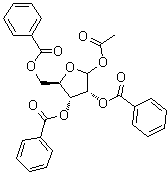 |
| Molecular Formula | C28H24O9 |
| Molecular Weight | 504.48 |
| CAS Registry Number | 14215-97-5 |
| EC Number | 965-193-4 |
| SMILES | CC(=O)OC1[C@@H]([C@@H]([C@H](O1)COC(=O)C2=CC=CC=C2)OC(=O)C3=CC=CC=C3)OC(=O)C4=CC=CC=C4 |
| Density | 1.4±0.1 g/cm3 Calc.* |
|---|---|
| Melting point | 126-127 °C (Expl.)** |
| Boiling point | 621.0±55.0 °C 760 mmHg (Calc.)* |
| Flash point | 264.3±31.5 °C (Calc.)* |
| Index of refraction | 1.61 (Calc.)* |
| * | Calculated using Advanced Chemistry Development (ACD/Labs) Software V11.02 (©1994-2015 ACD/Labs) |
| ** | Weygand, Friedrich |
| Hazard Symbols |  GHS07 Warning Details GHS07 Warning Details | ||||||||||||||||||||
|---|---|---|---|---|---|---|---|---|---|---|---|---|---|---|---|---|---|---|---|---|---|
| Risk Statements | H302-H315-H319-H335 Details | ||||||||||||||||||||
| Safety Statements | P261-P264-P264+P265-P270-P271-P280-P301+P317-P302+P352-P304+P340-P305+P351+P338-P319-P321-P330-P332+P317-P337+P317-P362+P364-P403+P233-P405-P501 Details | ||||||||||||||||||||
| Hazard Classification | |||||||||||||||||||||
| |||||||||||||||||||||
| SDS | Available | ||||||||||||||||||||
 chemBlink Chemical Story
|
1-O-Acetyl-2,3,5-tri-O-benzoyl-D-ribofuranose is a fully protected derivative of D-ribose in which the hydroxyl groups at positions 2, 3, and 5 are esterified with benzoyl groups and the anomeric hydroxyl group at position 1 is acetylated. The compound is typically obtained as a crystalline solid and is used primarily as a synthetic intermediate in carbohydrate and nucleoside chemistry. Its development is closely associated with the evolution of protective group strategies that enabled controlled functionalization of sugars in the first half of the 20th century. The study of D-ribose intensified after its identification as a constituent of ribonucleic acid. Once the structural role of ribose in nucleotides was established, chemists sought reliable methods to derivatize and manipulate the sugar moiety for synthetic purposes. Direct reactions of unprotected ribose are complicated by the presence of multiple hydroxyl groups of similar reactivity and by the equilibrium between furanose and pyranose forms. To address these challenges, selective acylation methods were developed to mask specific hydroxyl groups and stabilize the furanose ring form. Preparation of 1-O-Acetyl-2,3,5-tri-O-benzoyl-D-ribofuranose typically involves stepwise or controlled acylation of D-ribose using acetic anhydride and benzoyl chloride or benzoic anhydride in the presence of suitable base catalysts. Reaction conditions are chosen to favor ester formation at the secondary hydroxyl groups at C-2 and C-3 and at the primary hydroxyl group at C-5, while the anomeric hydroxyl group is acetylated. Structural characterization by elemental analysis, infrared spectroscopy, and nuclear magnetic resonance spectroscopy confirms the presence of three benzoyl ester groups and one acetyl ester group, as well as retention of the D-configuration of the sugar. This protected ribose derivative has played an important role in nucleoside synthesis. In classical glycosylation reactions, the activated anomeric center of acyl-protected ribose reacts with nitrogen-containing heterocycles such as purine or pyrimidine bases to form N-glycosidic bonds. The presence of electron-withdrawing benzoyl groups stabilizes intermediates and influences the stereochemical outcome of the glycosylation step. Such strategies were central to early synthetic routes to ribonucleosides, which in turn supported structural and biochemical studies of nucleic acids. The compound has also been used in the preparation of modified nucleosides and nucleotide analogues. By controlling protecting group patterns, chemists can introduce specific substitutions on the sugar or base before final deprotection. After formation of the desired glycosidic linkage, the benzoyl and acetyl groups can be removed under controlled hydrolytic conditions to regenerate free hydroxyl groups. This reversible protection is fundamental to multistep synthesis in carbohydrate and nucleic acid chemistry. Beyond nucleoside synthesis, 1-O-Acetyl-2,3,5-tri-O-benzoyl-D-ribofuranose serves as a model substrate in studies of acyl migration and anomeric reactivity. Investigations have examined the stability of the acetyl group at the anomeric position and the potential for interconversion between alpha and beta anomers under acidic or basic conditions. Such studies contribute to understanding the behavior of protected sugars under reaction conditions commonly employed in organic synthesis. The introduction of benzoyl protecting groups represented a significant methodological advance because these groups provide stability during glycosylation yet can be removed without degrading the sugar framework. The combination of acetyl and benzoyl esters in a single molecule allows fine control over reactivity and solubility. The benzoyl groups increase hydrophobic character and facilitate purification by crystallization or chromatography, properties that have been documented in practical laboratory use. From its origins in foundational work on ribose chemistry to its established role in the synthesis of nucleosides and related compounds, 1-O-Acetyl-2,3,5-tri-O-benzoyl-D-ribofuranose exemplifies the importance of protecting group strategies in organic chemistry. Its preparation, characterization, and application are grounded in well-documented experimental procedures that have enabled precise manipulation of biologically significant sugars. References 2013. An efficient synthesis and biological study of substituted 8-chloro-5-methoxy/8-chloro-4H-1,4-benzothiazines, their sulphones and ribofuranosides. Journal of Chemical Sciences. DOI: 10.1007/s12039-013-0363-4 |
| Market Analysis Reports |