
Online Database of Chemicals from Around the World
| BOC Sciences | USA | |||
|---|---|---|---|---|
 | www.bocsci.com | |||
 | +1 (631) 485-4226 | |||
 | +1 (631) 614-7828 | |||
 | info@bocsci.com | |||
| Chemical manufacturer | ||||
| chemBlink Standard supplier since 2010 | ||||
| Hubei Tuoyuan Fine Chemical Co., Ltd. | China | |||
|---|---|---|---|---|
| www.chemty.com | |||
| +86 (027) 8470-0466 | |||
| +86 (027) 8470-0466 | |||
| 59741184@qq.com | |||
 | QQ Chat | |||
 | WeChat: 13260668040 | |||
| Chemical manufacturer since 2025 | ||||
| chemBlink Standard supplier since 2011 | ||||
| Jiangsu Konson Chemical Co., Ltd. | China | |||
|---|---|---|---|---|
| www.konsonchem.com | |||
| +86 (518) 8081-7151 | |||
| +86 (518) 8591-6658 | |||
| llchem.chris@gmail.com konson@konsonchem.cn | |||
| Chemical manufacturer since 1998 | ||||
| chemBlink Standard supplier since 2020 | ||||
| Gelest, Inc. | USA | |||
|---|---|---|---|---|
| www.gelest.com | |||
| +1 (215) 547-1015 | |||
| +1 (215) 547-2484 | |||
| info@gelest.com | |||
| Chemical manufacturer | ||||
| AK Scientific, Inc | USA | |||
|---|---|---|---|---|
| www.aksci.com | |||
| +1 (510) 429-8835 | |||
| +1 (510) 429-8836 | |||
| sales@aksci.com | |||
| Chemical manufacturer | ||||
| Classification | Organic raw materials >> Carboxylic compounds and derivatives |
|---|---|
| Name | Cadmium diethyldithiocarbamate |
| Synonyms | Bis(diethyldithiocarbamate)cadmium complex; Cadmium bis(diethyldithiocarbamate) |
| Molecular Structure | 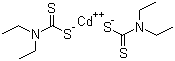 |
| Molecular Formula | 2(C5H10NS2).Cd |
| Molecular Weight | 408.95 |
| CAS Registry Number | 14239-68-0 |
| EC Number | 238-113-4 |
| SMILES | CCN(CC)C(=S)[S-].CCN(CC)C(=S)[S-].[Cd+2] |
| Hazard Symbols |   GHS07;GHS08 Danger Details GHS07;GHS08 Danger Details |
|---|---|
| Risk Statements | H302-H312-H332-H350-H372 Details |
| Safety Statements | P203-P260-P261-P264-P270-P271-P280-P301+P317-P302+P352-P304+P340-P317-P318-P319-P321-P330-P362+P364-P405-P501 Details |
 chemBlink Chemical Story
|
Cadmium diethyldithiocarbamate is an organocadmium compound formed by the coordination of cadmium(II) ions with diethyldithiocarbamate ligands. It belongs to the class of metal-dithiocarbamate complexes, which have been extensively studied for their chemical stability, coordination behavior, and potential applications in materials science and biological systems. The chemical structure typically features a central cadmium ion coordinated by two diethyldithiocarbamate ligands through sulfur atoms, forming a four-coordinate complex with a chelate ring system. The diethyldithiocarbamate ligand consists of a nitrogen atom bonded to two ethyl groups and a dithiocarboxyl group (−CS2−), which is responsible for metal coordination. The ligand binds to metal centers via both sulfur atoms, creating a five-membered chelate ring. In the case of cadmium diethyldithiocarbamate, the cadmium ion adopts a square planar or slightly distorted tetrahedral geometry, depending on the crystalline or solution state. The synthesis of cadmium diethyldithiocarbamate is typically achieved by mixing a cadmium salt, such as cadmium chloride or cadmium acetate, with sodium or ammonium diethyldithiocarbamate in aqueous or alcoholic solution. Upon mixing, the complex precipitates as a yellow to orange crystalline solid, which is then isolated by filtration and dried. The compound is moderately stable in air and soluble in organic solvents such as chloroform and carbon disulfide. Cadmium diethyldithiocarbamate has been used primarily as a chemical reagent and model compound in studies of metal-sulfur coordination chemistry. Its stability and defined structure make it suitable for spectroscopic investigations, including UV-Vis, IR, and NMR studies. These analyses provide insights into the electronic structure and bonding properties of metal-dithiocarbamate complexes. The compound is also used to explore the behavior of cadmium in biological and environmental contexts, particularly due to cadmium's known toxicity and relevance in heavy metal contamination studies. In materials science, cadmium diethyldithiocarbamate has served as a single-source precursor for the preparation of cadmium sulfide (CdS) thin films and nanoparticles. When subjected to thermolysis, the complex decomposes to form cadmium sulfide and volatile organic byproducts. This property is utilized in the controlled synthesis of CdS semiconducting materials, which are used in photovoltaic cells, photocatalysis, and optoelectronic devices. The use of cadmium diethyldithiocarbamate in these applications is favored by its ability to yield uniform and crystalline CdS products under relatively mild processing conditions. Despite its useful properties, cadmium diethyldithiocarbamate must be handled with care due to the inherent toxicity of cadmium compounds. Exposure to cadmium is associated with serious health risks, including damage to the kidneys, lungs, and bones. Therefore, research involving this compound is conducted under strict safety protocols to minimize the risk of contamination or exposure. Overall, cadmium diethyldithiocarbamate exemplifies a functional coordination compound with applications in both fundamental and applied chemistry. Its role in the synthesis of semiconductor materials and its contribution to the understanding of metal-ligand interactions continue to be of interest in chemical and materials research. References 1983. Embryotoxicity of industrial chemicals on the chicken embryo: Dithiocarbamates. Teratogenesis, Carcinogenesis, and Mutagenesis, 3(2). DOI: 10.1002/1520-6866(1990)3:2<163::aid-tcm1770030208>3.0.co;2-k 1986. Gas chromatographic analysis of trace metals isolated from aqueous solutions as diethyldithiocarbamates. Journal of Chromatography A, 351. DOI: 10.1016/s0021-9673(01)97307-8 1989. Response of rat hepatocyte cultures to cadmium chloride and cadmium-diethyldithiocarbamate. Toxicology, 56(2). DOI: 10.1016/0300-483x(89)90208-4 |
| Market Analysis Reports |